Modern Australian
Men's Weekly

.

Budget restraint? When it comes to transport projects, it's hard to find

  • Written by Marion Terrill, Transport and Cities Program Director, Grattan Institute
Budget restraint? When it comes to transport projects, it's hard to find

“Restraint” – that’s what Treasurer Jim Chalmers claimed as the watchword of Tuesday’s federal budget. Perhaps the claim can be made in general, but when it comes to transport infrastructure, the budget is remarkable not for how different it is to budgets past, but how similar. It has left plenty of opportunities for actual restraint for next time around, in May 2023.

The first similarity to budgets past is how much is being committed to transport infrastructure.

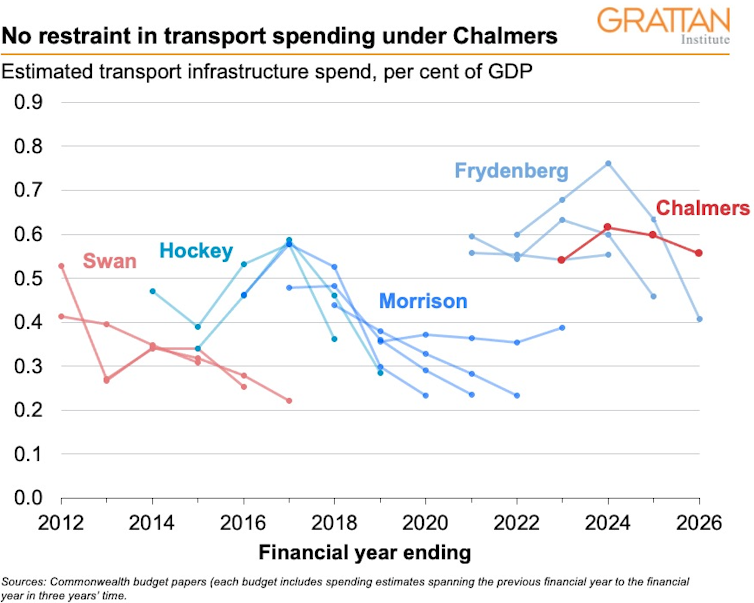
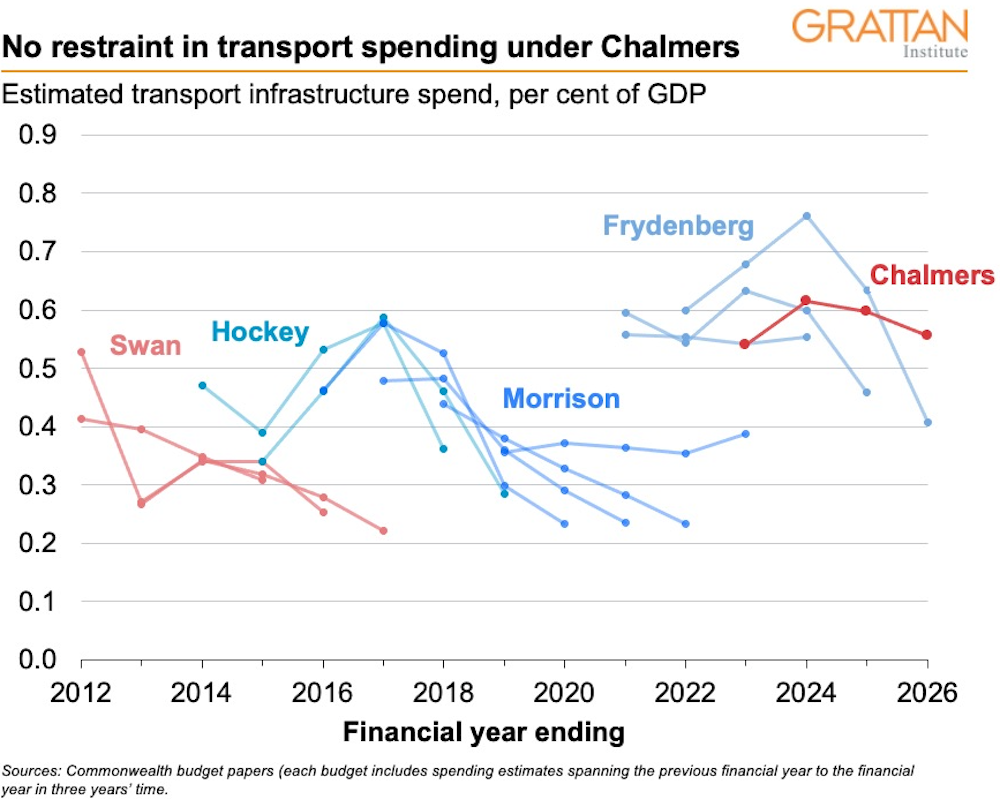
This year the total is about 0.6% of GDP, much like Josh Frydenberg’s budgets of the past three years. That equates to A$13.4 billion this year, rising to about A$15 billion for each of the next three years.

Chart showing level of transport spending in federal budgets, 2012 to 2022
Author provided What Frydenberg and Chalmers have in common is that they have presided over a big shift upwards in the total spend, from around 0.4% of GDP under their predecessors Scott Morrison, Joe Hockey and Wayne Swan. It’s hardly “restraint”. Headline numbers are inflated The second similarity to budgets past is the irresistible temptation to quote far bigger numbers than are actually committed in the budget. It’s all very well to say what you plan to deliver in ten years and beyond, but the budget is all about what you’re committing this year and the following three. It’s just like legislating stage 3 tax cuts in 2019; three years and a pandemic later, it’s hard to backtrack. The problem is exacerbated because the headline number includes projects already committed long ago. The claim in the budget glossy is that the Albanese government “is delivering on its election commitments as part of the more than $120 billion pipeline of investment in transport infrastructure over the next 10 years”. But what’s actually committed in the budget for additional road and rail is $8.1 billion of new money over ten years. Most of the eye-watering $120 billion predates this government. For example, New South Wales residents may applaud the promise to spend $300 million on western Sydney roads and $500 million on early works for high-speed rail, and a total NSW commitment of $1.4 billion over ten years. But it’s hard to square that with the infrastructure minister’s promises of $5.25 billion for the Sydney Metro to Western Sydney Airport, and $1.6 billion for the M12 motorway. Similarly, Victorians may eagerly anticipate the $125 million for the Barwon Heads Road upgrade and $2.2 billion towards the Suburban Rail Loop. There’s a total commitment of $2.6 billion for the state over ten years. But how does that line up with the minister’s promises of $5 billion for Melbourne Airport Rail, along with $448 million for Gippsland Rail? Infrastructure Australia bypassed The third similarity to budgets past is how projects are selected for funding. Prime Minister Anthony Albanese is proud of Infrastructure Australia. It’s the body he set up as infrastructure minister in the Rudd government to help elected representatives who, he said, struggled “with the need to take a long-term non-partisan view” of infrastructure. Yet this budget includes billions of dollars for projects that should have gone through an Infrastructure Australia assessment, but haven’t. The standout is Melbourne’s Suburban Rail Loop. It’s the signature project of the Andrews state government as it heads into a November election. The project was announced three months out from the previous Victorian election, and a business case wasn’t published until three years after the decision to invest. It’s very controversial. The state government claims that building the east and north sections of the rail loop and operating them for 50 years will cost $31 billion to $51 billion. In stark contrast, the Victorian Parliamentary Budget Office calculates it will cost $200 billion. What does Infrastructure Australia think? It considers the project a very long way from investment-ready. Another standout is a $500 million down payment on high-speed rail. Even without a current business case, the government has declared it is “absolutely committed” to the project. If the numbers run in 2013 were correct, this project will cost at least $130 billion, and will compete with the since-begun Western Sydney Airport. What does Infrastructure Australia think? Again, it considers that even corridor preservation for the project is a long way from investment-ready. A third standout is $586 million to upgrade the Bruce Highway through Brisbane’s outer northern suburbs. The Bruce has had a massive program of upgrades over many years. Many sections have been assessed by Infrastructure Australia – but not this one. None of these decisions could be described as restrained, and there are many similar. Still waiting for rigorous assessments Of course, it’s not easy to inherit a swag of major projects from the previous government, many of which are begun or at least anticipated. And it’s to this government’s credit that it has moved $6.5 billion worth of these projects to beyond the budget forward estimates, in recognition that the engineering construction sector is already struggling to keep up with demand. But in this environment, it makes little sense for the government to have thrown its weight behind new commitments, such as east-coast high-speed rail and the Suburban Rail Loop, that will tie its hands for decades to come. Next time around, the treasurer should insist that each individual project up for funding consideration has been properly assessed by the government’s own independent advisory body. If the project is at too early a stage, the government shouldn’t invest public money in it. A more rigorous project-by-project assessment would help the government determine how much of the transport spend is really worth it. Let’s hope. When it comes to transport, restraint is hard to find. Authors: Marion Terrill, Transport and Cities Program Director, Grattan Institute

Read more https://theconversation.com/budget-restraint-when-it-comes-to-transport-projects-its-hard-to-find-192848

Why Medical Fitout Melbourne Practices Rely on for Modern Healthcare Spaces

A well-planned medical fitout Melbourne is essential for creating healthcare environments that support patient care, clinical efficiency, and regula...

Luxury Builders Melbourne Crafting Homes Defined by Design and Detail

Building a premium home is about far more than size or appearance. It is about precision, craftsmanship, and a deep understanding of how refined spa...

Electric Sliding Door Solutions for Modern Living and Commercial Spaces

The way people move through spaces has changed dramatically over the years, and the electric sliding door has become a defining feature of that evol...

Australia’s New Fast Track to Advanced Care in Vietnam

For many Australians, the decision to seek medical care abroad often begins with a specific feeling: the quiet frustration of waiting. According to ...

Cardboard Boxes: A Practical Packaging Solution for Modern Businesses

Reliable cardboard boxes play a vital role in how goods are stored, protected, and transported across industries. From small retailers to large-sca...

The Rise of Smart Homes in Australia: What’s Worth Investing In?

Australia is in the midst of a home technology revolution. From energy efficiency to integrated security, today’s homeowners are transforming thei...

Winter Hairstyling Tips to Prevent Dryness

Winter can be particularly harsh on your hair. Cold air outside, dry indoor heating, and frequent temperature changes can strip moisture from the ha...

Short Term Loans in Australia: Practical Insights for Borrowers and Finance Professionals

Short term loans play a crucial role in Australia’s personal finance landscape. They are designed to cover short-term expenses, unexpected bills, ...

Best EPD Consultants in Australia

Environmental Product Declarations (EPDs) play an increasingly important role in the Australian construction, manufacturing, and infrastructure sect...

I/O Controller And Its Role In Modern Industrial Automation

Industrial automation relies on a range of advanced technologies to ensure precision, speed, and reliability in day-to-day operations. Among these t...

Hydraulic Systems And Their Importance In Modern Industry

A hydraulic system plays a vital role in powering machinery, controlling movement, and delivering high-force performance across countless industrial...

Why Australian Businesses Are Having a Second Think About Digital Growth

Running a business these days is a whole lot different to how it was even a few short years ago. Customers are better informed, there's more competi...

Restaurants Risk Compliance Issues Amid Commercial Plumber Shortage

As demand for housing, roads and facilities increases, so does the demand for trade workers. According to Infrastructure Australia, the construction i...

The Importance Of A Professional Medical Fitout Melbourne For Modern Healthcare Facilities

Healthcare environments must operate with precision, efficiency, and a strong focus on patient comfort. A well-planned medical fitout Melbourne hel...

Top Safety and Comfort Features to Consider in Family Off Road Caravans

Exploring Australia’s coastline, bush tracks or outback locations is far more enjoyable when travelling in a caravan designed for both comfort and...

“Logistical Nightmare” – Rural and Remote Communities Supply Chain Nightmares

Australia’s road logistics need major reform to counteract the supply chain issues that are hitting rural and regional communities hard. With 80% of...

The Importance Of Quality Bait Boards For Boats To Enhance Fishing Efficiency And Comfort

Fishing enthusiasts understand that having the right equipment on board makes every trip smoother and more enjoyable. One essential accessory for an...

The Essential Safety Gear Every Tradesman Needs

Across industries like construction, electrical work, plumbing, carpentry, and welding, workers face hazards every single day. For tradesmen, having...