

Journalists must be protected in police investigations. Here's our five point plan for reform
- Written by: Rebecca Ananian-Welsh, Associate Professor, TC Beirne School of Law, The University of Queensland
Australia is now 39th in Reporters Sans Frontiers’ World Press Freedom Index, a staggering decline of 20 places since 2018. This reflects a fact acknowledged by both the Morrison and Albanese governments: Australia has a press freedom problem.
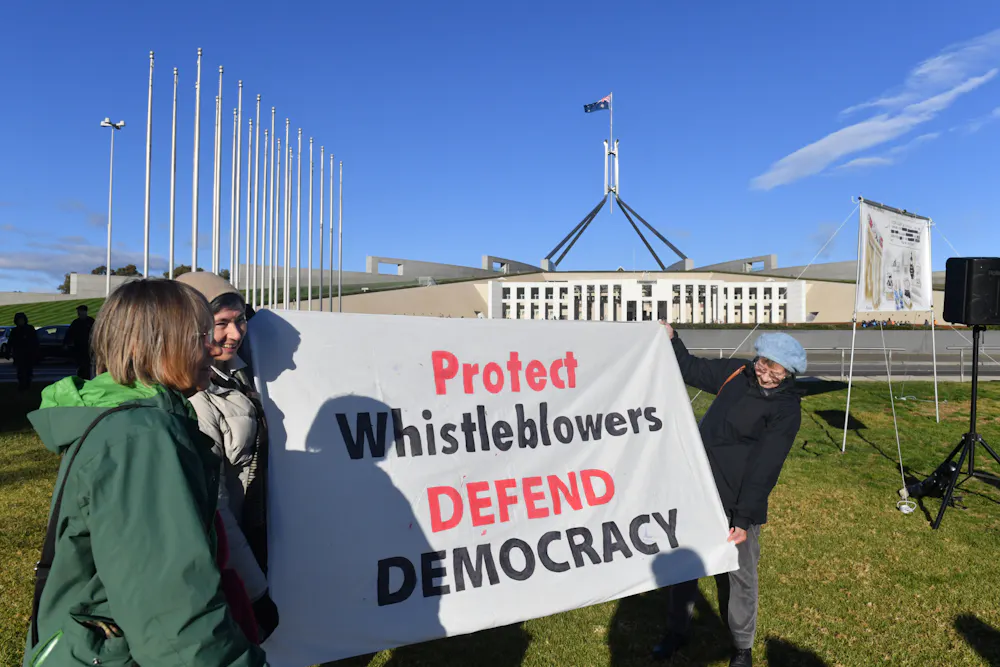
The 2019 AFP raids on News Corp journalist Annika Smethurst and the ABC prompted two parliamentary inquiries and as many constitutional challenges. Meanwhile, the prosecutions of whistleblowers David McBride, Witness K and Richard Boyle revealed the potential consequences for those who expose government wrongdoing.
Vast and complex security laws, set against an absence of protections unique in the Western world, have made public interest reporting a risky business for journalists and their sources.
These problems are well known, but we are yet to see actual law reform to support public interest journalism.
Read more: Australia needs a Media Freedom Act. Here's how it could work
A commitment to reform
Attorney-General Mark Dreyfus recently assured Australians his government was “going to do something” about press freedom reform.
Specifically, it would act on Parliamentary Joint Committee on Intelligence and Security recommendations made in 2020 and accepted by the Morrison government.
A central pillar of the committee’s report were reforms to federal warrant applications.
It recommended only senior judges have the power to grant warrants relating to journalists and media organisations.
It also said the “interests of public interest journalism” should be represented by a government-appointed “public interest advocate”. Otherwise, warrant applications should remain ex parte (meaning without the knowledge or presence of other parties, such as the affected media organisation).
The government has committed to these reforms. But as several overseas examples show, the proposals go nowhere near far enough to address the deficiencies in press freedom in Australia.
Read more: Security committee recommends bare minimum of reform to protect press freedom
Learning from our allies
Under US law, a blanket protection exists to prevent state access to journalistic materials, subject to strictly limited exemptions.
In New Zealand, as in Queensland and Victoria, a journalist cannot be forced to show police materials that would identify a confidential source (unless a judge determines the public interest in the administration of justice outweighs the public interests in source confidentiality and press freedom).
In Canada, only a senior judge may grant police access to information a journalist holds – and only where there is no alternative and access is justified by a robust public interest test.
The most compelling framework is presented by the UK Police and Criminal Evidence Act, which New Zealand is on the cusp of embracing.
UK police cannot get a warrant to see any journalistic materials such as recordings or documents (unless it is necessary to avoid seriously prejudicing an investigation).
Instead, UK law sets up a special process by which police apply for “production orders”, which the media gets a chance to contest.
Access to journalistic material will only be granted if other methods of getting the material have been tried (or would be futile) and if access is in the public interest.
In recognition of journalists’ ethical obligations to protect their confidential sources, police access to confidential journalistic materials is limited to terrorism investigations. Even then, strict limitations and protections apply.
These considerations are not taken lightly. UK courts have emphasised the high bar police must reach to obtain a production order, and the importance of rights to privacy and press freedom.
 The home of journalist Annika Smethurst was raided by the AFP.
AAP Image/Lukas Coch
The home of journalist Annika Smethurst was raided by the AFP.
AAP Image/Lukas Coch
A five point plan
Australia remains the only liberal democracy lacking a national bill or charter of human rights, with the protections for privacy, speech and press freedom they usually entail.
Something would be better than nothing. But compared to international practice, the Parliamentary Joint Committee recommendations fall short.
Tellingly, Dreyfus and his Labor colleagues on the committee noted the recommendations did “not go far enough” and were “a bare minimum – a starting point – for reform.”
Now Dreyfus is attorney-general and can actually drive reform. There is no need to reinvent the wheel, and Australia could introduce laws shaped by the experience of our closest international partners.
We suggest a five point plan based on comparative research and analysis:
create a special framework of production orders for controlling state access to all journalistic materials, not just confidential source information.
have only senior judges determine access to such material.
create a mechanism by which access can be contested in court prior to being executed.
ensure substantive protection via a clear public interest test. Investigators should only be able to access journalistic material if there is no reasonable alternative source and the public interest in the investigation of crime outweighs the public interest in press freedom.
in exceptional circumstances, police may be able to get a warrant (without the knowledge of the media organisation they’re targeting) instead of a production order.
In these exceptional circumstances referred to in point five, however:
a public interest advocate should be present to represent the public interest in press freedom
the warrant should be drafted as narrowly as possible, and
if a warrant is granted and executed, any seized material should be held by a court so media can challenge police access and, if necessary, for this to be resolved by a court.
Police raids on Australian media have tangible effects on press freedom, but they are not the whole story. Meaningful protections should also:
safeguard journalists’ sources through privacy law
enhance whistleblower protections
limit data surveillance, and
include journalism-based defences to certain criminal offences.
With both sides of politics behind press freedom reforms, now is the time to support democracy. Australia must not slip further down in global standings.
Authors: Rebecca Ananian-Welsh, Associate Professor, TC Beirne School of Law, The University of Queensland


















