

Coffin? Casket? Cremation? How to make your death more environmentally friendly
- Written by: Paola Magni, Senior Lecturer in Forensic Science, Murdoch University
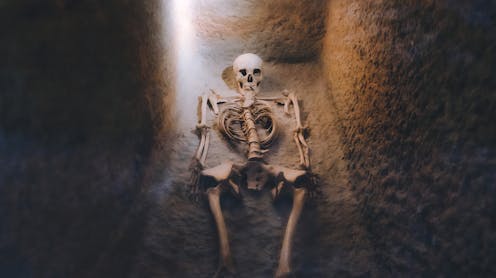
We can all agree humans need to reduce their impact on the environment. And while most of us think of this in terms of daily activities – such as eating less meat, or being water-wise – this responsibility actually extends beyond life and into death.
The global population is closing on eight billion, and the amount of land available for human burial is running out, especially in small and densely populated countries.
To minimise environmental impact, human bodies should return to nature as quickly as possible. But the rate of decay in some of the most common traditional disposal methods is very slow. It can take several decades for a body to decompose.
In a one-of-its-kind study, our team analysed 408 human bodies exhumed from grave pits and stone tombs in the north of Italy to find out what conditions help speed up decay.
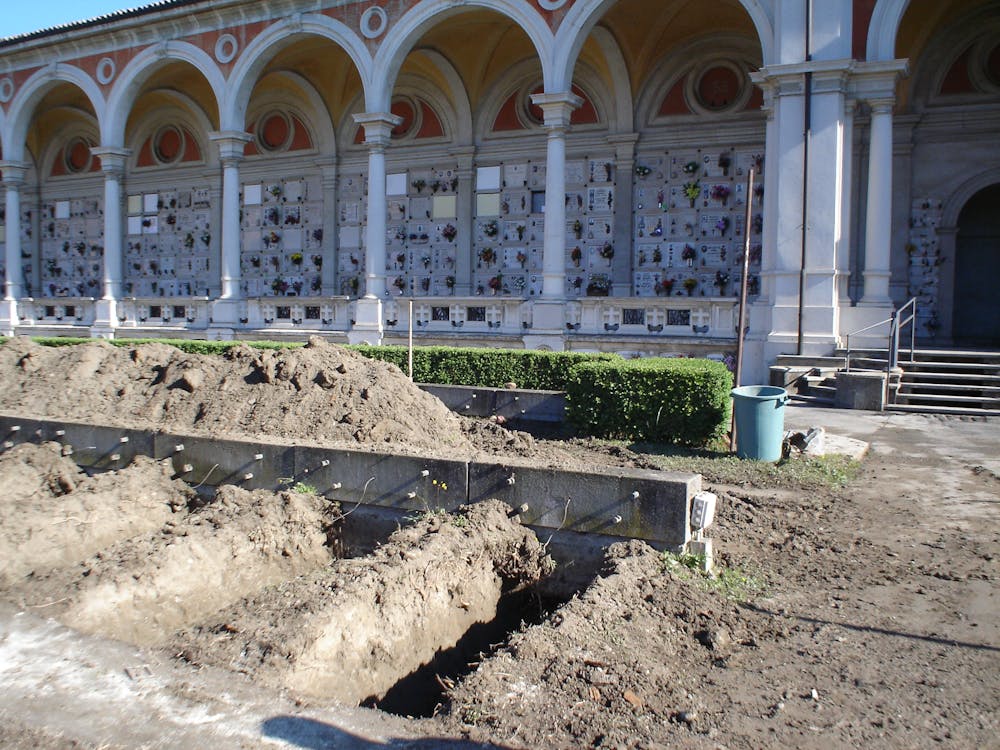
The environmental cost of traditional burials
Funeral rituals should respect the dead, bring closure to families and promote the reaching of the afterlife in accordance with people’s beliefs. This looks different for different people. Although the Catholic church has allowed cremation since 1963, it still prefers burials. Muslims are always supposed to be buried, while most Hindus are cremated.
Read more: Indians are forced to change rituals for their dead as COVID-19 rages through cities and villages
In Australia, however, the latest census revealed almost 40% of the population identifies as “not religious”. This opens up more avenues for how people’s bodies may be handled after death.
Most traditional burial practices in industrialised countries have several long-lasting harmful effects on the environment. Wood and metal fragments in coffins and caskets remain in the ground, leaching harmful chemicals through paint, preservatives and alloys. Chemicals used for embalming also remain in the ground and can contaminate soil and waterways.
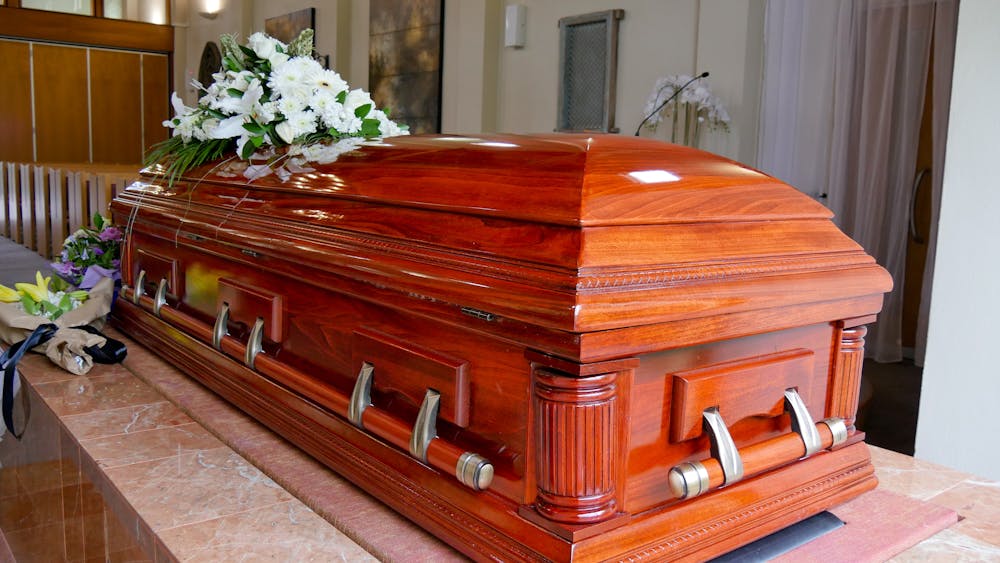 Caskets made out of processed materials like metal and wood are bad for the environment.
Shutterstock
Caskets made out of processed materials like metal and wood are bad for the environment.
Shutterstock
Cremation also has a large carbon footprint. It requires lots of trees for fuel and produces millions of tons of carbon dioxide each year, as well as toxic volatile compounds.
There are several alternatives to traditional burials. These include “water cremation” or “resomation” (where the body is rapidly dissolved), human composting, mummification, cryonics (freezing and storage), space burials, and even turning the body into trees or the ashes into diamonds or record vinyls.
However, many of these alternatives are either illegal, unavailable, costly or not aligned with people’s beliefs. The vast majority choose coffin burials, and all countries accept this method. So the question of sustainable burials comes down to choosing between the many types of coffins available.
What leads to faster decomposition?
Coffins range from traditional wooden caskets, to cardboard coffins, to natural coffins made from willow, banana leaf or bamboo, which decompose faster.
The most environmentally sustainable choice is one that allows the body to decompose and reduce to a skeleton (or “skeletonise”) quickly – possibly in just a few years.
Our research has presented three key findings on conditions that promote the skeletonisation of human bodies.
First, it has confirmed that bodies disposed in traditionally sealed tombs (where a coffin is placed inside a stone space) can take more than 40 years to skeletonise.
In these sealed tombs, bacteria rapidly consume the oxygen in the stone space where the coffin is placed. This creates a micro-environment that promotes an almost indefinite preservation of the body.
We also found burial grounds with a high percentage of sand and gravel in the soil promote the decomposition and skeletonisation of bodies in less than ten years – even if they are in a coffin.
That’s because this soil composition allows more circulation of air and microfauna, and ample water drainage – all of which are helpful for degrading organic matter.
Finally, our research confirmed previous suspicions about the slow decomposition of entombed bodies. We discovered placing bodies inside stone tombs, or covering them with a stone slab on the ground, helps with the formation of corpse wax (or “adipocere”).
This substance is the final result of several chemical reactions through which the body’s adipose (fat) tissues turn to a “soapy” substance that’s very resistant to further degradation. Having corpse wax slows down (if not completely arrests) the decomposition process.
A new, greener option
In looking for innovative burial solutions, we had the opportunity to experiment with a new type of body disposal in a tomb called an “aerated tomb”.
Over the past 20 years aerated tombs have been developed in some European countries including France, Spain and Italy (where they have been commercialised). They allow plenty of ventilation, which in turn enables a more hygienic and faster decomposition of bodies compared to traditional tombs.
They have a few notable features:
an activated carbon filter purifies gases
fluids are absorbed by two distinct biodegrading biological powders, one placed at the bottom of the coffin and the other in a collecting tray beneath it
once the body has decomposed, the skeletal remains can be moved to an ossuary (a site where skeletal remains are stored), while the tomb can be dismantled and most of its components potentially recycled.
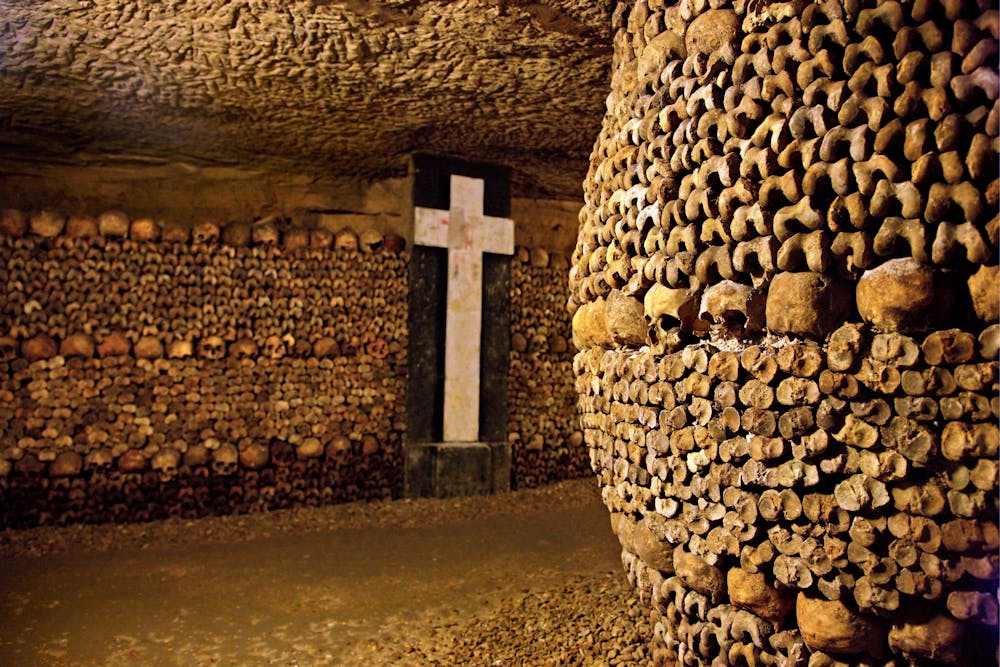 Arguably one of the world’s most famous ossuaries, the Paris Catacombs is an underground labyrinth containing the remains of more than six million people.
Shutterstock
Arguably one of the world’s most famous ossuaries, the Paris Catacombs is an underground labyrinth containing the remains of more than six million people.
Shutterstock
Aerated tombs are also cheaper than ordinary tombs and can be built from existing tombs. They would be simple to use in Australia and would comply with public health and hygiene standards.
Most of us don’t spend much time thinking about what will happen to our bodies after we die. Perhaps we should. In the end this may be one of our most important last decisions – the implications of which extend to our precious planet.
Read more: Most Americans today are choosing cremation – here's why burials are becoming less common
Authors: Paola Magni, Senior Lecturer in Forensic Science, Murdoch University


















