

Cruise ships are back and carrying COVID. No, it’s not 2020. But here’s what needs to happen next
- Written by: C Raina MacIntyre, Professor of Global Biosecurity, NHMRC Principal Research Fellow, Head, Biosecurity Program, Kirby Institute, UNSW Sydney
Cruise ships carrying passengers with COVID are back in the news. The Coral Princess, with an unconfirmed number of people testing positive on board, is set to dock at Fremantle, Western Australia. The Quantum of The Seas, with passengers reportedly testing positive, is heading for Brisbane. There have been similar situations at other ports in New Zealand and the Pacific.
But this isn’t 2020. The cruise ship industry and health authorities have learned much from large outbreaks linked to the Ruby Princess and Diamond Princess cruise ships early in the pandemic.
Yet, there’s even more we can do to limit the impact of SARS-CoV-2 (the virus that causes COVID) spreading from cruise ships to communities on land.
Read more: Fleas to flu to coronavirus: how 'death ships' spread disease through the ages
Why are we worried about cruise ships?
Cruise ships can have epidemics of a variety of infectious diseases, not just COVID, facilitated by large numbers of people in close proximity, especially during indoor social activities.
We know SARS-CoV-2 is spread mainly by inhaling contaminated air, so indoor activities may pose a risk if ventilation is poor.
Cruises typically last at least a week, which covers the incubation period for infections such as influenza and COVID. So all it takes is for one infected person to be on the ship to set off an epidemic.
Staff stay on ships much longer than passengers, and can continue to infect new passengers, perpetuating a cycle of outbreaks.
But almost half of infections are transmitted asymptomatically. So, without testing everyone on board (before they board and during outbreaks), infectious people can board a ship without being aware they are infected and cause an epidemic. Infected staff can also infect new passengers, and passengers can infect communities they visit on land.
Read more: Cruise ships are coming back to NZ waters – should we really be welcoming them?
What happened with cruise ships and COVID in 2020?
Early in the pandemic, large outbreaks on ships, such as the Diamond Princess made the headlines. Some 634 of 3,711 (17%) people on board tested positive for COVID. The ship was quarantined for two weeks.
An estimated 69% of transmissions on board were transmitted asymptomatically.
The Ruby Princess had a COVID outbreak in March 2020 with around 700 cases. Yet health authorities allowed passengers to disembark in Sydney without testing, who then dispersed around the country at a time we had no vaccines.
Our research showed this resulted in growing community clusters for weeks afterwards.
Read more: Ruby Princess inquiry blames NSW health officials for debacle
But it’s not 2020
We now have vaccines. But vaccination rates vary globally (and cruise passengers are often from many countries). Some vaccines are less effective than others, not everyone is up-to-date with their booster shots, vaccine immunity wanes (even after having a booster), and current vaccines are generally less-effective against currently circulating Omicron subvariants.
This means people can be infected and infectious despite being vaccinated.
Many of us have also had COVID, especially in 2022. But our immunity following infection (whether or not we’re also up to date with our vaccines) wanes too. People who were infected with older variants may also have a dampened immune response to Omicron, which means limited protection.
Cruise ships and health authorities have also tightened up their COVID protocols.
The New South Wales government, for instance, publishes on its website the COVID risk of in-coming vessels. It places ships in one of three categories according to a number of factors, including the number of COVID cases on board.
Cruise ships also have strict protocols for controlling and managing outbreaks. This includes masks for close contacts, mandatory isolation for infected passengers for five days, and testing of anyone with symptoms.
The problem is that transmission can continue because of asymptomatic infections. The ship may need medical evacuations or assistance for severely ill people. There is also the problem of infection being transmitted to communities on shore after people without symptoms disembark.
We can do more
People disembarking and unknowingly spreading the virus is especially a problem for small towns.
The itinerary of the Coral Princess, which has since been modified, included the Western Australian towns of Broome and Geraldton, both of which have large Aboriginal communities, and other towns, such as Albany and Busselton.
Small towns may not have a hospital, may have limited access to health care, and would not have capacity to deal with many severely ill patients. Capacity for medical evacuations are also limited.
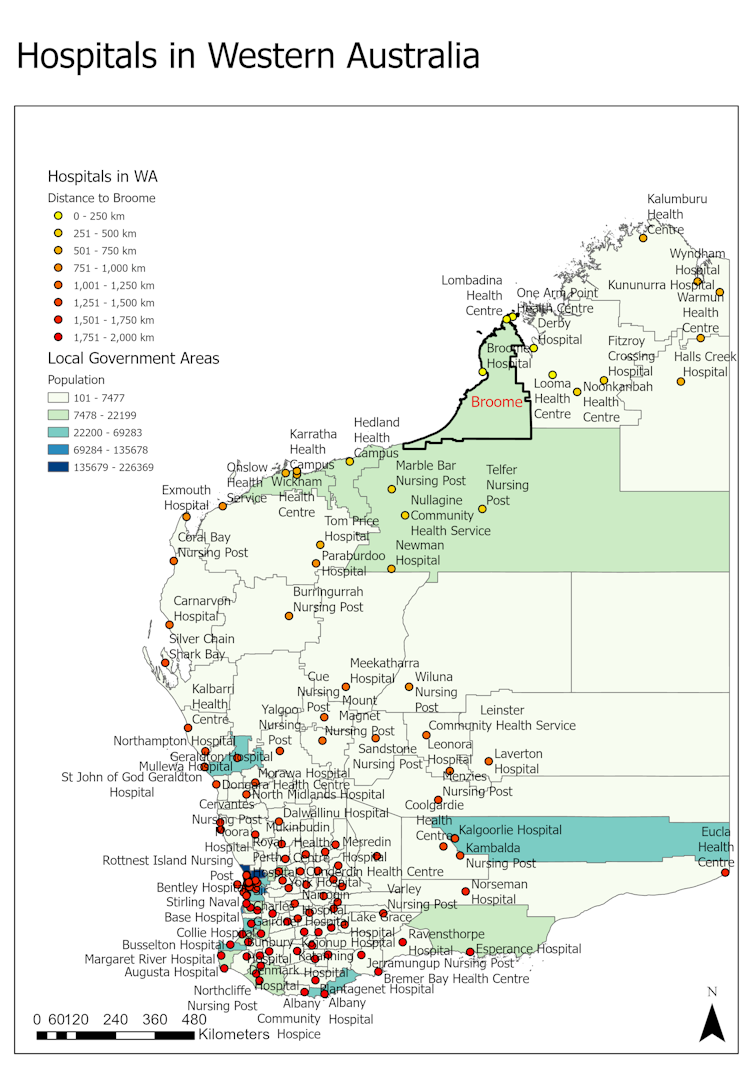
In the map below, we can see how hospitals are distributed in rural areas around Broome. Most hospitals are near Perth and the southwest coast. Broome has one hospital with about 40 beds. Large hospitals in Perth and Darwin are about 2,000 kilometres away, which would be the destinations for medical evacuations of severely ill patients.
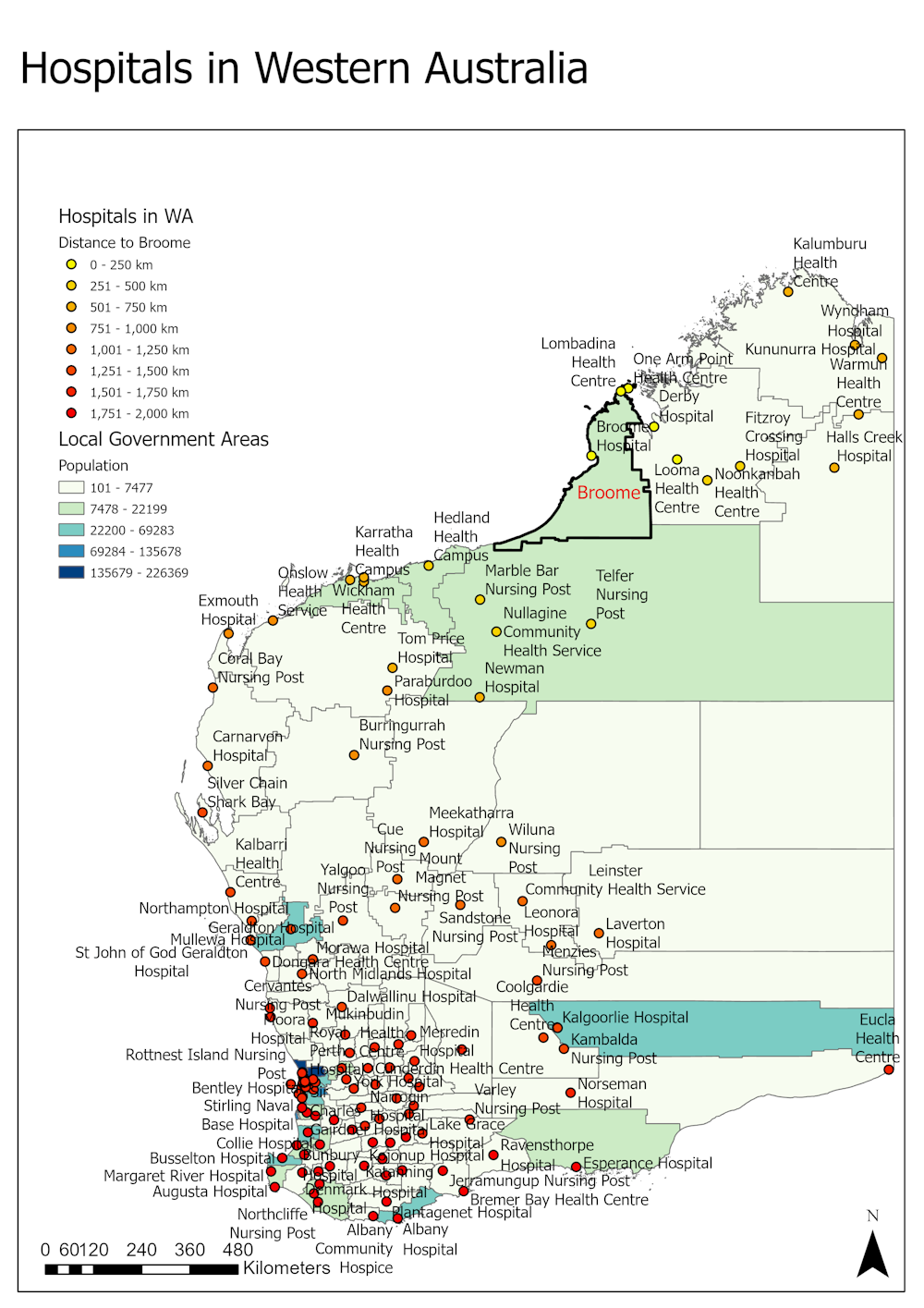
So it’s important to monitor for outbreaks in Broome after the Coral Princess docked there this week, and ensure availability of testing to enable early intervention (such as antiviral drugs) to control outbreaks.
Cruises with outbreaks on board should ideally avoid small towns or remote locations with limited health services or vulnerable populations, as the impacts on these communities may be much greater than in a large city.
Visiting small towns during an on-board epidemic would be safer if everyone who disembarks is tested first, is negative, and wears a mask on shore.
What else could we do?
The cruising industry has acknowledged the reality of COVID being a continuing threat. This could be improved by recognising the role of asymptomatic transmission in testing policies.
For instance, all passengers and crew should have a negative rapid antigen test at the start of the cruise, and during an outbreak. All close contacts and all disembarking passengers should be tested for COVID, regardless of symptoms. The cost of testing would be much less than the lost costs of large epidemics.
During a cruise epidemic, companies also need to consider the locations being visited, how much COVID is already present there (some remote towns have very little COVID) and available health-care systems for locals.
Rapid use of antivirals may also help to control epidemics on board as these allow passengers testing positive to clear the virus faster.
The aviation industry does well in providing safe air in-flight. The cruise industry has also started changing ventilation to add fresh air instead of recirculated air indoors.
But there is still some way to go before we can say the threat of COVID is over, on-board or on land.
Authors: C Raina MacIntyre, Professor of Global Biosecurity, NHMRC Principal Research Fellow, Head, Biosecurity Program, Kirby Institute, UNSW Sydney


















