

Dreamers and schemers and the election that changed us
- Written by: Frank Bongiorno, Professor of History, ANU College of Arts and Social Sciences, Australian National University
This is an edited extract from Dreamers and Schemers: A Political History of Australia by Frank Bongiorno, La Trobe University Press, 2022.
The term “democracy sausage” first appeared in Australia in 2012. It literally referred to the practice of voluntary organisations running fundraising barbecues at polling booths during Australian elections. Symbolically, though, the term expressed the spirit in which Australian elections are held, perhaps even saying something broader about the political culture.
Australians, it seemed to suggest, do not take their politics so seriously that they cannot have a laugh. Contention and disagreement are necessary ingredients of democracy, but a smoking barbecue and a cake stall speak to a deeper sense of community, a more meaningful civic belonging than can be expressed by the political system itself.
There is, of course, a sleight of hand in the rise of the democracy sausage, which occurred during the very same time political trust plunged to very low levels. A peaceful election day came about through historical development. Early elections were often far from gentle occasions. It is the bureaucratic administration of elections that permits organisations to go about the business of fundraising on election day.
Outside extreme libertarianism, a minority taste in Australia, there tends to be only mild political disagreement. Otherwise, most people get on with their lives, expecting the state to set reasonable parameters for individual behaviour while allowing people a wide scope to pursue their private interests as individuals and families. As Hancock said, “collective power at the service of ‘individualistic’ rights”.
Yet is this sufficient? Australian political history has had its dreamers and visionaries alongside the pragmatists and schemers.
Big change of the kind that occurred in Australia in the 1850s, 1890s, 1940s and 1980s would have been impossible without the idealists and thinkers: that is, without political leaders, activists, intellectuals and movements who refused to be merely “practical”. Change depended on people willing to resist complacent utilitarian appeals to majority interests and consensus opinion, on refusing to accept injunctions merely to tinker rather than transform. In the end, it depended on a vision, however modest, of the good life.
It remains too easy in a political culture based on the vague notion that everyone should be treated “equally”, and that nurtures a value as contested as “fairness”, to marginalise those who have historically been left out or left behind.
Their claims are sometimes dismissed as “special treatment”, their needs as no more compelling or urgent than the better-off – “battlers”, “aspirationals”, “working families” – whom politicians flatter as the most deserving of their constituents.
Meanwhile, a political culture that lays so much stress on the practical and material can shun the creativity and imagination invariably required to master the complexities of intractable problems.
There are, in our own times, plenty of these. On issues as diverse as constitutional recognition for First Nations people, the transition from fossil fuels to renewable energy and management of the rise of China, Australia’s political system has often appeared stodgy and ineffective.
New forms of online politics have evolved, yet political parties with rapidly declining membership bases, whose practices persistently fail to conform to reasonable democratic norms, still play the central role in the system. An adversarial parliament too closely resembles an arena for a sporting contest, with citizens as spectators rather than players, if indeed they engage at all.
As Australians faced a federal election that Scott Morrison called for May 21 2022, it was hard to discern among the major parties a political vision that might engage the imaginations and ideals of masses of people. The aspirations that attached to democratic self-government in the 19th century, to the social laboratories of the federation era, to postwar reconstruction in the 1940s, and to progressive reform in the late 20th century were now apparently beyond either the consciousness or memory of many Australians.
Read more: Book extract: From secret ballot to democracy sausage
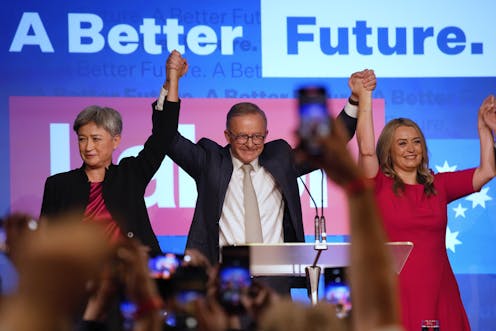
The 2022 election, however, produced a result that was potentially transformative for the nation’s politics. A government that had served three terms without establishing much that could be called a legacy trailed in the polls. Morrison’s personal standing, revived in the early months of the pandemic, now collapsed, the marketing man’s habit of denying responsibility for failure while owning every success having eroded respect for his leadership.
While the parties tussled in their usual way, a political revolution was brewing in parts of the country that usually received little attention in elections. In electorates normally regarded as safe for the Liberals – predominantly in the leafy, affluent suburbs of Sydney, Melbourne, Adelaide and Perth, but also in a few regional areas – independent candidates came forward. Most were women already successful in business or the professions. They were known as the “voices of” movement, “community independents” or “teals”.
They received a bitter opposition from the Liberal Party and its friends in the Murdoch media, who saw in this unwelcome outbreak of grassroots politics a clear and present danger to good government and stable democracy. The teals, they said, were really fake independents advancing the Labor cause. Coalition partisans made it plain they felt their own enterprise was being deprived of property that was rightly its own.
While often insulting their values and lifestyles as those of the fashionable inner-city elite, the Coalition did little to draw women into its ranks, protect the planet or promote clean politics. Two of the eventual teal victors – Allegra Spender in Wentworth, Sydney, and Kate Chaney in Curtin, Perth – belonged to multi-generational Liberal parliamentary dynasties.
Each teal, moreover, received financial and strategic support from Climate 200, a political action committee on the US model founded and led by businessman and clean-energy advocate Simon Holmes à Court. Predictably, right-wing commentators depicted Holmes à Court as a puppeteer, which only confirmed the prevailing impression among women of the way that conservative male politicians and their media mouthpieces demeaned them.
The 2022 election disclosed the resilience and adaptability of the country’s distinctive democracy. Independent candidates had successfully challenged well-resourced party machines and had raised the profile of issues that mattered to voters but which had been handled badly by the major parties, especially by the incumbent government.
Read more: Did Australia just make a move to the left?
There was an increase in the number of women elected, of Indigenous parliamentarians and of members from non-English-speaking backgrounds; the parliament would at last begin to reflect the notable diversity of the country. Chinese-Australians acted on their disaffection with the increasingly aggressive posturing towards China among senior Coalition politicians.
Millions of voters ignored the urgings of News Corp to shun Labor, the Greens and the teal independents, and they seemed to pay little attention to right-leaning media that often appeared more interested in testing the memory of the Labor Party leader than in impartially assessing the offerings of parties and candidates, or in holding a three-term government to account for its record.
Rather, the result arguably saw the most drastic electoral shift to the left since the elections of 1969 and 1972 that had brought Gough Whitlam to power. Dreamers imagined that a new era of political creativity might be just around the corner, even as the schemers manoeuvred in their familiar patterns. While the challenges faced by the new government were formidable, for a moment it seemed possible that the nation’s imaginative energies might not yet be completely exhausted.
Authors: Frank Bongiorno, Professor of History, ANU College of Arts and Social Sciences, Australian National University


















