

7 'creepy crawlies' you don't need to be afraid of this spooky season
- Written by: Tanya Latty, Associate professor, University of Sydney
The vast majority of animals on Earth are invertebrates (animals without backbones) – such as insects, arachnids and crustaceans.
These amazing animals are absolutely crucial to our ecosystems: they are pollinators, pest controllers, soil creators and waste managers. Invertebrates also serve as food for countless other animals. Despite all their hard work, many of these creatures are often described as “creepy crawlies”.
Their alien-looking bodies might seem like the stuff of nightmares, but the vast majority of invertebrate species are harmless to humans. In fact, the scariest thing about invertebrates is the rate at which they are quietly disappearing from our planet.
Here are seven fascinating creepy crawlies you don’t need to be afraid of.
Social huntsman spiders (Delena cancerides)
Native to Australia, social huntsman spiders live in large family groups beneath the loose bark of dead or dying trees.
Sound like nightmare fuel? Don’t worry, social huntsman spiders are gentle giants who rarely bite humans (and cause minimal harm when they do).
Unlike most spider species, social huntsmans live together in groups containing a large adult female and up to 300 of her offspring. Spiders will aggressively defend their nest against outsiders, suggesting they have ways of recognising nestmates from non-nestmates.
At night, individual huntsmans leave the communal nest to hunt their insect prey. Although they are solitary hunters, spiders that come across the same insect will share food rather than fight with one another. In fact, spiderlings would rather starve to death than cannibalise a fellow spider. By consuming large numbers of bugs, social huntsmans help to keep insect populations under control.
Giant burrowing cockroach (Macropanesthia rhinoceros)
Cockroaches are among the world’s most feared and reviled insects – which is a great pity, as most cockroaches are harmless animals that play a crucial role in our natural environment. Take the giant burrowing cockroach, found in the warm tropical and subtropical forests of Australia.
This gentle giant is the world’s heaviest species of cockroach, tipping the scales at 30-35 grams. Unlike its infamous relatives, the giant burrowing cockroach is not a pest and prefers to spend most of its time in underground burrows. Giant burrowing cockroaches feed on dry eucalyptus leaves, which they collect and drag into their burrows.
By moving and mixing the soil, giant burrowing cockroaches help keep soils healthy. They are excellent mothers who feed and care for their young for up to nine months after birth. The giant burrowing cockroach is also surprisingly long-lived, with a lifespan of up to 10 years.
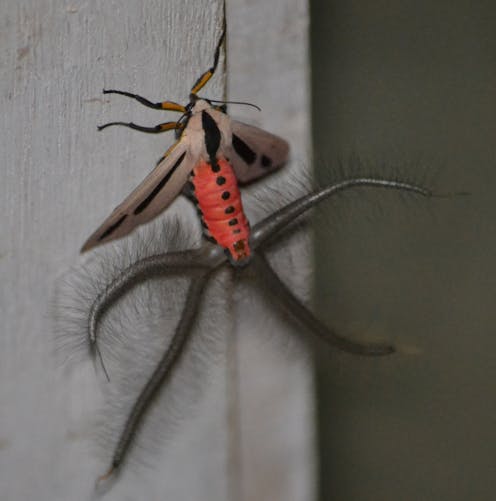
Baphomet moth (Creatonotos gangis)
With weirdly pulsating tentacles, the Baphomet moth looks like an alien nightmare – but these moths are simply looking for love. When male Baphomet moths sense the presence of a female, they inflate enormous, tentacle-like organs called “coremata”, which produce an irresistible female-attracting chemical bouquet.
While it’s not the only moth species with coremata, Baphomet moths take theirs to ridiculous lengths, with “tentacles” sometimes exceeding the length of their abdomens.
As caterpillars, male Baphomet moths get the ingredients they need to make their female-attracting scents by eating plant leaves that contain chemicals called pyrrolizidine alkaloids. Plants produce these alkaloids to deter plant-munching animals, but Baphomet moths have evolved a way to convert these chemicals into their own attractive scents.
Black soldier fly maggots (Hermetia illucens)
A big, writhing mass of maggots might not sound like one of nature’s marvels, but the larvae of the black solder fly are recycling superheroes that may one day help humanity cut down on food waste. Roiling masses of soldier fly maggots can rapidly devour food through a process physicists colourfully described as a “maggot fountain”.
The incredible speed at which maggots demolish food waste has captured the attention of scientists who hope to use soldier fly maggots to convert waste products such as animal faeces and food waste into maggot-based proteins that can be fed to livestock or humans. Yum!
Tailless whip scorpion (Amblypygi)
Despite their name, tailless whip scorpions are not scorpions, but instead belong to an unusual group of arachnids called amblypygids. Despite their fearsome appearance, amblypygids lack venom and are timid animals that rarely bite unless threatened.
These shy animals prefer to stay hidden in humid habitats such as in leaf litter, inside caves or under bark.
Amblypygids have elongated front legs that act as feelers and help the arachnid locate its insect prey. Once prey is detected, amblypygids use their sharp pedipalps to impale their victim.
Some of these arachnids display complex social behaviours, with mothers staying near and caring for their young for up to a year.
The giant elephant mosquito (Toxorhynchites speciosus)
Few things in life are as horrifying as the high-pitched squeal of a mosquito in the dark. Now imagine an enormous mosquito five times the size of your average mozzie. Measuring in at a shocking 8mm in length, the Australian elephant mosquito is the world’s largest mosquito species.
But fear not, this enormous mozzie is a nectar-sipping vegetarian.
Most female mosquitoes need a meal of blood to provide nutrients for their developing eggs. Female elephant mosquitoes collect much-needed nutrients by feeding voraciously on other aquatic insects when they are larvae. And it gets better, because the favourite food of larval elephant mosquitoes is … other mosquito larvae!
Common scorpion fly (Panorpa)
Scorpionflies look like a bizarre mashup between a fly and a scorpion. Combine their sinister appearance with a somewhat ghoulish habit of feeding on fresh human corpses, and you have the makings of an excellent horror movie.
Luckily, scorpionflies are not, as their name suggests, flying scorpions, nor are they capable of harming a human. In fact, scorpionfly “stingers” are actually enlarged male genitalia!
During courtship, male scorpionflies attempt to woo females by offering them either a dead insect or a blob of saliva. Scorpion flies are mostly scavengers and are frequently seen stealing prey from spider webs.
They are among the first insects to turn up on newly deceased corpses, making them important for establishing time of death.
Read more: When remains are found in a suitcase, forensics can learn a lot from the insects trapped within
Authors: Tanya Latty, Associate professor, University of Sydney


















