

The first biography of Lachlan Murdoch provides some insights, but leaves important questions unanswered
- Written by: Matthew Ricketson, Professor of Communication, Deakin University
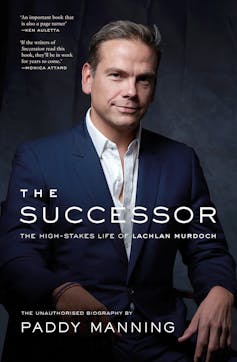
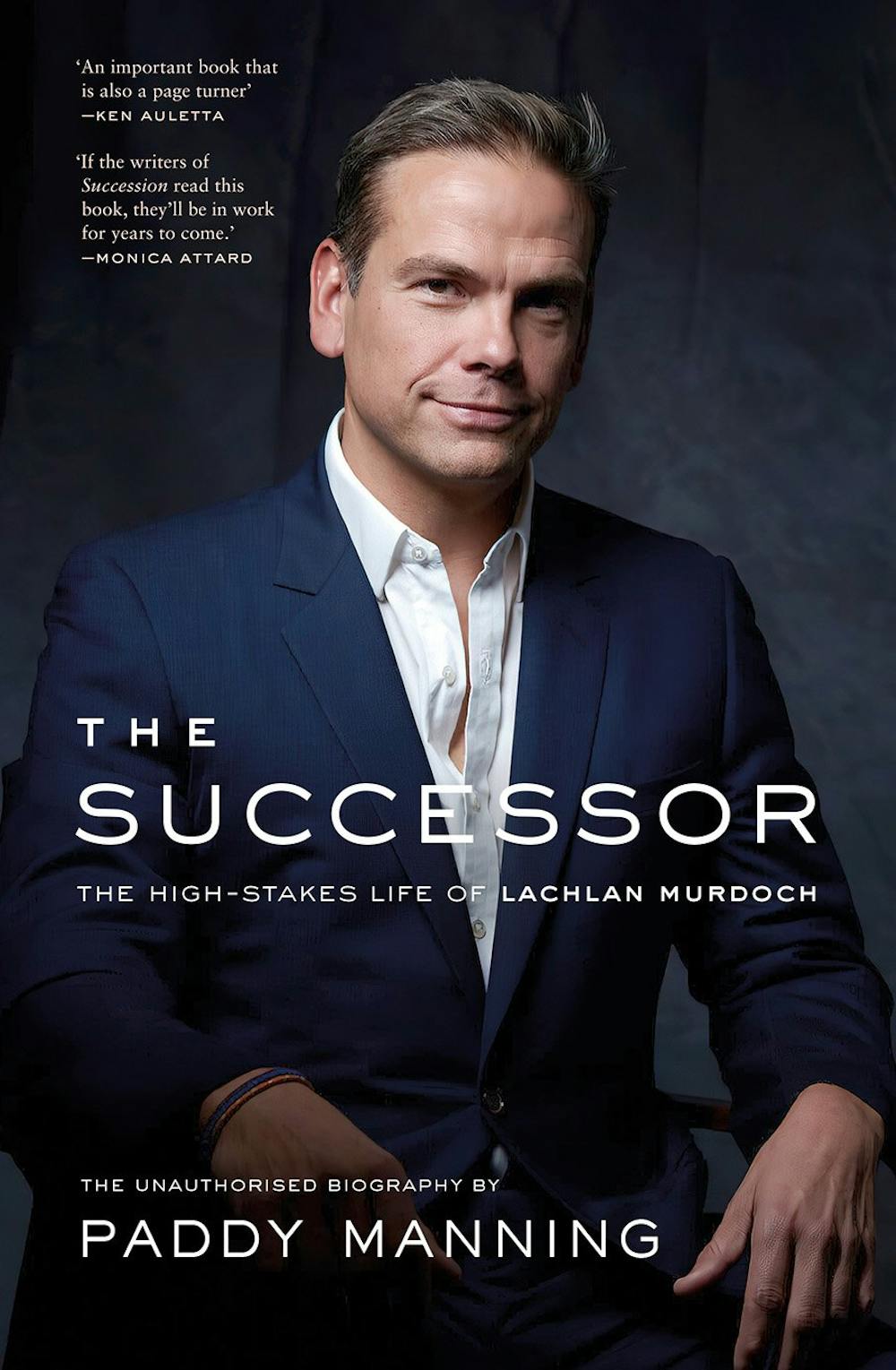
The title of Paddy Manning’s The Successor: The High-Stakes Life of Lachlan Murdoch tells us what is good and not so good about this biography.
It is a smart play on the title of the much-applauded HBO television series, Succession, which everyone except the show’s creators says is modelled on the decades-long corporate psychodrama within the Murdoch family. The Murdochs have said little about the Emmy Award-winning show, but in a knowing wink they chose to use Succession’s grandly jarring theme music in a tribute to Rupert at his 90th birthday party.
I say “Rupert” because he has long since joined the small club of globally famous figures known by their first name. Not so Lachlan Murdoch, Rupert’s third child but, importantly for him, his eldest son.
Review: The Successor: The High-Stakes Life of Lachlan Murdoch – Paddy Manning (Black Inc.)
The book’s subtitle is the giveaway. If a “high-stakes life” was Lachlan Murdoch’s defining feature, would it need to be spelt out? The subtitle of a biography of, say, Don Bradman, does not need to inform us of his “high-stakes” life as a cricketer.
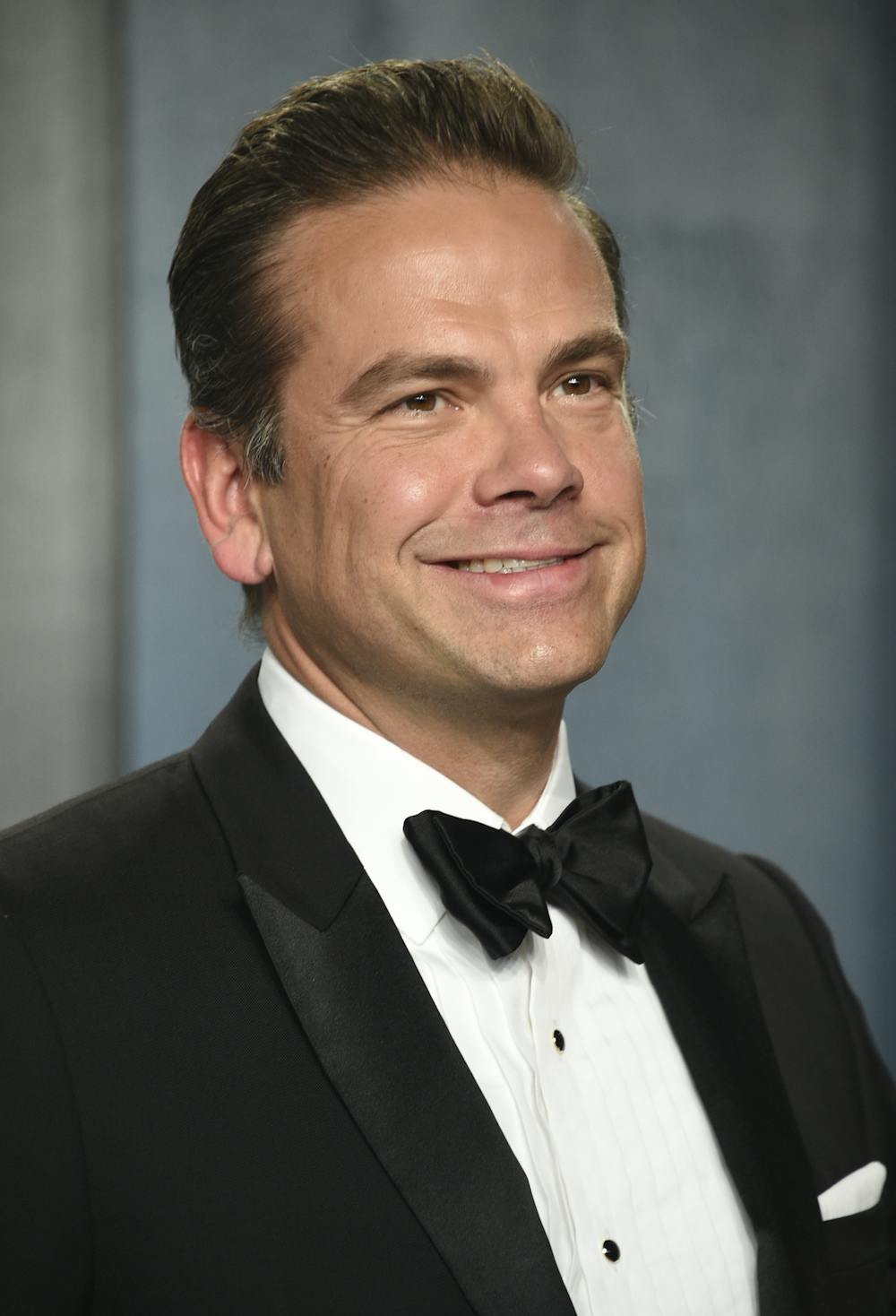 Lachlan Murdoch at the Vanity Fair Oscar Party, February 2020.
Evan Agostini/AP
It draws less heavily on the voluminous academic literature about the Murdoch media, though when it does, Yochai Benkler, Robert Faris and Hal Roberts’ book Network Propaganda (2018) is quoted to good effect. Discussing the role of the Fox News television network, they write: “Conspiracy theories that germinate in the nether regions of the internet stay there unless they find an amplification vector”.
What do we learn about the person who wields so much media power and influence? About Lachlan himself, not much. About Lachlan as a businessman, a bit more. About how Lachlan compares with Rupert and what that might mean for the media – and us, the audience – a good deal more.
The portrait that emerges of Lachlan is drawn in bright colours – he has an adventurous spirit, tattoos, boyish good-looks; he is friendly and easygoing – but it does not have much depth. There are endless descriptions, in real-estate brochure mode, of overlong yachts and stylishly appointed bathrooms in multi-million dollar mansions dotted across the globe. And there are numerous gossipy accounts of parties with Tom and Nicole and Baz.
Manning plumbs the standard biographical sources of his subject’s formative years, but they yield little of much import. At several points Joe Cross, a futures trader friend, is wheeled in to provide testimonials that are the verbal equivalent of eyewash. Here he is on Lachlan meeting his future wife, Sarah O’Hare:
It was on […] he’s like, hook, line and sinker gone. And fair enough! With Sarah, she’s the whole package, she’s like a completely down-to-earth knockabout Aussie, being a supermodel didn’t hurt, and she loves all the things that Lachlan loved […] and she’s got a whole group of fabulous friends that now come together with his tight group of mates, and everyone gets on.
More fruitfully, Manning recounts how Lachlan, for his final year thesis in an arts degree at Princeton, wrote about Immanuel Kant’s categorical imperative as inflected by the ideas in the Bhagavad Gita. The thesis was good, according to his supervisor, Professor Beatrice Longuenesse. But what stayed with her, as reported by a journalist who interviewed her many years later, was how Lachlan resembled many other graduates of elite universities, who “glide to the highest reaches of the business world, which they do not tend to disrupt with the lofty ideas they explored as undergraduates”.
Family business
Perhaps the most interesting insight is the extent to which Lachlan is conscious of his family and its history. The family business and the business of the family are pillars around which his life revolves, both by birthright and by choice. He remembers everything negative written about his father, and is fiercely protective of both him and the memory of his grandfather, Keith Murdoch, who for many years headed the Herald and Weekly Times.
Surprisingly for an accomplished journalist, Manning tacitly accepts an abiding myth of the Murdoch family – Keith’s heroic role in writing the so-called “Gallipoli letter” during the first world war. Lachlan retold the story when his grandfather was inducted into the Melbourne Press Club’s Hall of Fame in 2012.
That Sir Keith’s letter was, in important ways, misleading and sensationalised has been discussed by several journalists and authors, including Les Carlyon in his bestselling book Gallipoli, Mark Baker in his biography of another Gallipoli correspondent, Phillip Schuler, and by Tom Roberts in his award-winning 2015 biography of Keith Murdoch.
Not that Lachlan has always deferred to his father. Manning recounts his subject’s fury when, in 1999, Rupert reneged on an agreement with his second wife Anna, Lachlan’s mother, who had “given up her claim to an equal share of Rupert’s fortune precisely to ensure that Prudence, Elisabeth, Lachlan and James would not have to share the control or assets of the Murdoch Family Trust with any children from Rupert’s marriage to Wendi Deng”.
Lachlan Murdoch at the Vanity Fair Oscar Party, February 2020.
Evan Agostini/AP
It draws less heavily on the voluminous academic literature about the Murdoch media, though when it does, Yochai Benkler, Robert Faris and Hal Roberts’ book Network Propaganda (2018) is quoted to good effect. Discussing the role of the Fox News television network, they write: “Conspiracy theories that germinate in the nether regions of the internet stay there unless they find an amplification vector”.
What do we learn about the person who wields so much media power and influence? About Lachlan himself, not much. About Lachlan as a businessman, a bit more. About how Lachlan compares with Rupert and what that might mean for the media – and us, the audience – a good deal more.
The portrait that emerges of Lachlan is drawn in bright colours – he has an adventurous spirit, tattoos, boyish good-looks; he is friendly and easygoing – but it does not have much depth. There are endless descriptions, in real-estate brochure mode, of overlong yachts and stylishly appointed bathrooms in multi-million dollar mansions dotted across the globe. And there are numerous gossipy accounts of parties with Tom and Nicole and Baz.
Manning plumbs the standard biographical sources of his subject’s formative years, but they yield little of much import. At several points Joe Cross, a futures trader friend, is wheeled in to provide testimonials that are the verbal equivalent of eyewash. Here he is on Lachlan meeting his future wife, Sarah O’Hare:
It was on […] he’s like, hook, line and sinker gone. And fair enough! With Sarah, she’s the whole package, she’s like a completely down-to-earth knockabout Aussie, being a supermodel didn’t hurt, and she loves all the things that Lachlan loved […] and she’s got a whole group of fabulous friends that now come together with his tight group of mates, and everyone gets on.
More fruitfully, Manning recounts how Lachlan, for his final year thesis in an arts degree at Princeton, wrote about Immanuel Kant’s categorical imperative as inflected by the ideas in the Bhagavad Gita. The thesis was good, according to his supervisor, Professor Beatrice Longuenesse. But what stayed with her, as reported by a journalist who interviewed her many years later, was how Lachlan resembled many other graduates of elite universities, who “glide to the highest reaches of the business world, which they do not tend to disrupt with the lofty ideas they explored as undergraduates”.
Family business
Perhaps the most interesting insight is the extent to which Lachlan is conscious of his family and its history. The family business and the business of the family are pillars around which his life revolves, both by birthright and by choice. He remembers everything negative written about his father, and is fiercely protective of both him and the memory of his grandfather, Keith Murdoch, who for many years headed the Herald and Weekly Times.
Surprisingly for an accomplished journalist, Manning tacitly accepts an abiding myth of the Murdoch family – Keith’s heroic role in writing the so-called “Gallipoli letter” during the first world war. Lachlan retold the story when his grandfather was inducted into the Melbourne Press Club’s Hall of Fame in 2012.
That Sir Keith’s letter was, in important ways, misleading and sensationalised has been discussed by several journalists and authors, including Les Carlyon in his bestselling book Gallipoli, Mark Baker in his biography of another Gallipoli correspondent, Phillip Schuler, and by Tom Roberts in his award-winning 2015 biography of Keith Murdoch.
Not that Lachlan has always deferred to his father. Manning recounts his subject’s fury when, in 1999, Rupert reneged on an agreement with his second wife Anna, Lachlan’s mother, who had “given up her claim to an equal share of Rupert’s fortune precisely to ensure that Prudence, Elisabeth, Lachlan and James would not have to share the control or assets of the Murdoch Family Trust with any children from Rupert’s marriage to Wendi Deng”.
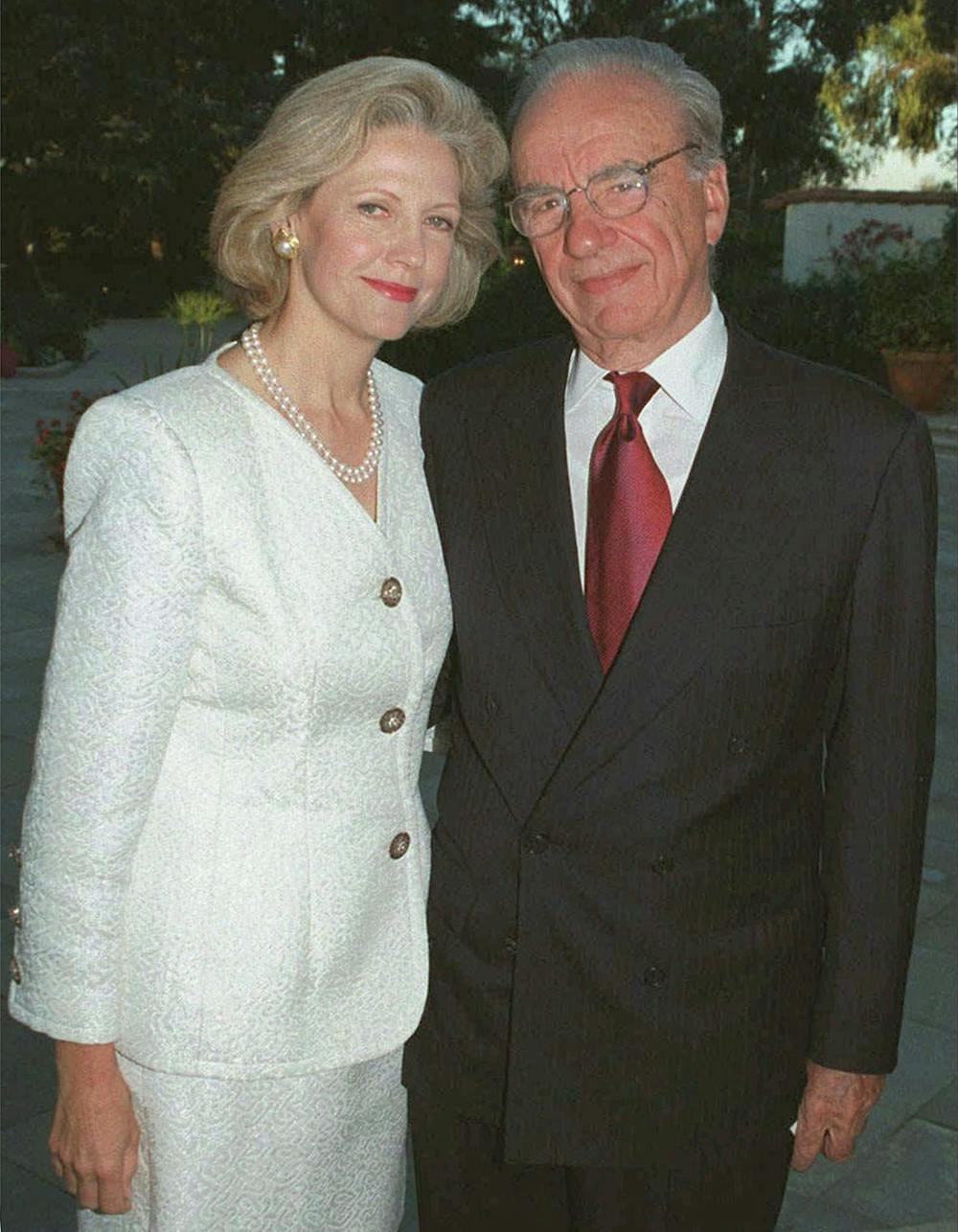 Lachlan Murdoch’s parents, Rupert and Anna, in 1997.
Alan Berliner/AP
Manning’s biography shows it is not well known that Lachlan and Anna, whose marriage to Rupert lasted much longer than his other three wives, staved off an attempt by Rupert and Elisabeth to sack James after the News of the World phone-hacking scandal. The unfolding scandal overlapped with the period between 2005 and 2014 when Lachlan had left the family company, because his father had not backed him when he was being monstered by executives in the US arm of the business.
Manning also recounts scenes from this period seemingly drafted for Succession. The then head of News Limited in Australia, John Hartigan, was forced to mediate between father and son over the amount of access Lachlan could have to the company’s Sydney headquarters. “Don’t let him into the fucking building,” Rupert is reported as saying. “When you’re out, you’re out.”
Later, the Murdoch siblings began attending family counselling, where they discussed working together to “hold Rupert to account to be a mentor to James and not undermine him, as he had done with Lachlan so many years before”.
Read more:
Fox News, Donald Trump's cheerleaders and the journalists who challenged his narrative
Failures and successes
Even Rupert Murdoch’s foes concede he has been a highly successful media businessman; what about Lachlan?
He has had some searing failures. He led News’ role in the 1990s rugby league wars. With James Packer, he made a multi-million dollar losing investment in the internet service provider OneTel. Worst of all, he lost his $150 million investment in Channel Ten, which for a time he headed.
He has also had some notable successes. He invested around $10 million early in a standalone online classified advertising site, realestate.com.au, that is today worth billions. He bought a share of an Indian Premier League cricket team, the Rajasthan Royals, whose value increased dramatically. And he bought into Nova Entertainment, successfully re-setting the pitch of its radio stations, notably Smooth FM.
On the evidence presented in Manning’s biography, Lachlan is a good businessman, if not in the same league as his father, which is admittedly rarefied air. He was given a start in business few others have enjoyed. Sifting the benefits of privilege from natural ability and hard work is not straightforward, but Manning lays out a telling statistic. In 2022, Lachlan’s wealth was estimated at $3.95 billion in the Australian Financial Review’s annual rich list. The same list gave the wealth of his older sister Prudence at $2.58 billion. She “had not worked a day for their father’s business and had mostly escaped the Murdoch spotlight”.
Prudence may well be a savvy investor, and her second husband worked for many years in News Corp. She may also have an eye to what happens to News and Fox in the future. The latest speculation among Murdoch watchers, which Manning discusses, is the possibility that after Rupert Murdoch’s passing, three of the four siblings who retain shares in the family company, Prudence, Elisabeth and James, will combine to oust Lachlan. According to one Wall Street analyst, who has followed News for decades and is privy to the breakdown in the relationship between the siblings, it is “fair to assume Lachlan gets fired the day Rupert dies”.
Lachlan Murdoch’s parents, Rupert and Anna, in 1997.
Alan Berliner/AP
Manning’s biography shows it is not well known that Lachlan and Anna, whose marriage to Rupert lasted much longer than his other three wives, staved off an attempt by Rupert and Elisabeth to sack James after the News of the World phone-hacking scandal. The unfolding scandal overlapped with the period between 2005 and 2014 when Lachlan had left the family company, because his father had not backed him when he was being monstered by executives in the US arm of the business.
Manning also recounts scenes from this period seemingly drafted for Succession. The then head of News Limited in Australia, John Hartigan, was forced to mediate between father and son over the amount of access Lachlan could have to the company’s Sydney headquarters. “Don’t let him into the fucking building,” Rupert is reported as saying. “When you’re out, you’re out.”
Later, the Murdoch siblings began attending family counselling, where they discussed working together to “hold Rupert to account to be a mentor to James and not undermine him, as he had done with Lachlan so many years before”.
Read more:
Fox News, Donald Trump's cheerleaders and the journalists who challenged his narrative
Failures and successes
Even Rupert Murdoch’s foes concede he has been a highly successful media businessman; what about Lachlan?
He has had some searing failures. He led News’ role in the 1990s rugby league wars. With James Packer, he made a multi-million dollar losing investment in the internet service provider OneTel. Worst of all, he lost his $150 million investment in Channel Ten, which for a time he headed.
He has also had some notable successes. He invested around $10 million early in a standalone online classified advertising site, realestate.com.au, that is today worth billions. He bought a share of an Indian Premier League cricket team, the Rajasthan Royals, whose value increased dramatically. And he bought into Nova Entertainment, successfully re-setting the pitch of its radio stations, notably Smooth FM.
On the evidence presented in Manning’s biography, Lachlan is a good businessman, if not in the same league as his father, which is admittedly rarefied air. He was given a start in business few others have enjoyed. Sifting the benefits of privilege from natural ability and hard work is not straightforward, but Manning lays out a telling statistic. In 2022, Lachlan’s wealth was estimated at $3.95 billion in the Australian Financial Review’s annual rich list. The same list gave the wealth of his older sister Prudence at $2.58 billion. She “had not worked a day for their father’s business and had mostly escaped the Murdoch spotlight”.
Prudence may well be a savvy investor, and her second husband worked for many years in News Corp. She may also have an eye to what happens to News and Fox in the future. The latest speculation among Murdoch watchers, which Manning discusses, is the possibility that after Rupert Murdoch’s passing, three of the four siblings who retain shares in the family company, Prudence, Elisabeth and James, will combine to oust Lachlan. According to one Wall Street analyst, who has followed News for decades and is privy to the breakdown in the relationship between the siblings, it is “fair to assume Lachlan gets fired the day Rupert dies”.
 Lachlan, Rupert and James Murdoch at the Television Academy Hall of Fame, Beverly Hills, California, March 2014.
Dan Steinberg/AP
Read more:
Courting the chameleon: how the US election reveals Rupert Murdoch's political colours
Right and wrong
It is hard to know whether this is real or just speculation. It is also not clear how much of the breakdown in family relationships is sibling rivalry and how much is fuelled by ideological differences. James Murdoch has severed ties with News and Fox. He is on the record criticising the company’s reporting on climate change and its coverage of former president Trump’s efforts to reject the electorate’s decision in the 2020 election.
The core question The Successor raises in this reader’s mind, though, is how the portrait of Lachlan as a decent, socially progressive family guy in the first half of the book squares with the picture in the second half of a hard-nosed businessman who endorses the extreme, inflammatory opinions broadcast nightly on Fox News. Does he do this because it attracts viewers or because he actually believes Tucker Carlson’s ravings about the racist “great replacement” theory?
Where does Lachlan stand on these issues? Like his father, he has an abiding love of newspapers, but appears most engaged with them as a business, where Rupert has always had an almost visceral sense of news, both for itself and for what it can do for him and his companies. Manning reports Lachlan’s speeches espousing the virtues of press freedom and his interviews defending Fox, but the speeches are boilerplate and the comments unconvincing. Asked in one interview about Fox’s role in polarising America, Lachlan pointed to criticism of Fox from the far right, saying: “If you’ve got the left and the right criticising you, you’re doing something right.”
Lachlan, Rupert and James Murdoch at the Television Academy Hall of Fame, Beverly Hills, California, March 2014.
Dan Steinberg/AP
Read more:
Courting the chameleon: how the US election reveals Rupert Murdoch's political colours
Right and wrong
It is hard to know whether this is real or just speculation. It is also not clear how much of the breakdown in family relationships is sibling rivalry and how much is fuelled by ideological differences. James Murdoch has severed ties with News and Fox. He is on the record criticising the company’s reporting on climate change and its coverage of former president Trump’s efforts to reject the electorate’s decision in the 2020 election.
The core question The Successor raises in this reader’s mind, though, is how the portrait of Lachlan as a decent, socially progressive family guy in the first half of the book squares with the picture in the second half of a hard-nosed businessman who endorses the extreme, inflammatory opinions broadcast nightly on Fox News. Does he do this because it attracts viewers or because he actually believes Tucker Carlson’s ravings about the racist “great replacement” theory?
Where does Lachlan stand on these issues? Like his father, he has an abiding love of newspapers, but appears most engaged with them as a business, where Rupert has always had an almost visceral sense of news, both for itself and for what it can do for him and his companies. Manning reports Lachlan’s speeches espousing the virtues of press freedom and his interviews defending Fox, but the speeches are boilerplate and the comments unconvincing. Asked in one interview about Fox’s role in polarising America, Lachlan pointed to criticism of Fox from the far right, saying: “If you’ve got the left and the right criticising you, you’re doing something right.”
 Tucker Carlson and Donald Trump at the Trump National Golf Club, Bedminster, New Jersey, 31 July 2022.
Justin Lane/EPA
Or something profoundly wrong. This is the evidence of several media analyses reported in The Successor. Manning acknowledges that at a key point in the vote-counting for the 2020 presidential election, Fox News correctly called the result. But in the following two weeks the network cast doubt on the result at least 774 times, according to the watchdog group Media Matters.
Media Matters is a left-leaning organisation, so its count might be dismissed as partisan, but an investigation earlier this year by the New York Times of 1100 episodes of Tucker Carlson Tonight found that he had amplified the great replacement theory 400 times. The number of guests who disagreed with Carlson was found to be decreasing, while the length of his monologues was increasing to double, even triple their earlier length.
When the US congressional hearings into the January 6 riot at the Capitol were held earlier this year, Lachlan, according to Manning, decided to air them not on Fox News, but on the little watched Fox Business channel. This was in stark contrast not only to the prominence other television networks gave to the historic hearings, but to the vast amount of airtime previously given on Fox News to the
wild and false claims of a rigged election by Rudy Guiliani and Sidney Powell […] once again calling into question whether the channel was really in the news business at all.
Lachlan has argued that, however florid the opinions aired on Fox, the network’s news coverage is professional and balanced. Its coverage of the congressional hearings belied this claim. It was aired late at night, from 11pm. Apart from muted acknowledgement of the force of some of the testimony, Manning writes, “the rest was about sowing doubt and trying to move on”.
By this point, most have realised that Lachlan is further to the right than his father, whose primary outlets in America, the Wall Street Journal and the New York Post, have denounced as shameful former president Trump’s role in the Capitol riot. The effect, then, of the second half of The Successor is to undermine the portrait of Lachlan in first half, rendering it almost meaningless. The two can’t be squared.
Ultimately, Lachlan has to take responsibility for what Fox News does and the impact of its broadcasts. If he won’t, there are two multi-billion dollar lawsuits underway to focus his attention. The voting-machine companies, Smartmatic and Dominion, are alleging Fox News knowingly and maliciously spread a false narrative accusing them of election fraud.
Lachlan is still young by the family’s standards. His grandmother, Dame Elisabeth Murdoch, died aged 103, which Rupert described, perhaps apocryphally, as an early death. As the first biography of the current head of a powerful media empire, The Successor is well worth reading. It probably won’t be the last biography; nor should it be, as there is more to know about Lachlan Murdoch, the enterprise he heads, and the siblings who appear to covet it.
Read more:
Cruelty, pettiness and real estate: in Confidence Man, Maggie Haberman wields eye popping anecdotes to plumb the Trump phenomenon
Authors: Matthew Ricketson, Professor of Communication, Deakin University
Tucker Carlson and Donald Trump at the Trump National Golf Club, Bedminster, New Jersey, 31 July 2022.
Justin Lane/EPA
Or something profoundly wrong. This is the evidence of several media analyses reported in The Successor. Manning acknowledges that at a key point in the vote-counting for the 2020 presidential election, Fox News correctly called the result. But in the following two weeks the network cast doubt on the result at least 774 times, according to the watchdog group Media Matters.
Media Matters is a left-leaning organisation, so its count might be dismissed as partisan, but an investigation earlier this year by the New York Times of 1100 episodes of Tucker Carlson Tonight found that he had amplified the great replacement theory 400 times. The number of guests who disagreed with Carlson was found to be decreasing, while the length of his monologues was increasing to double, even triple their earlier length.
When the US congressional hearings into the January 6 riot at the Capitol were held earlier this year, Lachlan, according to Manning, decided to air them not on Fox News, but on the little watched Fox Business channel. This was in stark contrast not only to the prominence other television networks gave to the historic hearings, but to the vast amount of airtime previously given on Fox News to the
wild and false claims of a rigged election by Rudy Guiliani and Sidney Powell […] once again calling into question whether the channel was really in the news business at all.
Lachlan has argued that, however florid the opinions aired on Fox, the network’s news coverage is professional and balanced. Its coverage of the congressional hearings belied this claim. It was aired late at night, from 11pm. Apart from muted acknowledgement of the force of some of the testimony, Manning writes, “the rest was about sowing doubt and trying to move on”.
By this point, most have realised that Lachlan is further to the right than his father, whose primary outlets in America, the Wall Street Journal and the New York Post, have denounced as shameful former president Trump’s role in the Capitol riot. The effect, then, of the second half of The Successor is to undermine the portrait of Lachlan in first half, rendering it almost meaningless. The two can’t be squared.
Ultimately, Lachlan has to take responsibility for what Fox News does and the impact of its broadcasts. If he won’t, there are two multi-billion dollar lawsuits underway to focus his attention. The voting-machine companies, Smartmatic and Dominion, are alleging Fox News knowingly and maliciously spread a false narrative accusing them of election fraud.
Lachlan is still young by the family’s standards. His grandmother, Dame Elisabeth Murdoch, died aged 103, which Rupert described, perhaps apocryphally, as an early death. As the first biography of the current head of a powerful media empire, The Successor is well worth reading. It probably won’t be the last biography; nor should it be, as there is more to know about Lachlan Murdoch, the enterprise he heads, and the siblings who appear to covet it.
Read more:
Cruelty, pettiness and real estate: in Confidence Man, Maggie Haberman wields eye popping anecdotes to plumb the Trump phenomenon
Authors: Matthew Ricketson, Professor of Communication, Deakin University 

















