

Are bananas really 'radioactive'? An expert clears up common misunderstandings about radiation
- Written by: Sarah Loughran, Director Radiation Research and Advice (ARPANSA), and Adjunct Associate Professor (UOW), University of Wollongong
The simple mention of the word “radiation” often evokes fear in people. For others, it’s fun to think a little exposure to radiation could turn you into the next superhero, just like the Hulk.
But is it true basically everything around us is radioactive, even the food we eat? You may have heard bananas are mildly radioactive, but what does that actually mean? And despite us not being superheroes, are human bodies also radioactive?
What is radiation?
Radiation is energy that travels from one point to another, either as waves or particles. We are exposed to radiation from various natural and artificial sources every day.
Cosmic radiation from the Sun and outer space, radiation from rocks and soil, as well as radioactivity in the air we breathe and in our food and water, are all sources of natural radiation.
Bananas are a common example of a natural radiation source. They contain high levels of potassium, and a small amount of this is radioactive. But there’s no need to give up your banana smoothie – the amount of radiation is extremely small, and far less than the natural “background radiation” we are exposed to every day.
Artificial sources of radiation include medical treatments and X-rays, mobile phones and power lines. There is a common misconception that artificial sources of radiation are more dangerous than naturally occurring radiation. However, this just isn’t true.
There are no physical properties that make artificial radiation different or more damaging than natural radiation. The harmful effects are related to dose, and not where the exposure comes from.
What is the difference between radiation and radioactivity?
The words “radiation” and “radioactivity” are often used interchangeably. Although the two are related, they are not quite the same thing.
Radioactivity refers to an unstable atom undergoing radioactive decay. Energy is released in the form of radiation as the atom tries to reach stability, or become non-radioactive.
The radioactivity of a material describes the rate at which it decays, and the process(es) by which it decays. So radioactivity can be thought of as the process by which elements and materials try to become stable, and radiation as the energy released as a result of this process.
Read more: Explainer: the difference between radiation and radioactivity
Ionising and non-ionising radiation
Depending on the level of energy, radiation can be classified into two types.
Ionising radiation has enough energy to remove an electron from an atom, which can change the chemical composition of a material. Examples of ionising radiation include X-rays and radon (a radioactive gas found in rocks and soil).
Non-ionising radiation has less energy but can still excite molecules and atoms, which causes them to vibrate faster. Common sources of non-ionising radiation include mobile phones, power lines, and ultraviolet rays (UV) from the Sun.
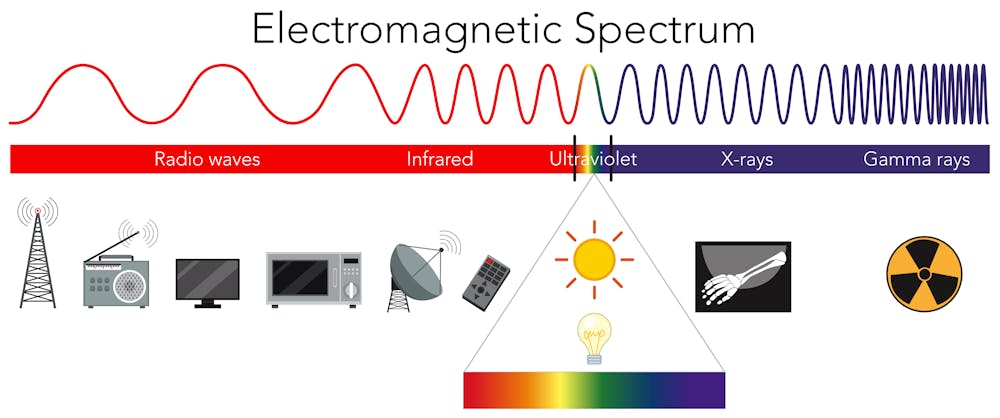
Read more: Explainer: what is the electromagnetic spectrum?
Is all radiation dangerous? Not really
Radiation is not always dangerous – it depends on the type, the strength, and how long you are exposed to it.
As a general rule, the higher the energy level of the radiation, the more likely it is to cause harm. For example, we know that overexposure to ionising radiation – say, from naturally occurring radon gas – can damage human tissues and DNA.
Read more: Have you tested your home for cancer-causing radon gas?
We also know that non-ionising radiation, such as the UV rays from the Sun, can be harmful if the person is exposed to sufficiently high intensity levels, causing adverse health effects such as burns, cancer, or blindness.
Importantly, because these dangers are well known and understood, they can be protected against. International and national expert bodies provide guidelines to ensure the safety and radiation protection of people and the environment.
For ionising radiation, this means keeping doses above the natural background radiation as low as reasonably achievable – for example, only using medical imaging on the part of the body required, keeping the dose low, and retaining copies of images to avoid repeat exams.
For non-ionising radiation, it means keeping exposure below safety limits. For example, telecommunications equipment uses radiofrequency non-ionising radiation and must operate within these safety limits.
Additionally, in the case of UV radiation from the Sun, we know to protect against exposure using sunscreen and clothing when levels reach 3 and above on the UV index.
Read more: What is the UV index? An expert explains what it means and how it's calculated
Radiation in medicine
While there are clear risks involved when it comes to radiation exposure, it’s also important to recognise the benefits. One common example of this is the use of radiation in modern medicine.
Medical imaging uses ionising radiation techniques, such as X-rays and CT scans, as well as non-ionising radiation techniques, such as ultrasound and magnetic resonance imaging (MRI).
Read more: The science of medical imaging: magnetic resonance imaging (MRI)
These types of medical imaging techniques allow doctors to see what’s happening inside the body and often lead to earlier and less invasive diagnoses. Medical imaging can also help to rule out serious illness.
Radiation can also help treat certain conditions – it can kill cancerous tissue, shrink a tumour or even be used to reduce pain.
So are our bodies also radioactive? The answer is yes, like everything around us, we are also a little bit radioactive. But this is not something we need to be worried about.
Our bodies were built to handle small amounts of radiation – that’s why there is no danger from the amounts we are exposed to in our normal daily lives. Just don’t expect this radiation to turn you into a superhero any time soon, because that definitely is science fiction.
Read more: There's no evidence 5G is going to harm our health, so let's stop worrying about it
Authors: Sarah Loughran, Director Radiation Research and Advice (ARPANSA), and Adjunct Associate Professor (UOW), University of Wollongong


















