

Modern Australian
The Times

This is what Australia needs to bring to Egypt for COP27

  • Written by Wesley Morgan, Research Fellow, Griffith Asia Institute, Griffith University
This is what Australia needs to bring to Egypt for COP27

Officials from nearly 200 nations are gathering in Sharm-El-Sheikh, Egypt, for the 27th United Nations climate change conference known as COP27. Multiple global crises threaten to overshadow the summit, but the task at COP27 over the next two weeks is more urgent than ever.

A report released today by the Climate Council shows the world is in the grip of a deepening climate crisis. Without more ambitious emission cuts this decade, we are headed for a full-blown catastrophe.

In this time of global volatility, Australia can play a key role. At COP27, Australian officials will be lobbying to co-host the UN climate talks with Pacific island countries.

But, to succeed in its bid, Australia will need to walk the talk. That means moving rapidly away from coal and gas, and helping developing nations to manage climate impacts.

Read more: 3 things a climate scientist wants world leaders to know ahead of COP27

Australia must show more ambition

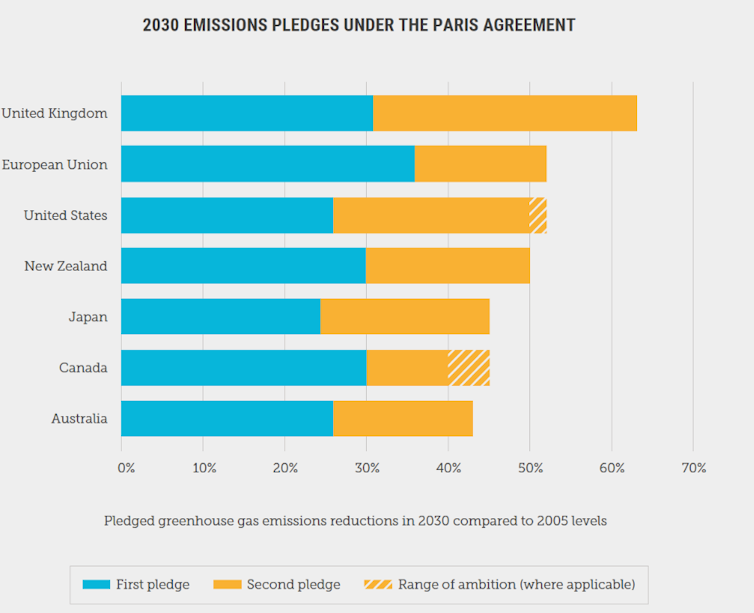
After a decade of denial and delay, Australia has rejoined the global shift toward a clean energy economy. However, Australia’s new 2030 target – to cut emissions by 43% from 2005 levels – is still one of the weakest in the developed world. And dozens of major fossil fuel projects remain in the pipeline.
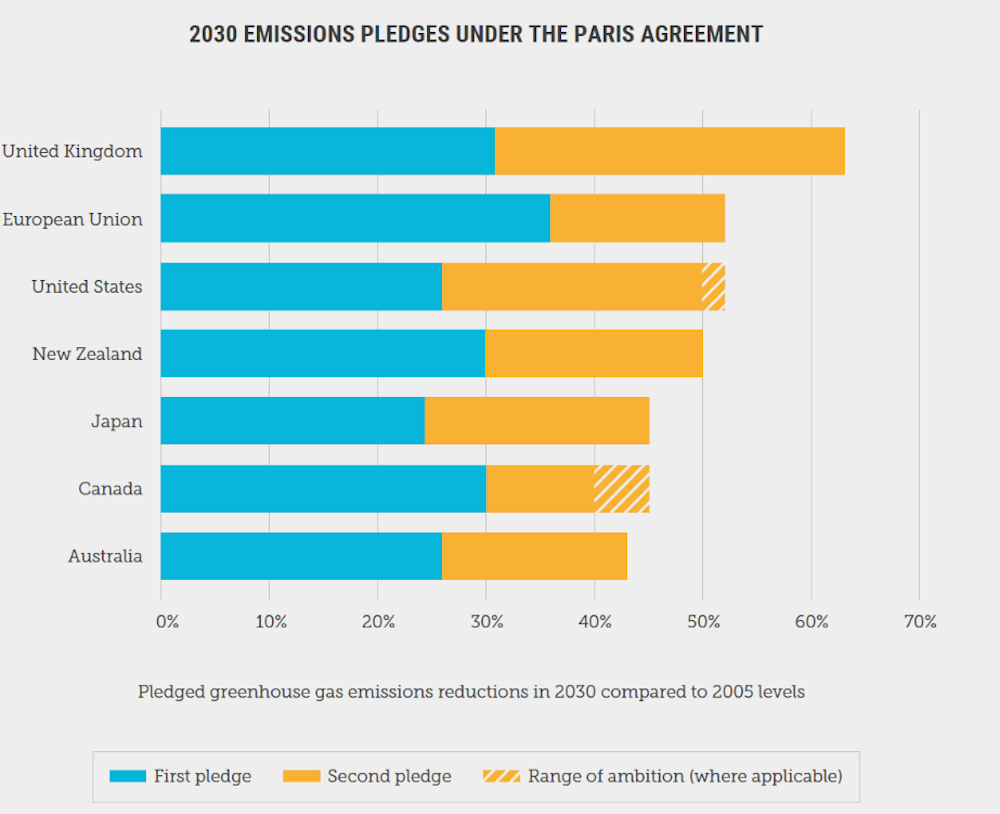
horizontal bar chart showing developed nations' emission reduction targets for 2030
Source: Climate Council of Australia, Author provided More ambition is needed. At COP27, Climate Change and Energy Minister Chris Bowen has a chance to signal that Australia intends to become a renewables superpower, exporting the clean energy commodities and critical minerals other nations need to decarbonise their economies. Australian diplomacy matters too. Australia is formally bidding to host a future round of UN climate talks, for the first time, in partnership with Pacific island nations. But a bigger role will come with bigger expectations. To demonstrate Australia’s climate credentials, Bowen will need to explain that our 2030 target is just a starting point. Pacific island nations will want to see Australia end public finance for fossil fuels and join the growing list of countries that have set a clear deadline for exiting coal. Australia will also be expected to commit more climate finance for developing countries and support a new global fund to address permanent loss and damage from climate change. Read more: Famine should not exist in 2022, yet Somalia faces its worst yet. Wealthy countries, pay your dues With a responsible international climate agenda, Australia could play a crucial role reinforcing global co-operation and brokering the next phase of climate action. We need delegates and world leaders to stay focused at COP27. Distraction will be deadly. A world of climate suffering Extreme weather records were broken on every continent this year. From Lismore to Lahore, records tumbled so fast it was hard to keep up. Australia recorded its equal-hottest day on record and its costliest flood disaster. Read more: Some councils still rely on outdated paper maps as supercharged storms make a mockery of flood planning China endured its most intense heatwave. In Pakistan, extreme floods affected more than 30 million people and killed thousands. Europe’s hottest summer on record smashed the record from just last year. The continent also suffered one of its worst ever droughts. UK temperatures topped 40℃ for the first time. The western United States also recorded its worst heatwave. In South Africa, record rainfall led to hundreds of deaths. Drought in East Africa has left millions at risk of starvation. These climate impacts, sadly, are just the beginning. They are occurring in a world that has warmed 1.2℃ since the Industrial Revolution, but it’s going to get worse. Even if all countries meet their targets for emission reductions by 2030, the world is headed for 2.4-2.6℃ of warming this century. Deeper cuts to emissions this decade can avoid worst-case scenarios. But we must act now. Global emissions must fall by 45% by 2030 to have any chance of achieving the Paris Agreement goal of limiting warming to 1.5℃. Geopolitics is driving clean energy race Even while climate records tumble, world leaders are focused on strategic rivalry between nations. It’s not all bad news, however. While competition may undermine joint action, it is also speeding up the shift to clean energy. The United States and China are competing to lead this transition. China is the world’s largest emitter and relies heavily on coal-fired power, but it’s also the global leader in clean energy production and deployment. Last year China built nearly half the world’s new renewable energy infrastructure. China also dominates global production of solar photovoltaics, batteries, wind turbines and electric vehicles. In September, the US Congress passed legislation authorising the largest climate spend in US history. The intention is to establish a clean energy manufacturing base in the US, and to displace China as a key supplier of components for solar, wind, batteries and electric vehicles. Read more: Heat pumps can cut your energy costs by up to 90%. It’s not magic, just a smart use of the laws of physics In Europe, Russia’s invasion of Ukraine has sped up the move away from fossil fuels, as it’s now also an issue of security. In May, the European Union set out a plan to cut Russian gas imports by two-thirds this year and end them altogether before the decade is out. The strategy will cut Europe’s overall gas use — not just Russian gas — by a third by 2030. It also sets more ambitious 2030 targets for renewable energy and energy savings, and requires rooftop solar installations on new buildings. As a result, the EU is expected to exceed its 2030 emissions target. European policymakers have agreed to formally strengthen the target next year. Competition among major powers is clearly accelerating, not slowing, the shift to clean energy. A majority of countries — representing more than 90% of the world economy — have committed to achieving net-zero emissions. Most of the developed world has pledged to at least halve emissions this decade. Australia is well placed to benefit from the global clean energy transition. At COP27 we must signal our shift from fossil fuel heavyweight to renewables superpower. Authors: Wesley Morgan, Research Fellow, Griffith Asia Institute, Griffith University

Read more https://theconversation.com/this-is-what-australia-needs-to-bring-to-egypt-for-cop27-193531

Choosing the Right Devices for a Flexible Workplace

For IT leaders managing large fleets, the device layer is where workforce productivity and security policy meet. The shift towards flexible and hybrid...

How Business Advisory Services Help Companies Achieve Sustainable Growth

Every business owner aims to build a profitable and sustainable organisation. While dedication, innovation, and hard work are important, achieving l...

Why Body Contouring Has Become A Popular Cosmetic Treatment

Many people maintain healthy lifestyles through regular exercise and balanced eating habits but still struggle with stubborn areas of fat that are dif...

How to Choose the Right POS Hardware for Your Business in Australia

A lot of Australian business owners spend weeks researching POS software but buy hardware almost as an afterthought. That's a mistake. The wrong har...

Why Material Handling Hose Is Critical for Industrial Efficiency

A high-performance material handling hose is an essential component in industries that transport abrasive, dry, or bulk materials on a daily basis...

How to Choose the Right Lawyer in Melbourne for Your Situation

Choosing legal support can feel difficult, especially when the stakes are personal or business-related. The right lawyer in Melbourne should underst...

Hoteliers Look to Clever Value Adds to Increase Revenue

The Australian hospitality industry is still in recovery mode after a notoriously rough patch in recent years. While there has been a post-COVID tra...

Moving to Queensland? Here’s How to Prep Your Car for the Big Move North

There’s no sign of the northern migration slowing down, with thousands of southerners fleeing from chaotic lifestyles and cooler climates for a brig...

Diesel Shortage to Impact Trades and Contractors

Strait of Hormuz blockage affecting all major parts of trades and construction Trades and construction across residential, commercial and industria...

Why Holiday Home Owners Turn to Rental Management Agents

The Allure — and the Reality — of Renting Out Your Property Owning a holiday home is a dream for many Australians. Whether it's a beachside sha...

Why Finding Reliable Doctors In Bundoora Is Important For Long-Term Health

Access to quality healthcare plays an important role in maintaining overall wellbeing and managing health concerns early. Trusted Doctors in Bundoor...

Understanding the Different Types of Car Services: Minor vs Major

When it comes to car maintenance, one of the most important things every vehicle owner should understand is the difference between a minor and a maj...

How Superannuation and TPD Insurance Work Together

Superannuation is an essential part of financial planning in Australia. It is designed to provide individuals with income during retirement, helping...

Tiny Towns funding granted for Mt Hotham and Mt Buller upgrades

Alpine Resorts Victoria (ARV) has welcomed funding support from the Victorian Government’s  Tiny Towns Fund, with both Mt Hotham and Mt Buller se...

Locksmith Services: Why Professional Security Solutions Matter More Than Ever

Security is a critical concern for homeowners, businesses, and vehicle owners alike. Whether it involves protecting a property, replacing damaged lo...

Why Tooth Fillings Are Important For Protecting Damaged Teeth

Cavities and minor tooth damage are common dental problems that can worsen if left untreated. Professional tooth fillings help restore damaged teeth, ...

The Connection Between Visibility and Driver Confidence

Operating a vehicle safely requires an immediate, uncompromised stream of visual information from the surrounding road environment. A driver's decis...

Important Things To Know Before Starting An SMSF Setup

Planning for retirement requires careful financial decisions, and many Australians are now looking for more direct control over how their superannua...

















