

Australian schools are starting to provide food, but we need to think carefully before we 'ditch the lunchbox'
- Written by: Brittany Johnson, Postdoctoral Research Fellow, Flinders University
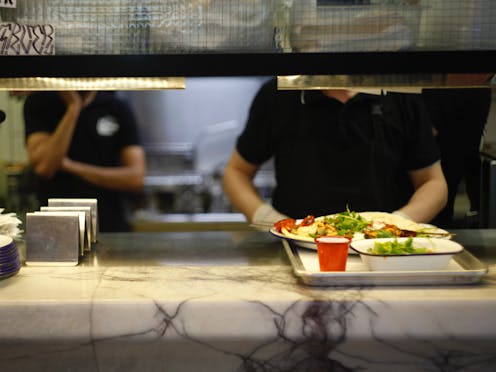
State Liberal leader Matthew Guy has promised a trial to provide free lunches in Victorian public schools if elected on November 26.
The A$300 million election policy is aimed at helping families with cost-of-living pressures, through an opt-in system sourcing meals from local business and cafes.
This idea is part of a small but growing trend in Australia to provide meals at schools. There are lots of good reasons to move away from kids bringing their own food to school.
But before we ditch the lunchbox, we need to think carefully about how we replace it.
Most Australian kids bring their lunch
In theory, about 90% of Australian children bring their own food to school, with 10% of children eating food bought from a school canteen or tuckshop, or via food relief programs.
We know the current system is failing to support children’s growth, health and development.
More than one-third of the food students eat at school is unhealthy (such as sweet and savoury biscuits, sugary muesli bars and chips), with most lunchboxes not having any vegetables.
We also know 15% of children arrive at school without lunch or money to spend at the canteen, when families have limited budgets.
This is not just a question of children going hungry or eating too many meat pies. Good nutrition during school years supports health, growth, concentration, brain development and academic achievement.
Why don’t we have school lunches in Australia?
One in two children around the world are provided with a meal at school.
Most high-income countries offer school-provided meals, such as the United States, United Kingdom, Finland, Sweden, France and Japan. New Zealand is moving from a “lunchbox system” to school meals, and Canada is also looking at the idea.
Apart from some breakfast programs – which target children from disadvantaged backgrounds – Australia hasn’t had a tradition of offering food at school. This is largely because we have had a lunchbox system for so long, it is simply the norm that parents are responsible for feeding their children.
But this is starting to change. There are now are several pilot projects aimed at providing food at the individual school level, exploring options within schools or with local businesses.
There are also pockets of schools trialling food programs around Australia, including in the Nothern Territory, Australian Capital Territory and Tasmania. This is either to address food access in remote areas or improve nutritious food at school.
A three-school pilot in Tasmania has recently been expanded to 30 schools in 2022-23. Schools in the pilot provide students with a cooked meal, based on a set menu, certain days of the week. Where meals are prepared and served varies depending on the school. School staff are noticing increased attendance on school lunch days and a boost to social skills and school connection.
Why are school lunches a good idea?
Providing food at school has many benefits. Not only does it save time-poor families time and energy (no more morning meal prep), but it makes sure all students have access to good food.
It can also create jobs and other opportunities to teach students about food production and healthy eating.
From an environmental perspective, it can cut down on packaging waste.
We know there is support
In our research, we asked teachers, parents, canteen managers, food relief workers, and health promotion officers to come up with ideas for how school food could be done differently in Australia.
This group said a school-provided lunch prepared onsite was likely to be most achievable and have an impact. By repurposing existing canteen facilities, schools could provide a nutritious, sit-down meal.
We also know there is support from parents. Depending on how the question is it framed, surveys have found support ranging from 53% to 86%.
Parents don’t necessarily expect lunches to be free, either. They are already spending on average $4 per child per day, and some are willing to pay similar or more for school-provided lunches.
But we need to think about these issues
But while we know there is a good level of support at the community level, swapping from from a predominantly lunchbox model to a school-provided meals system will take some work.
There are several things we need to consider – it’s not just a question of handing out cheese and ham sandwiches. If meals are going to be provided at school, they will need to accommodate different cultures, dietary needs and geographic areas.
It also needs to be sustainable. Funding needs to be ongoing, and food supply chains and waste need to be taken into account. Importantly, those who access the meals need to be able to do so without stigma.
This leads to questions of who is responsible for running this? If school-provided meals are going to be successful and embraced by school communities, they need support from families, governments, health and education experts, as well as primary industries.
Read more: A gutful of lunchbox hype – has selling 'good bugs not drugs' for kids' health gone too far?
Schools will also need the appropriate infrastructure, so there is a place for food to be prepared and eaten. Together with the produce and staffing, this leads to inevitable questions about costs and funding.
Finally, we also need to think about whether this is a universal or opt-in system. While many families will welcome food at school, some others may feel disempowered, and as though their choices are being removed.
What next?
School meals could provide so many benefits, from creating jobs to addressing food insecurity, supporting local food production, reducing the burden on parents, and supporting student wellbeing, attendance and school performance.
With pockets of enthusiasm and innovation occurring across Australia, it is time for a national conversation to help get universal school-provided lunches on the menu at schools across Australia.
Authors: Brittany Johnson, Postdoctoral Research Fellow, Flinders University


















