

navigating a city that wasn't planned for women
- Written by: Dorina Pojani, Senior Lecturer in Urban Planning, The University of Queensland
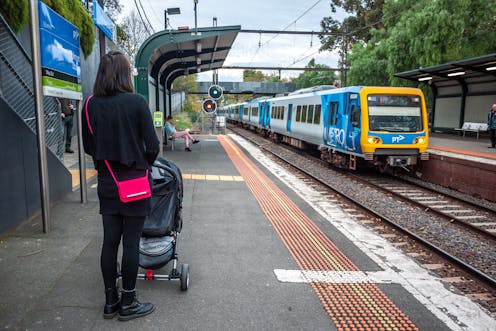
Chauffeur mums are a well-known Australian phenomenon. A lack of convenient transport options coupled with gendered roles has made many suburban women (and their children) car-dependent, whether they like it or not. And, more often than not, the demands of household chores and child rearing fall more heavily on women.
The car is the default option because public transport services are a poor fit for the complex travel patterns of working mothers. Schools and childcare are often not conveniently located close to either home or the workplace. Managing drop-offs in peak hour while trying to get to work on time can be a nightmare.
Lower workforce participation and higher rates of part-time and casual work among women are also sometimes due simply to the fact that women can’t get to work quickly and efficiently.
So many of the issues women face are a result of urban planning that hasn’t properly considered their needs. As one planner explained to researchers:
“The way that we learn and do planning in Australia is a derived Victorian model. The reasons why development is regulated and the way that planning is regulated and the language we use is hugely around those very white male concepts.”
These gendered impacts need to be placed at the heart of all stages of urban planning, an approach known as gender mainstreaming. Until this happens, our cities won’t be woman-friendly.
Read more: Sexism and the city: how urban planning has failed women
A blind spot in the quest for gender equality
The federal government’s recent Women’s Budget Statement recognises that “gender inequality is holding Australia back”. It commits the government to “advancing gender equality as a national priority and closing the gender gaps in our community”.
The government promises significant investments to support structural changes in favour of women. Key topics include women’s economic equality, safety, health and wellbeing. Better financial access – to housing, child care, health care and so on – is a recurring theme of the statement.
This is all highly desirable. What the federal budget fails to explicitly recognise is that poor urban planning causes, or makes worse, so many of the difficulties facing Australian women.
How is urban planning to blame?
The budget statement highlights, for example, the housing affordability crisis and a lack of shelters for homeless, battered women. But these issues are also part and parcel of urban planning.
Physical access to work is mentioned in relation to disability, but it affects able-bodied women as well. Part of the problem lies with the layout of our cities and the design of our public transport systems.
Inflexible trunk lines link suburbs to central business districts and run on rigid schedules. They do not cater well for trips that are not a simple commute, but which instead might involve various destinations across the suburbs.
On-demand services, such as those provided by ride-hailing companies, may better suit many women. So may micromobility services, such as bike-sharing, provided that dedicated, safe infrastructure is in place. Yet, unlike conventional public transport, those services are not subsidised in Australia.
Read more: 1 million rides and counting: on-demand services bring public transport to the suburbs
Gendered practices add to car dependence
Women generally drive less than men. But mothers who choose to shun cars can be stigmatised as immature or irresponsible. One study of car-free lifestyles notes:
“Here, parents are expected to ensure that their children have access to a range of after-school activities, even where these are located quite far apart. The onus is on the parents to drive their children any distance lest they miss out on opportunities for enrichment.”
These gendered practices are costly – and environmentally unfriendly – but the way we plan our cities forces women to adopt them.
The budget report contains a section on “climate change and gender” but does not elaborate on how the two may be related.
Read more: Children in the car era: bad for them and the planet
Another issue is physical access to childcare. The budget talks about “cheaper childcare”, which is obviously crucial. But where it’s located matters too.
If kindergartens are not integrated with people’s workplaces or placed near people’s homes, the extra travel to get to them lengthens and complicates women’s work days. A helpful intervention would be to require all large employers to provide childcare on site.
Finally, the budget statement treats gender-based violence as something that only occurs behind closed doors. But women lack safety in many public spaces too, even on public transport, leading to inequitable use.
According to an OECD report, only 61% of Australian women feel safe when walking alone at night in their suburb, compared to 77% of men. As a professional planner observed:
“I don’t think men realise that women travel through the city differently. […] I had the experience of walking along the bike path the other evening and a jogger came up behind me, and instinctively I thought, ‘Is this OK? Is it a safe situation?’ But men don’t have those moments, even if they’re fleeting moments. I understand that statistically young men are much more likely to be victims of violent street crime than women. But women are more fearful, and that perception changes behaviour.”
Read more: What does the 'new normal’ look like for women’s safety in cities?
Put gender at the heart of planning
In future, the women’s budget might benefit from being structured around the concept of gender mainstreaming. In urban planning, it means gender issues are considered in all stages and aspects of the process: research, advocacy, dialogue, legislation, resourcing, implementation and evaluation.
In Australia, city planning rarely applies comprehensive gender mainstreaming techniques. Yet a number of generic toolkits and guidelines are available.
The United Kingdom’s Royal Town Planning Institute produced one of the first of these resources in 2003. This year, the global consultancy Arup, together with the United Nations Development Programme and the University of Liverpool, released a gender mainstreaming guide, which contains a wealth of best practice examples from around the world.
In addition, the World Bank, the Asian Development Bank, the African Development Bank and the United Nations all have released gender mainstreaming toolkits and guides for various urban planning subfields, such as transport or international development.
Read more: Crowd-mapping gender equality – a powerful tool for shaping a better city launches in Melbourne
It is time for Australia to follow suit, based on the premise that women-friendly cities work better for all. But a note of caution: generic gender-mainstreaming solutions will need to be tailored to work in the Australian context. Cookie-cutter policies and targets are not the way to go.
Authors: Dorina Pojani, Senior Lecturer in Urban Planning, The University of Queensland

















