

The criminal legal system does not deliver justice for First Nations people, says a new book
- Written by: Chris Cunneen, Professor of Criminology, University of Technology Sydney
This article contains information on deaths in custody and the violence experienced by First Nations people in their encounters with the Australian carceral system. It also contains references to and the names of people who are now deceased.
Early in Russell Marks’ book, Black Lives, White Law, he tells us that while he was writing it, at least 37 First Nations people died in Australia’s criminal justice system.
During the time I’ve been writing this review, we have listened to the coroner’s inquiry into the killing of Warlpiri teenager Kumanjayi Walker and seen (again) the racism and violence of police: from casual text messages commending physical assaults, to the use of deadly force against a young man, when there were multiple other options available.
And then came the death of Noongar 15-year-old Cassius Turvey who was fatally attacked in Perth last month. The immediate police response was to evade claims of racism in his alleged murder. “It may be a case of being in the wrong place at the wrong time,” speculated Western Australia’s police commissioner, saying he was “not operating on any principles of racism or motivation at this point”.
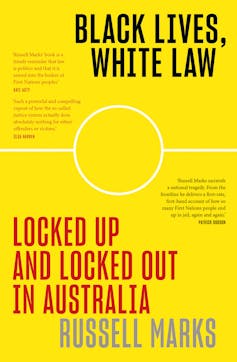
Review: Black Lives, White Law: Locked Up and Locked Out in Australia – Russell Marks (La Trobe University Press)

 Leetona Dungay, the mother of the late David Dungay Jr, announces she will go to the United Nations to hold the federal and NSW governments to account for their failure to stop First Nations deaths in custody.
Dan Himbrechts/AAP
During the period from the initial invasion of Australia through the 19th century, “the sheer brutality of the frontier violence by the invading British” was difficult to believe. And, like today, the concept of justice itself “meant remarkably different things to a Supreme Court Judge in a capital city [compared to] an Indigenous person who had survived a massacre of their family and community”.
The denial of Aboriginal experiences of colonisation has been compounded by a select reading of the colonial reality: that the legal story of Australia was one of British settlement, and Aboriginal people were neither recognised as sovereign, nor permitted to exercise their own laws.
Black Lives, White Law follows a fairly well-trodden historical path of settler-colonial interventions into Aboriginal life. It includes the more recent history of the Royal Commission into Aboriginal Deaths in Custody, and the Northern Territory Intervention and beyond. And it traces the growth in incarceration rates from the late 1980s onwards.
Australian governments have often rhetorically committed to reducing Aboriginal imprisonment. But in real terms, over the past few decades, imprisonment in general has increased, thanks to punitive laws and policies: a 130% increase (measured from 1985 to 2018). For First Nations people, imprisonment rates have increased drastically – they’ve more than doubled during that same period.
And they’re now proportionally higher than Black American imprisonment rates. In 2007, the Black American incarceration rate in the United States was 75% higher than the Indigenous rate in Australia. But ten years later, in 2017, Australia’s Indigenous incarceration rate for the first time exceeded the Black American rate.
Marks discusses the limitations of imprisonment as a crime control strategy. He notes, “it is an extraordinarily expensive and inefficient way of controlling crime”. I would have preferred to see this argument pushed beyond the pragmatic rationale of money and inefficiency, to question whether locking children, young people and adults in cages is ever justified.
Leetona Dungay, the mother of the late David Dungay Jr, announces she will go to the United Nations to hold the federal and NSW governments to account for their failure to stop First Nations deaths in custody.
Dan Himbrechts/AAP
During the period from the initial invasion of Australia through the 19th century, “the sheer brutality of the frontier violence by the invading British” was difficult to believe. And, like today, the concept of justice itself “meant remarkably different things to a Supreme Court Judge in a capital city [compared to] an Indigenous person who had survived a massacre of their family and community”.
The denial of Aboriginal experiences of colonisation has been compounded by a select reading of the colonial reality: that the legal story of Australia was one of British settlement, and Aboriginal people were neither recognised as sovereign, nor permitted to exercise their own laws.
Black Lives, White Law follows a fairly well-trodden historical path of settler-colonial interventions into Aboriginal life. It includes the more recent history of the Royal Commission into Aboriginal Deaths in Custody, and the Northern Territory Intervention and beyond. And it traces the growth in incarceration rates from the late 1980s onwards.
Australian governments have often rhetorically committed to reducing Aboriginal imprisonment. But in real terms, over the past few decades, imprisonment in general has increased, thanks to punitive laws and policies: a 130% increase (measured from 1985 to 2018). For First Nations people, imprisonment rates have increased drastically – they’ve more than doubled during that same period.
And they’re now proportionally higher than Black American imprisonment rates. In 2007, the Black American incarceration rate in the United States was 75% higher than the Indigenous rate in Australia. But ten years later, in 2017, Australia’s Indigenous incarceration rate for the first time exceeded the Black American rate.
Marks discusses the limitations of imprisonment as a crime control strategy. He notes, “it is an extraordinarily expensive and inefficient way of controlling crime”. I would have preferred to see this argument pushed beyond the pragmatic rationale of money and inefficiency, to question whether locking children, young people and adults in cages is ever justified.
 A Melbourne rally on 18 June 2022: a national day of action calling for justice for Aboriginal deaths in custody.
Diego Fedele/AAP
Read more:
Friday essay: 'not for me' – Amy Thunig on the stigma of having a dad in 'lock-up', and the embrace of Indigenous academia
Carceral feminism and youth imprisonment
In the final chapters, Marks explores some of the major issues in the criminalisation of First Nations people. He turns his attention to the matter of carceral feminism – that is, the approach to solving the problem of violence against women through an increasing reliance on the criminalisation and incarceration of men.
Examples of carceral feminism include increasing penalties for domestic violence orders (DVOs), the criminalisation of coercive control, and current suggestions of “women only” staffed police stations.
Marks argues the criminal legal system is incapable of solving the problem of violence against First Nations women for various reasons, and its current approach has resulted in the increased imprisonment of both men and women. He cites figures from Queensland that show two-thirds of women sentenced to prison for breaches of domestic violence orders are Indigenous.
Marks also takes aim at the youth legal system, which continues to incarcerate and brutalise children – but particularly First Nations children, who comprised around 50% of all children locked up at the time he was writing the book.
He draws on the Royal Commission into the Protection and Detention of Children in the Northern Territory to understand the violence and harm caused by the juvenile carceral system, which traumatises children who are often already traumatised (before they were imprisoned). This is exemplified by the experiences of Dylan Voller and others in Darwin’s Don Dale Youth Detention Centre – including violent assaults by staff, teargassing, and solitary confinement.
Marks also uses the NT royal commission to demonstrate the government’s failure to act on recommendations to remedy clearly identified problems. It continues to incarcerate young people in substandard conditions, and fails to seriously consider options that could substantially reduce youth imprisonment.
Read more:
Carceral feminism and coercive control: when Indigenous women aren't seen as ideal victims, witnesses or women
Community safety
The book explores what First Nations people are doing in the struggle to ensure safety within their communities. These include community (or “night”) patrols, law and justice groups, community justice groups and various community-generated approaches – from justice reinvestment to individual programs for helping young people in the community. And there’s the development of Aboriginal sentencing courts (such as the Murri court and Koori court), where First Nations people play a role in advising the court on criminal matters.
These initiatives have received inconsistent support (at best) from the state, and are often undermined by the scepticism of police, magistrates and other state officials. Marks questions the power of these courts to change the dominant Western legal system, when the law ultimately enforced is still the law of the settler state.
Yet Indigenous people continue to fight for their right to control community safety. After the fatal shooting by police of Kumanjayi Walker, the elders of Yuendumu released a statement demanding greater power to make decisions. They unambiguously stated that their night patrol and community police should be at the forefront of ensuring their community’s wellbeing.
A Melbourne rally on 18 June 2022: a national day of action calling for justice for Aboriginal deaths in custody.
Diego Fedele/AAP
Read more:
Friday essay: 'not for me' – Amy Thunig on the stigma of having a dad in 'lock-up', and the embrace of Indigenous academia
Carceral feminism and youth imprisonment
In the final chapters, Marks explores some of the major issues in the criminalisation of First Nations people. He turns his attention to the matter of carceral feminism – that is, the approach to solving the problem of violence against women through an increasing reliance on the criminalisation and incarceration of men.
Examples of carceral feminism include increasing penalties for domestic violence orders (DVOs), the criminalisation of coercive control, and current suggestions of “women only” staffed police stations.
Marks argues the criminal legal system is incapable of solving the problem of violence against First Nations women for various reasons, and its current approach has resulted in the increased imprisonment of both men and women. He cites figures from Queensland that show two-thirds of women sentenced to prison for breaches of domestic violence orders are Indigenous.
Marks also takes aim at the youth legal system, which continues to incarcerate and brutalise children – but particularly First Nations children, who comprised around 50% of all children locked up at the time he was writing the book.
He draws on the Royal Commission into the Protection and Detention of Children in the Northern Territory to understand the violence and harm caused by the juvenile carceral system, which traumatises children who are often already traumatised (before they were imprisoned). This is exemplified by the experiences of Dylan Voller and others in Darwin’s Don Dale Youth Detention Centre – including violent assaults by staff, teargassing, and solitary confinement.
Marks also uses the NT royal commission to demonstrate the government’s failure to act on recommendations to remedy clearly identified problems. It continues to incarcerate young people in substandard conditions, and fails to seriously consider options that could substantially reduce youth imprisonment.
Read more:
Carceral feminism and coercive control: when Indigenous women aren't seen as ideal victims, witnesses or women
Community safety
The book explores what First Nations people are doing in the struggle to ensure safety within their communities. These include community (or “night”) patrols, law and justice groups, community justice groups and various community-generated approaches – from justice reinvestment to individual programs for helping young people in the community. And there’s the development of Aboriginal sentencing courts (such as the Murri court and Koori court), where First Nations people play a role in advising the court on criminal matters.
These initiatives have received inconsistent support (at best) from the state, and are often undermined by the scepticism of police, magistrates and other state officials. Marks questions the power of these courts to change the dominant Western legal system, when the law ultimately enforced is still the law of the settler state.
Yet Indigenous people continue to fight for their right to control community safety. After the fatal shooting by police of Kumanjayi Walker, the elders of Yuendumu released a statement demanding greater power to make decisions. They unambiguously stated that their night patrol and community police should be at the forefront of ensuring their community’s wellbeing.
 Warlpiri Elder from Yuendumu, Ned Jampijinpa Hargraves, speaks to the media outside the Northern Territory Supreme Court.
Aaron Bunch/AAP
They demanded Warlpiri law be recognised and respected. They demanded a role in assessing and evaluating every police officer who comes to work in their community. And they demanded police in their community not be armed with guns and other lethal weapons.
These are radical demands, but they are completely consistent with the localised control over policing that First Nations peoples have insisted on for decades. After Rolfe’s acquittal for the murder of Kumanjayi Walker, Ned Tjampitjinpa Hargraves, a Yuendumu Elder and Lawman, stated:
The court didn’t take action, so we need to take action on the ground in our communities to protect ourselves … We have waited for too long.
Aboriginal justice
There is some discussion of Aboriginal justice agreements in the book, although it’s relatively short. A more nuanced discussion of their role would have been useful. It’s especially relevant for the Northern Territory, where the current Aboriginal Justice Agreement (2021-2027) is being implemented. (I note this particularly in the context of Hargraves’ comments, and the Yuendumu demands.)
One of the core principles underpinning the agreement is a commitment to local decision-making on a range of matters concerning law and justice. No doubt it will be a struggle for communities to ensure this principle is acted on in practice.
The outcome of First Nations struggles for recognition and autonomy from the settler-colonial state are not predetermined – and the end result is far from certain. The settler-colonial state is not a finished product.
The conflict between Indigenous governance and the settler state may result in new legal and administrative spaces: neither completely decolonised nor completely colonial, but reflecting a point in time. Incomplete in themselves, in an enduring political and historic conflict.
In the conclusion of Black Lives, White Law, Marks acknowledges the book is not about solutions; it’s about identifying the problems. This book certainly does that, comprehensively.
Marks does not pretend to have all the answers – unlike so many whitefellas before him, all too anxious to push their own barrows of policies and programs. And there are multiple different ways the future may unfold.
What’s clear is that mass criminalisation and incarceration is not justice and it is not a solution for First Nations people. Though it appears a convenient way for the settler state to avoid coming to terms with its own history of dispossession, genocide and racism.
Authors: Chris Cunneen, Professor of Criminology, University of Technology Sydney
Warlpiri Elder from Yuendumu, Ned Jampijinpa Hargraves, speaks to the media outside the Northern Territory Supreme Court.
Aaron Bunch/AAP
They demanded Warlpiri law be recognised and respected. They demanded a role in assessing and evaluating every police officer who comes to work in their community. And they demanded police in their community not be armed with guns and other lethal weapons.
These are radical demands, but they are completely consistent with the localised control over policing that First Nations peoples have insisted on for decades. After Rolfe’s acquittal for the murder of Kumanjayi Walker, Ned Tjampitjinpa Hargraves, a Yuendumu Elder and Lawman, stated:
The court didn’t take action, so we need to take action on the ground in our communities to protect ourselves … We have waited for too long.
Aboriginal justice
There is some discussion of Aboriginal justice agreements in the book, although it’s relatively short. A more nuanced discussion of their role would have been useful. It’s especially relevant for the Northern Territory, where the current Aboriginal Justice Agreement (2021-2027) is being implemented. (I note this particularly in the context of Hargraves’ comments, and the Yuendumu demands.)
One of the core principles underpinning the agreement is a commitment to local decision-making on a range of matters concerning law and justice. No doubt it will be a struggle for communities to ensure this principle is acted on in practice.
The outcome of First Nations struggles for recognition and autonomy from the settler-colonial state are not predetermined – and the end result is far from certain. The settler-colonial state is not a finished product.
The conflict between Indigenous governance and the settler state may result in new legal and administrative spaces: neither completely decolonised nor completely colonial, but reflecting a point in time. Incomplete in themselves, in an enduring political and historic conflict.
In the conclusion of Black Lives, White Law, Marks acknowledges the book is not about solutions; it’s about identifying the problems. This book certainly does that, comprehensively.
Marks does not pretend to have all the answers – unlike so many whitefellas before him, all too anxious to push their own barrows of policies and programs. And there are multiple different ways the future may unfold.
What’s clear is that mass criminalisation and incarceration is not justice and it is not a solution for First Nations people. Though it appears a convenient way for the settler state to avoid coming to terms with its own history of dispossession, genocide and racism.
Authors: Chris Cunneen, Professor of Criminology, University of Technology Sydney 
















