

Tensions and war undermine climate cooperation – but there's a silver lining
- Written by Hao Tan, Associate Professor, Newcastle Business School, University of Newcastle
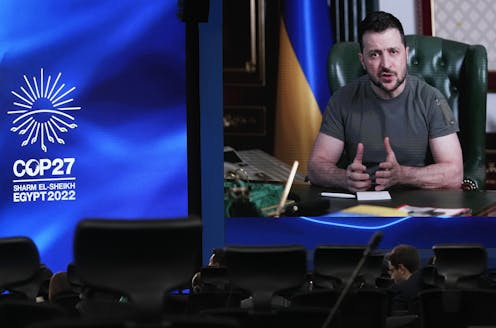
In retrospect, last year’s climate talks in Glasgow look like a dream. International cooperation on methane emissions and deforestation. Acknowledgement of the urgency of the task. The world beginning to rise to the challenge, as it did to the pandemic.
A lot has changed in a year. This week’s COP27 climate conference in Egypt comes amid war and disaster. Russia’s invasion of Ukraine saw fossil fuel prices spike and old coal plants temporarily reopen, while renewed tensions between the United States and China have cast a shadow over climate cooperation between the world’s top two carbon emitters.
You might think nations could put their tensions aside when it comes to climate change, which puts all of us – and our children – at risk. But so far, the signs are not great. At Glasgow, all 193 nations involved agreed to increase the ambition of their climate pledges. But on the eve of COP27, just over two dozen had actually done so.
While territorial tensions risk taking our focus away from the existential threat of climate change, there are positive signs such as a new rush to green energy on security grounds.

What’s the link between geopolitics and climate action?
Politics and war tend to be separated in media coverage from climate change and environmental disasters. But they’re closely connected.
Military conflict – actual or threatened – strains diplomatic relationships. This makes collective action on any issue more difficult – even an existential threat like climate change. In August, the G20 climate talks in Bali failed to produce a joint statement, largely due to Russia’s controversial presence amid its ongoing invasion of Ukraine. That same month, China suspended bilateral climate talks with Washington after US House Speaker Nancy Pelosi visited Taiwan, which Beijing sees as a breakaway province.
Geopolitical tensions also draw our leaders’ attention away from climate change. Leaders instead focus on immediate issues such as inflation, economic instability or energy security. Russia’s invasion sparked a global energy crisis and caused grave energy security concerns in many countries, including Australia.
What’s happening right now?
From the outside, it might look bleak. Many European countries appear to have watered down their climate ambitions to tackle the immediate energy crisis over the northern winter. In June, some moved to reactivate old coal plants to shore up energy security and avoid Russian gas. In July, the European Parliament voted to reclassify natural gas and nuclear energy as green investments, which could trigger a private investment wave. European countries have moved to boost non-Russian supplies of oil and gas from African and Middle Eastern suppliers, and scrambled to build new liquefied natural gas (LNG) terminals.
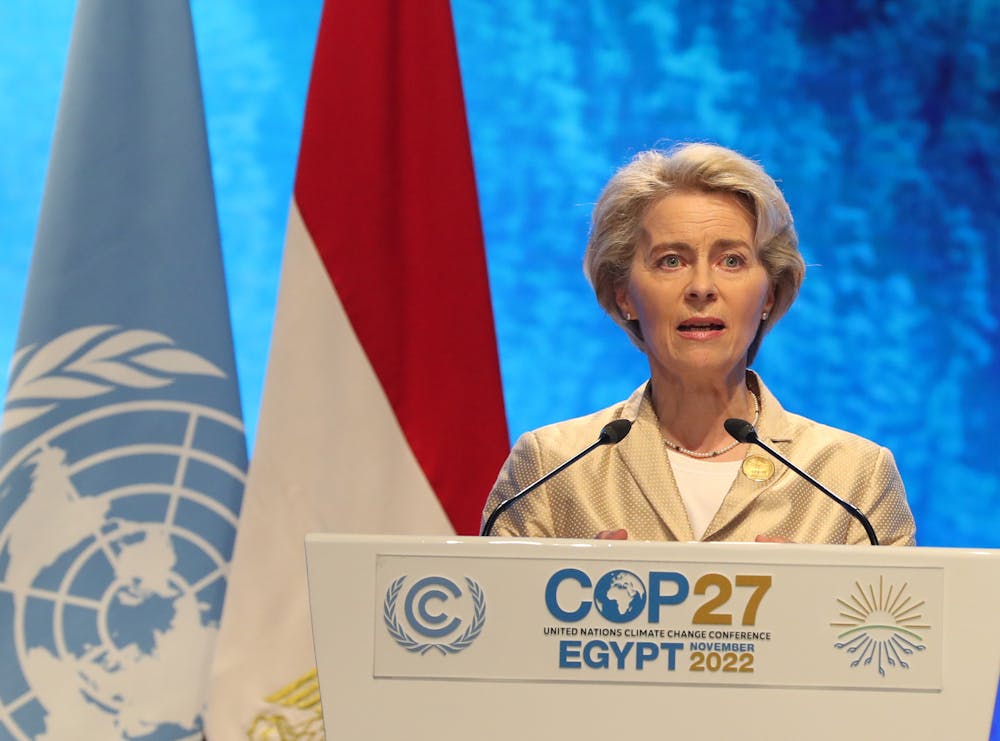 Europe has had to juggle climate action with immediate energy security this year. Pictured is.
European Commission President Ursula von der Leyen.
Khaled Elfiqi/AP
Europe has had to juggle climate action with immediate energy security this year. Pictured is.
European Commission President Ursula von der Leyen.
Khaled Elfiqi/AP
The energy crisis is less intense in the US, which has domestic supplies of gas and oil from fracking. Even so, the crisis could be used by some Republicans to push for “enhanced energy independence” – essentially, more oil and gas.
In China, election cycles are obviously not a concern. While President Xi Jinping has a strong personal commitment to environmental protection and green development, his authoritarian tendencies cast a shadow over China’s climate actions in the longer term. Authoritarian regimes are by their nature centralised. That means major policies could reverse abruptly if Xi’s priorities change – or if another leader takes over.
You can see the impact of international tensions and domestic consequences by who’s missing from the COP27 guest list. Leaders from many high-emitting nations are skipping the conference altogether, including China’s Xi Jinping, Russia’s Vladimir Putin and India’s Narendra Modi.
The case for optimism: look to the new momentum
It’s not an auspicious start for the conference billed as the moment when talk turns into actions.
But it is by no means all doom and gloom. Pro-coal leaders in Brazil and Australia have been voted out this year, with climate change and environmental concerns key factors for voters. The intensifying droughts and floods we’ve seen this year tends to boost votes for “green” political parties.
And geopolitical tensions are leading to accelerated investment and commitment to renewables. The International Energy Agency notes “energy security concerns reinforce the rise of low-emissions sources and efficiency”.
For the US, competition with China is accelerating the clean energy transition. The Biden administration this year approved A$570 billion of investment for emissions reduction and clean technology. Internally, renewables are regarded as vital in America’s intensifying rivalry with China. Perhaps we don’t always need cooperation – the emerging US-China clean energy race will benefit us all.
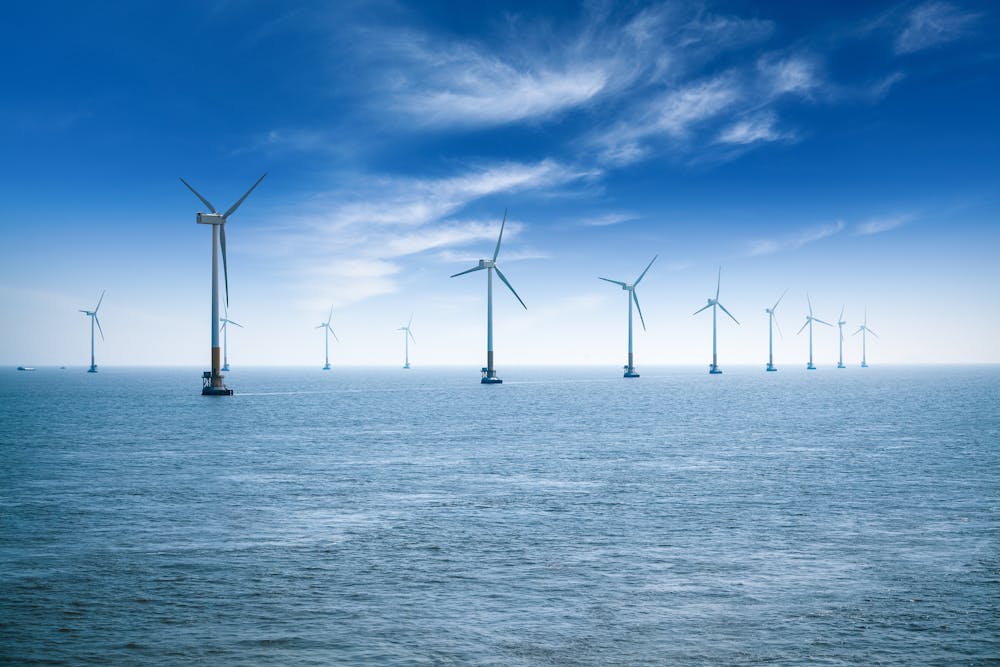 China is pressing ahead with major clean energy plans.
Shutterstock
China is pressing ahead with major clean energy plans.
Shutterstock
For its part, China is powering ahead on renewables, taking advantage of its manufacturing prowess. Last year, it spent A$411 billion on low-carbon energy, up 60% from 2020. That’s more than a third of the global total. And China’s solar cell factories are preparing to pump out truly enormous quantities in the next few years.
China is usually pragmatic about climate, seeing clean energy as a way to develop internationally competitive industries, and to build energy security through manufacturing renewables and contribute to its goal of “national rejuvenation”. It will push on with the clean energy transition regardless of the outcomes of climate summits. This year’s unprecedented drought and heatwaves in China’s south will make climate front of mind for party leaders.
Other developed countries are finally stumping up to help developing countries reduce emissions and adapt to new climatic conditions. Denmark has offered to pay A$20 million to developing nations damaged by climate change. That’s the first offer of this kind by a developed country.
Climate talks never occur in a vacuum. While this year’s talks are particularly fraught, we can rise to the challenges. Uncertainty is everywhere – but that doesn’t have to mean climate disaster. These overlapping tensions and crises could speed up the shift away from fossil fuels.
Read more: Will war in Ukraine hasten the end of fossil fuels?
Authors: Hao Tan, Associate Professor, Newcastle Business School, University of Newcastle

















