

'What am I supposed to do about all this really bad stuff?' Young people identify 7 'superpowers' to fight climate change
- Written by: Phoebe Quinn, Research Fellow, The University of Melbourne
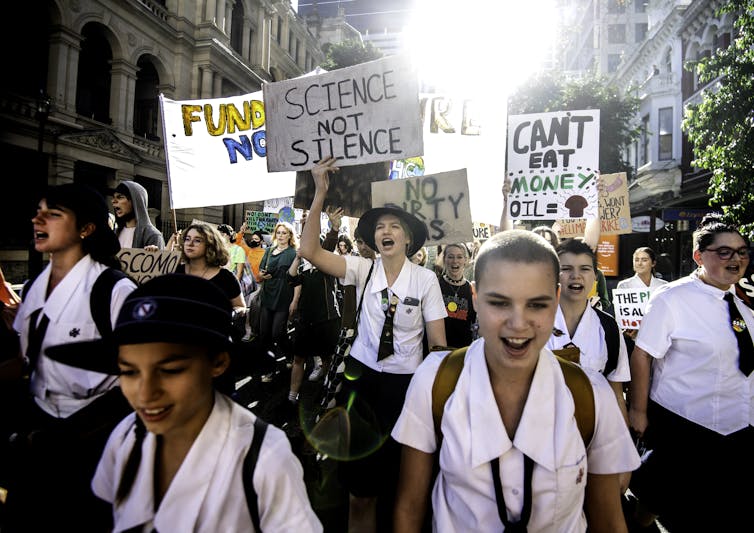
Many young people feel anxious, powerless, sad and angry about climate change.
Although there are some great resources on children’s eco-anxiety and climate distress, the vast majority are designed for and by adults.
So, what resources do children and young people themselves want, to support them in facing climate change? And what strengths do they have when it comes to learning about, coping with and acting on this vast and complex problem?
Read more: Climate change's impact on mental health is overlooked and misunderstood – here's what can be done
Our study involved young people
To find out, we ran a series of workshops with 31 young people aged 12 to 25 in Victoria. The aim was to design a website for other children and young people who are concerned about climate change.
The young co-designers told us about the unique strengths or “superpowers” children and young people have, and how they can draw on these in the face of climate change.
They shared stories and tips from their own experiences, as well as from the experiences of their friends, siblings, or young people they had read or heard about.
What do you young people want?
The co-designers said young people want opportunities to share these experiences and learn from each other, and for adults to genuinely engage with them. As one participant told us:
Make it in a way that’s not tokenistic.
They also said website needed to focus on “something I can do”. As another participant said:
I found initially when learning about climate change, and everything was very overwhelming, because it was all very big scale global issues. And then I got stuck on what am I supposed to do about all this really bad stuff happening?
The young co-designers recognise young people have diverse circumstances, skills, interests and experiences of climate change. They wanted to create a website that was inclusive and flexible, so each young person could choose what they wanted to focus on.
For example, one young person described the different ways young people can contribute to climate justice:
Some people interpret [climate justice] as like, literally striking every day, or like talking to their politicians […] And then there’s also [those who] stop eating meat. I think thinking about how everyone interprets it differently, it’s also really important.
The young co-designers also said young people wanted resources that are visually engaging and interactive:
We want to make it interesting and exciting for everybody.
Finally, young people said the website itself shouldn’t harm the environment – it should be powered by renewable energy, with no hard copies of the information.
Read more: How do we teach young people about climate change? We can start with this comic
The 7 climate superpowers
Based on these principles and stories, we created a draft website and then adapted it in response to their feedback. We also worked with artist Thu Huong Nguyen to create visual interpretations of the ideas from the workshops.
The result is the Your Climate Superpowers website, which is aimed at children, young people, and the adults in their lives looking for ways to deal with climate distress.
It features seven types of “climate superpower”:
1. Social: this is about building connections or trust with other people - it could be as simple as talking with family and friends when you feel worried about climate change.
2. Human: these are your own skills, knowledge, experiences and talents and can include creative and technological skills and volunteering.
3. Cultural: this is about understanding and knowing the world, and how you act within it. This could involve cultural practices and values that help take care of the environment.
4. Political: this is about influencing governments but also people and communities. It could involve going to rallies, signing petitions or voting a certain way.
5. Financial: this doesn’t necessarily mean you have a lot of money – it could be shopping sustainably, volunteering, or influencing how others spend their money.
6. Built: this involves transforming the built environment and things we use so they are more sustainable – it could involve things like riding a bike, or influencing your family to buy solar panels.
7. Natural: are activities that help you connect to nature to do something about climate change. It could include gardening, going for a bushwalk, composting and caring for Country.
Secret missions
Children and young people can take a quiz to find out what their strongest climate superpowers are. Then they can explore “secret missions” they can take on using these superpowers.
There are 120 missions, all based on the stories and ideas shared by the young co-designers. There are missions for learning about climate change, taking everyday action, transforming society and self-care.
Read more: Yes, young people are concerned about climate change. But it can drive them to take action
These range from documentaries to watch, to tips on dealing with eco-anxiety, sustainable shopping guides, how to make sure recycled toilet paper is used at school, and tips for engaging with your local council or local MP.
Climate change is a complicated problem. To tackle it, we need all sorts of people working on all sorts of missions, big and small.
That includes young people, who have superpowers they want to use to take care of themselves, each other and the planet.
This project was funded by a Climate Research Accelerator Grant from Melbourne Climate Futures at the University of Melbourne.
Authors: Phoebe Quinn, Research Fellow, The University of Melbourne


















