

ASEAN leaders give 'in-principle' support for Timor-Leste's membership. What does this actually mean?
- Written by: Rebecca Strating, Director, La Trobe Asia and Associate Professor, La Trobe University, La Trobe University
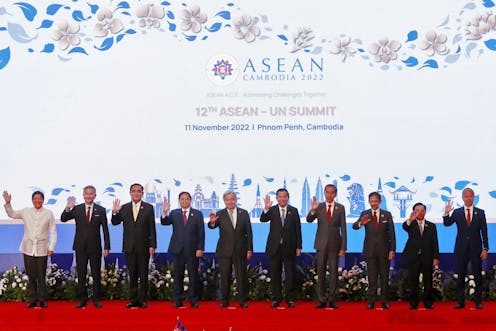
On Friday, leaders of the Association of Southeast Asian Nations (ASEAN)’s member states provided a statement announcing “in-principle” support for Timor-Leste to be admitted as its 11th member. So does this mean Timor-Leste’s long wait to become a member of ASEAN is finally over? The short answer is not quite.
It is a positive development that all 10 ASEAN states - Cambodia (current ASEAN chair), Indonesia, Singapore, Brunei, Malaysia, Thailand, Myanmar, Philippines, Laos and Vietnam - appear to have agreed to the move. However, the statement was unclear about when and how Timor-Leste would achieve full membership.
Timor-Leste will not immediately join the association. It will be granted observer status and allowed to participate in ASEAN meetings. The only other state with observer status is Papua New Guinea (PNG).
Since becoming independent in 2002, Timor-Leste has existed outside the region’s defining institution, despite being widely considered a Southeast Asian state. It was also seen to belong in ASEAN when it was incorporated in Indonesia.
Timor-Leste’s hard road to membership
Timor-Leste first applied for membership in 2011 when Indonesia was ASEAN chair. Successive Timorese governments have wanted the country to join ASEAN in order to advance national, security and economic interests, and alleviate some of the vulnerabilities that come with being a small state in an increasingly contested region.
The 2011 Timor-Leste Strategic Development Plan envisaged the nation becoming a full ASEAN member by 2015.
Part of the challenge for Dili was convincing Southeast Asian leaders of the value it would bring to the association. Technically, the ASEAN Charter stipulates four criteria for membership:
- geographical location
- recognition by other states
- agreement to be bound by the ASEAN charter
- ability and willingness to carry out obligations of membership.
It is the last criterion that has been the most troublesome.
As a consensus-based organisation, all 10 existing ASEAN states must agree to admit Timor-Leste. This is not an easy task, given these states have different national interests, political regimes, and levels of economic and social development. This has contributed to perceptions that ASEAN is slow-moving and divided on critical issues, such as the South China Sea and the Myanmar crisis.
There was speculation that Timor-Leste’s growing ties with China could mean it would become a “trojan horse” for Beijing within ASEAN. This overstated China’s influence in the country and understated Dili’s desire for foreign policy independence.
There were also concerns about further expansion of ASEAN given some of the dilemmas presented by Myanmar’s membership, and concerns around domestic instability and conflict.
Singapore in particular was sceptical about Timor-Leste’s economic and political prospects. It was also concerned Timor-Leste’s membership would undermine its plan for greater economic integration across the bloc.
Given this history, some interesting questions emerge from this announcement. Has Singapore’s leadership altered its view on Timor-Leste’s membership? If so, why?
Does ASEAN think Timor-Leste is “ready” for membership?
Over the past decade, Timor-Leste has undergone a series of reviews regarding its fitness to be an ASEAN member. ASEAN has three community pillars: political-security, economic, and socio-cultural. In 2016, the community pillars engaged in independent studies that found Timor-Leste needed capacity-building to meet membership requirements. Since then, the pillars have completed fact-finding missions to assess Timor-Leste’s reforms and human resource capacities.
Several of ASEAN’s joint communiques also framed Timor-Leste’s future membership eligibility in terms of “capacity-building”, including in 2021.
Yet, ASEAN’s precise membership standards for Timor-Leste remain unclear. In the statement, ASEAN’s leaders agreed they would formalise an “objective fact based criteria-based roadmap” for Timor-Leste’s full membership, including “milestones” that Timor-Leste would have to meet. The aim is for the roadmap to be adopted at ASEAN’s 42nd summit in 2023, when Indonesia will be chair.
The final point of agreement is perhaps the most revealing. The leaders have committed to helping Timor-Leste build its capacity to meet the milestones that will be set out in the roadmap. It seems there may be at least some ASEAN leaders who consider Timor-Leste not yet ready for membership and needing further assistance to meet the entry standards.
The continuing emphasis on capacity building and the absence of a clear timeline could mean the announcement is another stalling tactic.
More optimistically, though, ASEAN might be viewed as an institution where incremental progress should be taken as a positive step. Getting the 10 states to agree in principle is itself a considerable achievement given some of the concerns about Timor-Leste’s capacity.
This decision may also demonstrate that ASEAN is not as divided and dysfunctional as its critics make out. It is recognition that ASEAN leaders are prepared to work with Timor-Leste to ensure it achieves its long-held membership ambitions.
Authors: Rebecca Strating, Director, La Trobe Asia and Associate Professor, La Trobe University, La Trobe University


















