

why we'll all lose unless we stop Amazon, Spotify and other platforms squeezing cash from creators
- Written by: Rebecca Giblin, ARC Future Fellow; Associate Professor; Director, Intellectual Property Research Institute of Australia, The University of Melbourne

In 2020, the independent authors and small publishers whose audiobooks reach their readers via Audible’s ACX platform smelled a rat.
Audiobooks were booming, but sales of their own books – produced at great expense and well-reviewed – were plummeting.
Some of their royalty statements reported negative sales, as readers returned more books than they bought. This was hard to make sense of, because Audible only reported net sales, refusing to reveal the sales and refunds that made them up.
Perth-based writer Susan May wondered whether those returns might be the reason for her dwindling net sales. She pressed Audible to tell her how many of her sales were being negated by returns, but the company stonewalled.
Then, in October 2020, a glitch caused three weeks of returns data to be reported in a single day, and authors discovered that hundreds (and even thousands) of their sales had been wiped out by returns.
Suddenly, the scam came into focus: the Amazon-owned Audible had been offering an extraordinarily generous returns policy, encouraging subscribers to return books they’d had on their devices for months, even if they had listened to them the whole way through, even if they had loved them – no questions asked.
Encouraged by the policy, some subscribers had been treating the service like a library – returning books for fresh credits they could swap for new ones. Few would have realised that Audible clawed back the royalties from the book’s authors every time a book was returned.
Good for Amazon, bad for authors
It was good for Amazon – it helped Audible gain and hold onto subscribers – but bad for the authors and the performers who created the audiobooks, who barely got paid.
Understanding Amazon’s motivation helps us understand a phenomenon we call chokepoint capitalism, a modern plague on creative industries and many other industries too.
Orthodox economics tells us not to worry about corporations dominating markets because that will attract competitors, who will put things back in balance.
Read more: Five ways to boost Australian writers’ earnings
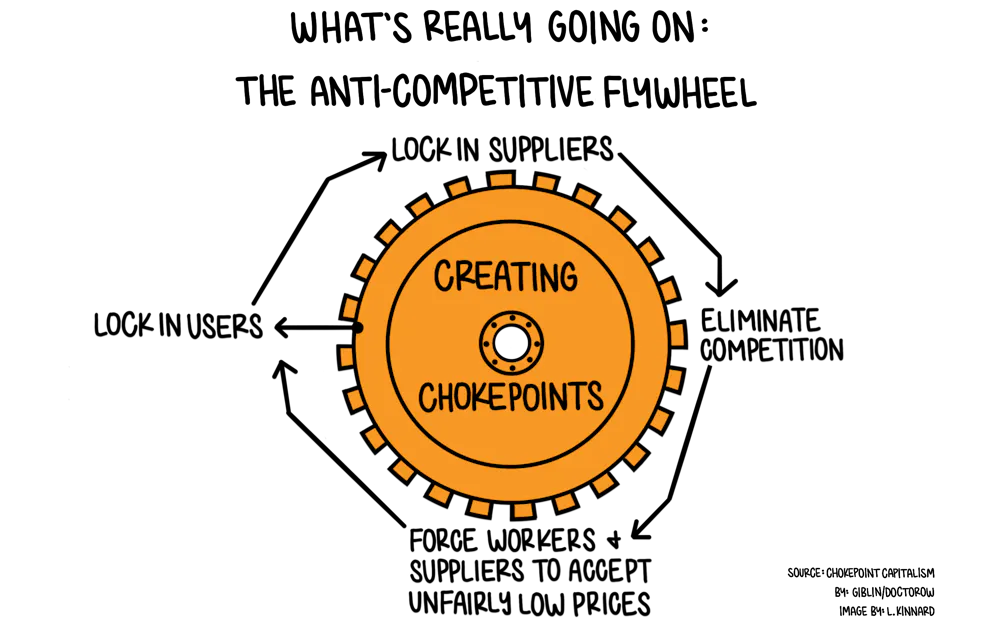
But many of today’s big corporations and billionaire investors have perfected ways to make those supposedly-temporary advantages permanent.
Warren Buffett salivates over businesses with “wide, sustainable moats”. Peter Thiel scoffs that “competition is for losers”. Business schools teach students ways to lock in customers and suppliers and eliminate competition, so they can shake down the people who make what they supply and buy what they sell.
Locking in customers and creators
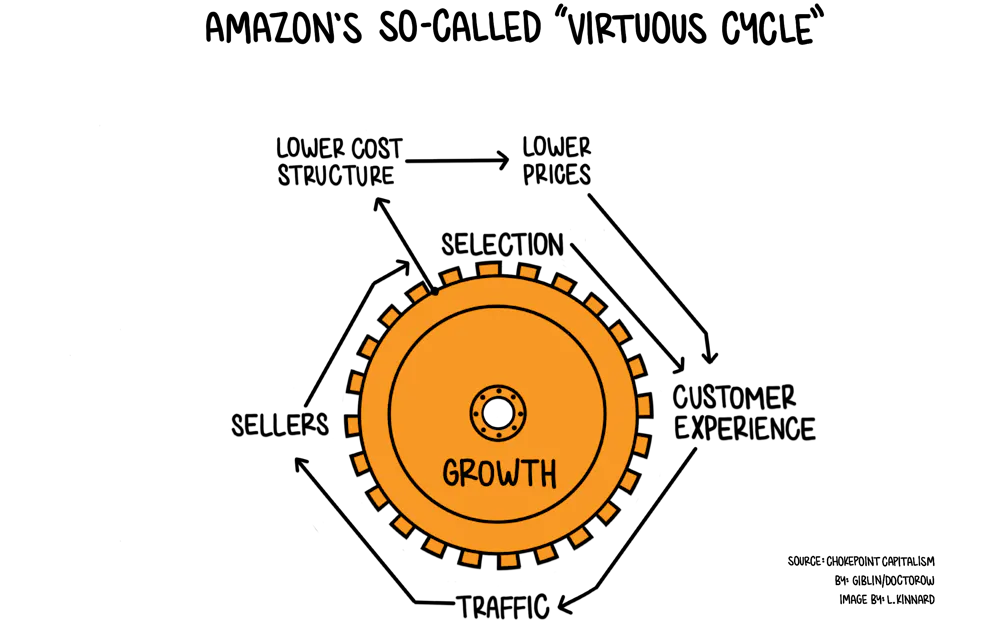
Amazon is the poster child for chokepoint capitalism. It boasts of its “flywheel” – a self-described “virtuous cycle” where its lower cost leads to lower prices and a better customer experience, which leads to more traffic, which leads to more sellers, and a better selection – which further propels the flywheel.
 How a few big buyers can control whole markets
The problem isn’t with middlemen as such: book shops, record labels, book and music publishers, agents and myriad others provide valuable services that help keep creative wheels turning.
The problem arises when these middlemen grow powerful enough to bend markets into hourglass shapes, with audiences at one end, masses of creators at the other, and themselves operating as a chokepoint in the middle.
Since everyone has to go through them, they’re able to control the terms on which creative goods and services are exchanged - and extract more than their fair share of value.
The corporations who create these chokepoints are trying to “monopsonise” their markets. “Monopsony” isn’t a pretty word, but it’s one we are going to have to get familiar with to understand why so many of us are feeling squeezed.
Monopoly (or near-monopoly) is where there is only one big seller, leaving buyers with few other places to turn. Monopsony is where there is only one big buyer, leaving sellers with few other places to turn.
Read more:
There's an obvious reason wages aren't growing, but you won't hear it from Treasury or the Reserve Bank
In our book, we quote William Deresiewicz, a former professor of English at Yale University, who points out in his book The Death of the Artist that “if you can only sell your product to a single entity, it’s not your customer; it’s your boss”.
Increasingly, it is how the creative industries are structured. There’s Audible for audiobooks, Amazon for physical and digital versions, YouTube for video, Google and Facebook for online news advertising, the Big Three record labels (who own the big three music publishers) for recorded music, Spotify for streaming, Live Nation for live music and ticketing – and that’s just the start.
But as corporate concentration increases across the board, monopsony is becoming a problem for the rest of us. For a glimpse into what happens to labour markets when buyers become too powerful, just think about how monopsonistic supermarkets bully food manufacturers and farmers.
How a few big buyers can control whole markets
The problem isn’t with middlemen as such: book shops, record labels, book and music publishers, agents and myriad others provide valuable services that help keep creative wheels turning.
The problem arises when these middlemen grow powerful enough to bend markets into hourglass shapes, with audiences at one end, masses of creators at the other, and themselves operating as a chokepoint in the middle.
Since everyone has to go through them, they’re able to control the terms on which creative goods and services are exchanged - and extract more than their fair share of value.
The corporations who create these chokepoints are trying to “monopsonise” their markets. “Monopsony” isn’t a pretty word, but it’s one we are going to have to get familiar with to understand why so many of us are feeling squeezed.
Monopoly (or near-monopoly) is where there is only one big seller, leaving buyers with few other places to turn. Monopsony is where there is only one big buyer, leaving sellers with few other places to turn.
Read more:
There's an obvious reason wages aren't growing, but you won't hear it from Treasury or the Reserve Bank
In our book, we quote William Deresiewicz, a former professor of English at Yale University, who points out in his book The Death of the Artist that “if you can only sell your product to a single entity, it’s not your customer; it’s your boss”.
Increasingly, it is how the creative industries are structured. There’s Audible for audiobooks, Amazon for physical and digital versions, YouTube for video, Google and Facebook for online news advertising, the Big Three record labels (who own the big three music publishers) for recorded music, Spotify for streaming, Live Nation for live music and ticketing – and that’s just the start.
But as corporate concentration increases across the board, monopsony is becoming a problem for the rest of us. For a glimpse into what happens to labour markets when buyers become too powerful, just think about how monopsonistic supermarkets bully food manufacturers and farmers.


















