

Australia and other countries must prioritise humanity in dealing with displaced people and migration
- Written by: Samuel Berhanu Woldemariam, PhD Candidate (Law), University of Newcastle
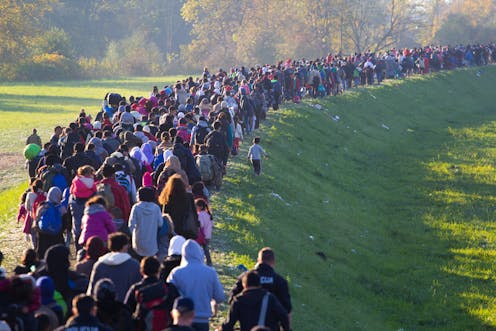
After six rounds of consultations, United Nations member states have produced the final draft of the Global Compact for Safe, Orderly and Regular Migration (GCM).
It is preceded by the New York Declaration for Refugees and Migrants, which the UN General Assembly adopted in 2016. This was an intergovernmental declaration to initiate development of two separate global compacts: one on refugees and another on migrants.
This latest global compact document focuses on the latter issue. It lays down 23 objectives in order to establish “a cooperative framework to address migration in all its dimensions”.
Key points include securing the human rights of migrants, reducing vulnerabilities in migration, and the use of migration detention only as a last resort. The global compact also promotes “integrated, secure and coordinated” border management. Its aim is for states to cooperate rather than focus strictly on their domestic priorities.
National responses to the draft global compact
Over the last month or so, states have started to declare their positions on the draft text. Notably, these positions do not always align with how those states have conducted themselves in intergovernmental negotiations. As is often the case, tensions can arise between domestic political priorities and intergovernmental relations.
Home Affairs Minister Peter Dutton said Australia would not sign the global compact in its current form. Australia is “happy to negotiate in good faith”, according to Dutton, but it will not “sign its border protection policy over to the UN”.
Read more: Why does international condemnation on human rights mean so little to Australia?
The Hungarian government also declared its opposition and officially announced its exit from the adoption process.
These developments follow the high-profile US withdrawal from the drafting process in December 2017. At the time, the Trump administration argued that numerous provisions of the New York Declaration were “inconsistent with US immigration policy”.
As the Global Compact on Migration moves towards finalisation in December 2018, there is a chance these early challenges may snowball.
The key to Australia’s resistance
The grounds for Australia’s particular resistance to the global compact are the provisions relating to migration detention. The compact insists detention should only be used as a “last resort”. Signatories would commit to:
review and revise relevant legislation, policies and practices related to immigration detention to ensure that migrants are not detained arbitrarily, that decisions to detain are based on law, are proportionate, have a legitimate purpose, and are taken on an individual basis, in full compliance with due process and procedural safeguards, and that immigration detention is not promoted as a deterrent or used as a form of cruel, inhumane or degrading treatment to migrants, in accordance with international human rights law.
Critical readings of domestic policy and practice find Australia’s behaviour in violation of some or all of the compact’s checks on migration detention.
Read more: Offshore detention: Australians have a right to know what is done in their name
Indeed, Dutton effectively acknowledges that Australia’s practice is out of alignment with international legal standards. He notes that “we’ve fought hard for [our policies]” and “we’re not going to sign a deal that sacrifices anything in terms of our border protection”.
Multiple actors have sought to bring Australia’s treatment of asylum seekers before the prosecutor of the International Criminal Court. The Australian government faces allegations including crimes against humanity and torture, arising from the system of mandatory offshore immigration detention it continues to enforce.
Global forced displacement and migration challenges are unprecedented
It is clear that states typically prioritise their national interests in international relations. Arguments are often framed in such a way as to absolve states of responsibility and position vulnerable refugees and migrants as a “problem”. It is past time for this mentality to change.
The UN High Commissioner for Refugees (UNHCR) recently released the 2017 Global Trends Report. It confirms that the number of forcibly displaced persons around the world has risen to 68.5 million. This is 2.9 million more than reported at the end of 2016.
The estimated global migrant population is 244 million.
States’ approaches to challenges of forced displacement and migration often fail to acknowledge a sometimes competing, but always essential, consideration – the basic dignity of the human person.
The agenda of the global compact is to encourage states to prioritise human dignity. This consideration does not have to contravene sovereignty. It does not dictate that a country abolish its borders. Nor is it against measures to protect its security.
To construct a justification for state cruelty based on sovereignty is an affront to the shared objectives of member states of the UN.
The case for greater cooperation
The current scope of forced displacement and migration necessitates more rather than less cooperation. Pakistan’s ambassador to the UN, Maleeha Lodhi, stated that the “success rests on mutual trust, determination and solidarity to fulfil the 23 objectives and commitments contained in the GCM”.
Bonds of solidarity at the international level are heavily strained by the disproportionate burdens borne by a small number of receiving states. Developing countries now host 84% of the world’s refugees.
In this context, the last thing national governments should do is abandon cooperative efforts to build stronger global responses to migration and refugee protection.
The lives and wellbeing of millions of people depend on countries working together and prioritising humanity in their domestic policies.
Authors: Samuel Berhanu Woldemariam, PhD Candidate (Law), University of Newcastle


















