

Visually striking science experiments at school can be fun, inspiring and safe – banning is not the answer
- Written by: Nathan Kilah, Senior Lecturer in Chemistry, University of Tasmania
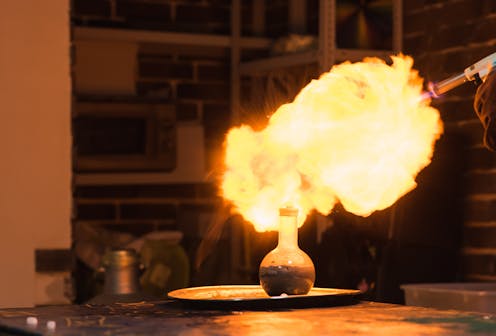
To a young mind, science can be magical. Perhaps you remember a visually striking or seemingly inexplicable scientific demonstration from your own youth?
A liquid spontaneously and unexpectedly changes colour. A banknote is set alight without being burnt. A column of colourful bubbles shoots into the air.
Scientists and science teachers often make use of dramatic demonstrations to capture the attention of young, impressionable minds, to inspire and to teach. But sometimes these experiments go wrong.
In September, a public display in Girona, Spain involving liquid nitrogen in large metal barrels failed, causing injuries to the presenters and the audience.
In October, a teacher and a student in the US state of Virginia were airlifted to hospital after a methanol fire demonstration caused an explosion.
And last week, a demonstration known as the “carbon snake” injured several schoolchildren in Sydney, leading to the suggestion that such experiments should be banned.
Demonstrations are a valuable teaching tool
Our rapidly changing, technologically complex world benefits greatly from a scientifically informed and engaged population.
A key aspect of achieving a “science-savvy” community is inspiring our children to value and connect with science. Demonstrations can be inspirational and memorable.
They are valuable tools to link young people with science, but a careful line must be walked to balance spectacle with the expectation that school is a safe place.
Read more: Science education the key to a better public debate
Demonstrations have been used in science education for centuries, and shown to enhance education when students are actively engaged in the experiment.
Scientific demonstrations are the living embodiment of science as an observational practice: seeing is believing.
Participating in an experiment provides direct, lived experience of scientific principles in action, while also affording an element of mystery and intrigue. This intrigue can open a curiosity-driven, questioning mindset that is central to building hypotheses, understanding, and applying the scientific method.
Not just ‘scientific theatre’
For effective learning it is crucial that a demonstration is more than scientific theatre.
Recreating an ancient alchemical pyrotechnic based on honey gives a brilliantly violent burst of flames. On its own, this is just noise, flash and smoke. It becomes much more when discussed in the context of the origins of medicine, the development of gunpowder, the ratio of chemicals needed for optimal reaction, and the contribution of alchemy to modern science.
However, this is also a potentially dangerous experiment, and should only be attempted by a suitably cautious chemist, with appropriate preparation and assessment of risk.
Assessing risk is an act of imagination. The worst possible outcomes must first be considered before controls are applied to make the activity as safe as possible.
Risk assessments are typically managed through the application of the hierarchy of controls to reduce or eliminate the dangers of an activity.
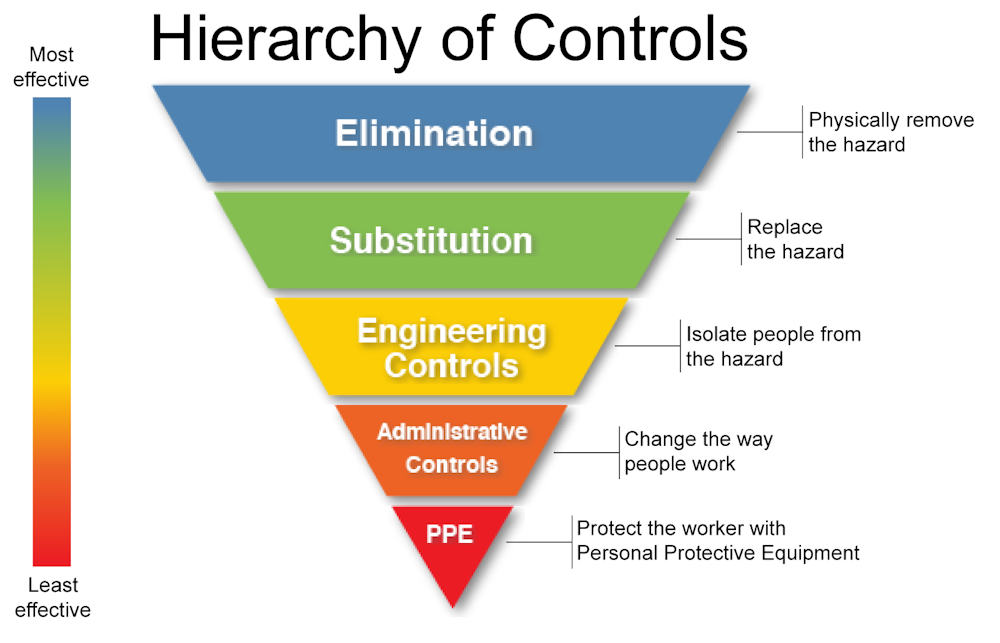
You might be surprised to see that personal protective equipment (think lab coats, gloves and safety glasses) only come into play at the final step in this process. These are among the first things that come to mind when we think “safety”. But they are most effective only after other elements of control have been implemented before them.
Introducing some controls can be challenging, like finding a suitable substitute for a hazardous material that is uniquely suited to a particular chemical reaction.
But engineering controls, such as increasing the distance between viewer and demonstration, are simple and usually highly effective.
Once we establish the risks and have considered their likelihood and potential consequences, we can decide whether the activity is worth pursuing.
Training, not banning
Universities and professional scientific bodies have a role to play in providing training, professional development and mentoring to teachers.
This is especially important for teachers who may be teaching outside their direct area of training and who may not have the hands-on experience of experimental risk assessment or chemical handling.
In addition to workplace-specific risk-assessment processes, the American Chemical Society has many resources available for school teachers, including highly useful safety guidelines for chemical demonstrations.
These guidelines show the depth of thought and preparation required before conducting a demonstration in front of others.
Time will tell what factors were responsible for the incidents mentioned above. In the meantime, teachers should be empowered to share the wonder and visual impact of science through demonstrations to their classes.
And while failed experiments are an important part of learning how to do science, they can and must be safe.
Read more: Curious Kids: how is lava made?
Authors: Nathan Kilah, Senior Lecturer in Chemistry, University of Tasmania



















