

why sponges may be the ‘canary in the coal mine’ for impacts of marine heatwaves
- Written by: James Bell, Professor of Marine Biology, Te Herenga Waka — Victoria University of Wellington
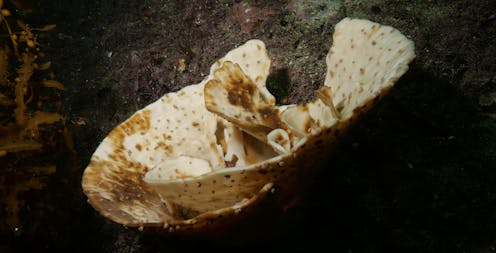
Marine sponges were thought to be more resilient to ocean warming than other organisms. But earlier this year, New Zealand recorded the largest-ever sponge bleaching event off its southern coastline.
While only one species, the cup sponge Cymbastella lamellata, was affected, a prolonged marine heatwave turned millions of the normally dark brown sponges bright white.
Subsequently, we reported tissue loss, decay and death of other sponge species across the northern coastline of New Zealand, with an estimated impact on hundreds of thousands of specimens. In contrast, we didn’t observe any bleaching or tissue loss in central areas of New Zealand’s coastline, despite extensive surveys.
Our latest research shows the most severe impacts on sponges occurred in areas where the marine heatwave was most intense. The loss of sponges may have major repercussions for the whole ecosystem.
Why should we care about sponges?
Sponges are among the most ancient and abundant animals on rocky reefs across the world. In New Zealand, they occupy up to 70% of the available seafloor, particularly in so-called mesophotic ecosystems at depths of 30-150m.
They serve a number of important ecological functions. They filter large quantities of water, capturing small food particles and moving carbon from the water column to the seafloor where it can be eaten by bottom-dwelling invertebrates. These invertebrates in turn are consumed by organisms further up the food chain, including commercially and culturally important fish species.
Sponges also add three-dimensional complexity to the sea floor, which provides habitat for a range of other species such as crabs, shrimps and starfish.
Sponge bleaching, tissue loss and decay
Like corals, sponges contain symbiotic organisms thought to be critical to their survival. Cymbastella lamellata is unusual in that it hosts dense populations of diatoms, small single-celled photosynthetic plants that give the sponge its brown colour.
These diatoms live within the sponge tissue, exchanging food for protection. When the sponge bleaches, it expels the diatoms, leaving the sponge skeleton exposed.
Tissue loss occurs when sponges are stressed and either have to invest more energy into cell repair or when their food source is depleted and they reabsorb their own tissue to reduce body volume and reallocate resources.
Tissue decay or necrosis on the other hand is generally associated with changes in the microbial communities living within sponges and growth of pathogenic bacteria.
Bleaching, tissue loss and decay in sponges have all previously been associated with heat stress, but didn’t necessarily result in sponge death. In other places where such impacts have been observed, they were much more localised, compared to what we saw in New Zealand.
The impact of marine heat waves
Marine heatwaves are defined as unusual periods of warming that last for five consecutive days or longer. Some can last from weeks to several months and extend over hundreds or thousands of kilometres of coastline.
The sponge bleaching and tissue loss or decay in New Zealand matched the duration and intensity of marine heatwaves to the north and south of New Zealand during the summer of 2021/2022. The Hauraki Gulf, where sponge necrosis and decay was reported, was in a continuous marine heatwave for 29 weeks from November 2021 to the end of May 2022, with a maximum intensity of 3.77℃ above normal.
In Fiordland, a prolonged marine heatwave developed in early February 2022 and persisted for more than 16 weeks into May, with a maximum intensity of 4.85℃ above normal temperatures. In contrast, the Wellington and Marlborough Sounds regions experienced only short (weeks) marine heatwaves with a lower intensity and we did not observe any impacts on sponges.
These extreme heat events can result from a combination of changes in the heat exchange between the air and the sea, wind patterns and ocean currents. Their likelihood is also influenced by large-scale climate patterns such as the El Niño Southern Oscillation (ENSO).
What the future may hold
Most global research on climate change impacts has focused on experimental studies exposing organism to temperatures predicted for 2100, often 2-4℃ higher than current temperatures. But the occurrence of marine heatwaves means organisms are already experiencing these temperatures, sometimes for several weeks or months. By 2100, marine heatwaves will become even more extreme.
For bleached Cymbastella, recent anecdotal reports suggest many sponges have recovered their colour, which is good news. However, observations immediately after the bleaching indicate many sponges were being eaten by fish, possibly because their symbionts may provide chemical defences against predation.
For bleached corals, studies have shown impacts on spawning success for many years after the event, likely because their energy reserves have been depleted.
We don’t yet know if this is the case for sponges. For sponges with decayed tissue the outlook is even less clear, as many probably died.
Sponges are not the only species to be affected by marine heatwaves New Zealand experienced in 2021/2022. There were reports of seaweed die-offs and changes to normal distribution patterns of tuna and other ecologically and commercially important fish species.
Marine heatwaves should be front of mind when thinking about climate impacts. They are happening now, not in 50 years, and we don’t know enough yet to determine if sponges may be the canary in the coal mine.
This is especially important because New Zealand’s northern coastlines are already experiencing almost continuous marine heatwave conditions, with the ongoing event forecast to extend into the coming summer.
Authors: James Bell, Professor of Marine Biology, Te Herenga Waka — Victoria University of Wellington


















