

Modern Australian
Times Advertising

To clean up Australia's power grid, we're going to need many thousands more skilled workers – and fast

  • Written by Jay Rutovitz, Research Director, Institute for Sustainable Futures, University of Technology Sydney
To clean up Australia's power grid, we're going to need many thousands more skilled workers – and fast

To get Australia’s grid 82% powered by renewables by 2030 is a huge increase. At present, the electricity powering eastern and southern states is around 33% renewable.

To get there means a lot of work. Over the next seven years, it would be equivalent to installing dozens of large wind turbines every month, and tens of thousands of solar panels every day.

And work needs workers. To make this happen, our modelling shows 15,000 more workers are needed by 2025 – less than three years away. That’s amid a skills shortage, an infrastructure boom and unemployment rates at the lowest level in decades.

So how to do it? We need to train more skilled workers and give them more security. Renewable projects have tended to operate on boom-bust cycles when it comes to jobs. But to get where we need to be, we need to shift to a long-term boom mentality. We’re going to need people doing these jobs for decades to come.
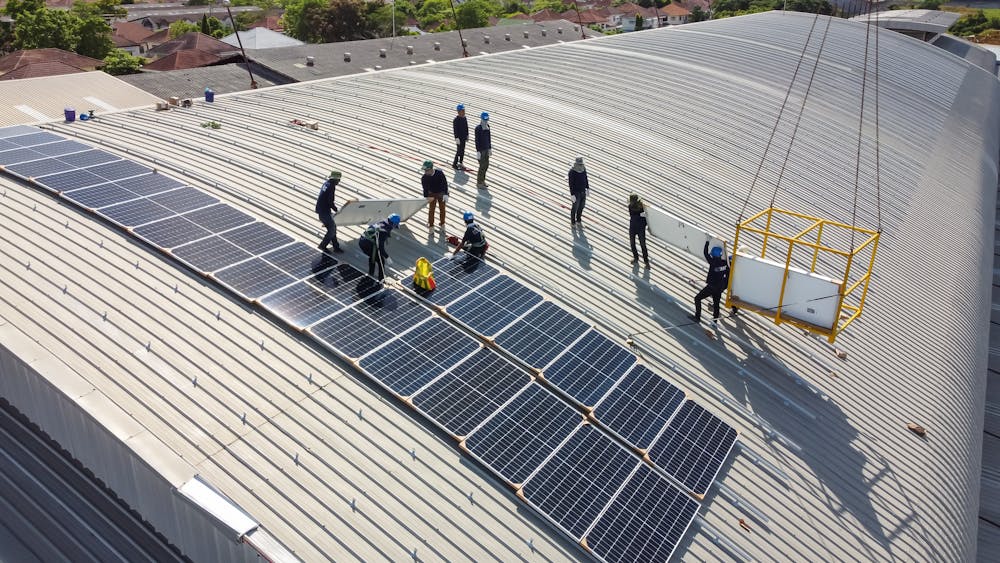
Solar panel installation
The big renewable build will only work if we have enough workers. Shutterstock

How big is this issue?

Big. Getting to 82% renewables and fast means we need to greatly scale up the electricity sector workforce in generation, storage and transmission line construction.

We estimate the current workforce is around 41,000, including 12,000 working in coal and gas power stations or supplying those power stations with fuel. This is only an estimate, as updated figures won’t be available until the federal government delivers its promised energy employment report.

Read more: Wind turbines off the coast could help Australia become an energy superpower, research finds

Australia’s energy market operator, AEMO, publishes regularly updated pathways to a clean-energy future. Now we have federal backing for accelerated timelines, the most likely outcome is the so-called “step change scenario”. This scenario envisages nine times more wind and solar by 2050, to boost capacity to 141 gigawatts, and four times more rooftop solar.

Under this scenario, 15,000 more workers must be ready and able to build and operate renewables and storage, or build transmission lines, by 2025.

The problem is, these workers don’t exist at present. Many existing skilled workers are already paid well by major infrastructure projects, such as metro rail projects in Melbourne and Sydney and regional projects such as inland rail. What’s more, unemployment rates are the lowest in decades, and peak demand for labour to build wind and solar projects is set to outstrip the entire current workforce in some regional areas where the renewable projects will be concentrated.

To add to the challenge, skilled workers tend to live in major population centres – but clean energy projects are virtually all in the regions. So the clean energy sector must compete with big infrastructure projects in the cities, which pay more and don’t involve travel. You can see the challenge. If we don’t get this right, the clean energy transition just won’t happen.

The common answer to workforce shortages is to train more workers. But here, too, there are challenges. Our skilled training sector has long been in the doldrums, with demand spread thin across far-flung regions and policy uncertainty leaving many gaps in capacity.

15,000 new skilled workers are just the start

We modelled the workforce needed to achieve three of the AEMO scenarios: the step change, the hydrogen superpower and the slow change. We also modelled an offshore wind scenario, using AEMO’s modified step change “sensitivity” which takes into account Victoria’s ambitious target for offshore wind.

Under the step change scenario, we found the demand for skilled jobs will increase 37,000 from 2023 and peak at 81,000 in 2049.

Jobs in generation, transmission construction and storage under different scenarios for the National Electricity Market.

But if Australia becomes a major exporter of renewable energy in the form of green hydrogen or green ammonia, as backers like iron ore billionaire Twiggy Forrest are hoping, that’s a different story. It would require up to twice the workers of the step-change scenario in the 2030s, and up to triple in the 2040s.

That’s a staggering peak demand of 237,000 jobs, with an average demand of 110,000. To get there, we would need 34,000 extra workers within three years.

Where will the jobs be? New South Wales will be the leading state in most scenarios, with a demand for over 20,000 skilled workers annually until 2050 under the step-change scenario. Across NSW, Queensland and Victoria, the job split by technologies is very similar in this scenario: 37% of jobs in solar, 27–30% for wind, and 17–22% in batteries. The pattern is similar in the offshore wind and slow-change scenarios.


What about the hydrogen superpower scenario? This would change things dramatically. Here, the highest demand for renewable jobs would be in Queensland, South Australia and Tasmania. Compared to the step-change scenario, Queensland would add over 100,000 jobs, while jobs in South Australia would more than treble and Tasmania quadruple from 2,200 to 9,400. Relatively modest growth is projected for NSW and Victoria – 4,000 new jobs in both states compared to the step change. Electricity sector jobs in the Step Change scenario by technology in the National Electricity Market. We can’t just leave it to the market Coordinated action is needed to plan and implement skills, training and workforce development. Here, state and territory governments can build on the recent creation of Renewable Energy Zones – essentially, renewable rich areas where transmission lines exist or will be built – to boost collaboration between industry and government on training strategies and programs. Workforce planning should be brought into overall energy system planning, to help reduce the employment boom-bust cycle. Most electricity planning favours “just in time” construction, where infrastructure is built as it is needed. That means demand for labour is volatile. The NSW government has created an electricity infrastructure jobs advocate and created EnergyCo to co-ordinate the development of the renewable energy zones and maximise local benefits. Given current shortages of workers, it’s vital governments take action now. Acting early would help future-proof our clean energy workforce and maximise benefits for regional areas. Even better, we could help boost numbers of workers from under-represented groups such as women and First Nations communities. Read more: How can Aboriginal communities be part of the NSW renewable energy transition? Authors: Jay Rutovitz, Research Director, Institute for Sustainable Futures, University of Technology Sydney

Read more https://theconversation.com/to-clean-up-australias-power-grid-were-going-to-need-many-thousands-more-skilled-workers-and-fast-195906

Why Does My Power Keep Tripping? Common Causes Explained by Electricians Sydney

The electrical system is the lifeblood of your home, powering everything from your phones to cooking utensils and more. But from time to time, your po...

Interstate Car Transporter Urges Buyers to Book Early

As the conflict in the Middle East continues to put increasing pressure on local fuel supply, Australian transport companies are experiencing increasi...

Digital Minimalism for Business Owners: Fewer Tools, Better Systems

Be honest. How many apps are open right now? One for scheduling, another for invoices, a third for customer notes, plus a spreadsheet someone email...

The Importance Of Proactive NDIS Renewal Preparation For Sustaining Your Provider Business

Your NDIS renewal notice is not a signal to start preparing. By the time it arrives, preparation should already be well underway. For new providers, s...

Why Fire Extinguisher Testing in Sydney Is Becoming a Records Game, Not Only a Maintenance Job

A fire extinguisher used to feel like one of the simpler parts of building safety. It hung on the wall, wore a service tag, and sat there quietly unle...

The Switchboard Upgrade Question Every Melbourne Renovator Should Ask Before the Walls Close Up

Renovations have a funny way of making people think on surfaces first. Splashback, stone, joinery, tapware, paint. Fair enough too. That is the exciti...

Winter Sanitation Gaps in Parramatta Kitchens: A Hidden Pest Risk

Winter brings a host of changes to our homes, from the chill in the air to the cozy warmth indoors. However, this season also introduces sanitation ch...

When to Seek Advice from Employment Lawyers in Melbourne

Australian employment law is detailed and, at times, complex, with rights and obligations that aren't always obvious to employees or employers witho...

7 Benefits of Professional Gutter Cleaning for Australian Homeowners

Gutters aren't exactly glamorous. They sit up there on the edge of your roof, doing their job quietly - until they stop working. Clogged, overflowing ...

Pipe Floats Strengthening Pipeline Performance In Demanding Environments

Pipelines often travel through environments that are anything but predictable, water currents shift, terrain changes, and materials keep moving unde...

Why Ceiling Fans Are Essential For Comfort, Efficiency, And Modern Living

Creating a comfortable indoor environment is not just about temperature; it is about how air moves, how a room feels, and how efficiently energy is ...

Why Duct Cleaning In Melbourne Is A Smart Investment For Healthier Living Spaces

Behind your walls, ceilings, and vents lies a network quietly working every day to keep your home comfortable. Yet over time, this system can become...

Disability Service Providers Supporting Inclusive And Independent Living

Finding the right support system can feel like assembling a puzzle where every piece must fit just right. For individuals and families navigating di...

A Beginner's Guide to Owning a Caravan in Australia

Owning a caravan opens up a style of travel that's hard to match for freedom and flexibility. However, for those just starting out, the process of c...

Preparing Your Air Conditioner for Summer: What Most Homeowners Overlook

As temperatures rise, many homeowners switch on their air conditioning for the first time in months — only to find it’s not performing the way i...

What Actually Adds Value to Properties in Newcastle

Newcastle has seen steady growth over the past few years, with more buyers looking beyond Sydney for lifestyle, space, and long-term value. As dema...

What is Design and Build in Construction?

Imagine you’re about to start a new construction project, maybe it’s a custom home or a commercial building. You’ve got the idea, the land, an...

Commercial roof leak detection: why early action protects your building

Water ingress is one of the most disruptive and costly issues facing commercial properties. For property managers and facilities teams, even a minor...
















