

how would upper house look using the Senate system?
- Written by: Adrian Beaumont, Election Analyst (Psephologist) at The Conversation; and Honorary Associate, School of Mathematics and Statistics, The University of Melbourne
At the November 26 Victorian election, Labor won 15 of the 40 upper house seats (down three since 2018), the Coalition 14 (up three), the Greens four (up three), Legalise Cannabis two (up two), the Liberal Democrats one (down one), Animal Justice one (steady), the Shooters one (steady), Labour DLP one (up one) and One Nation one (up one).
Derryn Hinch’s Justice (three seats in 2018), Sustainable Australia (one), Transport Matters (one) and Fiona Patten’s Reason (one) lost all their seats.
I had an article on the likely upper house result on December 1. The Liberal Democrats instead of the Liberals won the final seat in Southeastern Metro region, and the Greens instead of Legalise Cannabis won the final seat in Western Victoria.
Read more: Labor, Greens and Legalise Cannabis likely to have combined majority in Victorian upper house
The upper house uses the group voting ticket (GVT) system, which allows small parties to unfairly pass larger parties on 100% preference flows from above the line votes. In the federal Senate system, voters are told to number at least six boxes above the line, and preferences are directed by voters.
The table below gives the actual results and what I believe the results would have been using the Senate’s system. LC = Legalise Cannabis in the table. Others are the DLP (former Labor MP Adem Somyurek) in Northern Metro, the Liberal Democrats in Southeastern Metro, the Shooters in Eastern Victoria, and Animal Justice and One Nation in Northern Victoria.
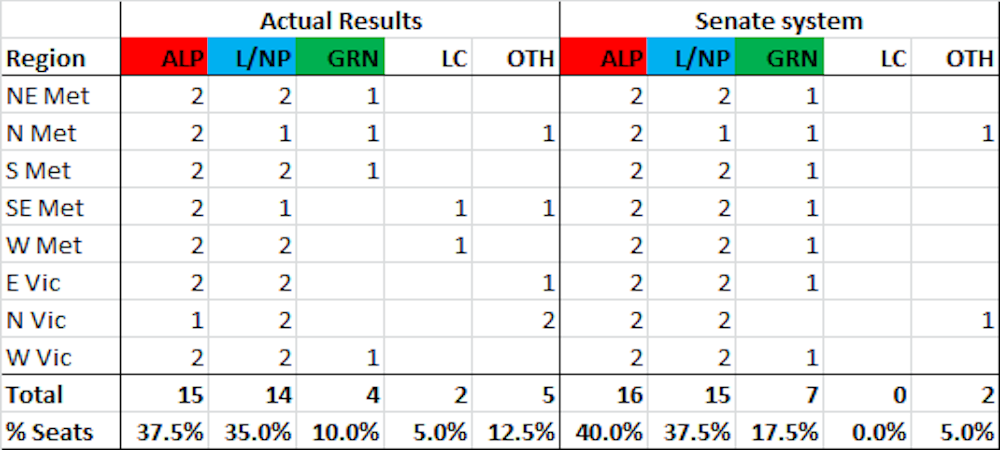
I will analyse each region’s result by the Senate system. With five members to be elected per region, a quota is one-sixth of the vote or 16.7%.
In Northeastern Metro, Labor won 2.02 quotas, the Liberals 1.82, the Greens 0.62 and Labour DLP 0.31. The Liberals and Greens would win the last two seats for an identical result.
In Northern Metro, Labor won 2.00 quotas, the Liberals 1.13, the Greens 1.12, the DLP 0.29, the Victorian Socialists 0.28 and Fiona Patten 0.22. This would be a race between the Socialists and the DLP in the Senate system, and Somyurek may not have won.
In Southeastern Metro, Labor won 2.36 quotas, the Liberals 1.61, the Greens 0.40, Legalise Cannabis 0.32 and the Liberal Democrats 0.22. The Liberals would win a second seat, with the final seat between Labor and the Greens. The Greens would likely attract more left-wing preferences to win this seat. The Greens and the Liberals would replace Legalise Cannabis and the Liberal Democrats.
In Southern Metro, the Liberals won 2.17 quotas, Labor 1.78, the Greens 0.92 and Legalise Cannabis 0.17. Labor and the Greens would win the final two seat for an identical result.
In Western Metro, Labor won 2.22 quotas, the Liberals 1.47, the Greens 0.48, the DLP 0.31 and Legalise Cannabis 0.26. As prominent parties, the Liberals and Greens would likely win the last two seats, with the Greens replacing Legalise Cannabis.
In Eastern Victoria, the Coalition won 2.18 quotas, Labor 1.59, the Greens 0.48, Legalise Cannabis 0.25 and the DLP 0.23. With the right vote for the last seat split between many parties, Labor and the Greens would have a strong chance of both winning the fourth and fifth seats. The Greens would replace a Shooter who won by preference spiral from 0.18 quotas.
In Northern Victoria, the Coalition won 2.10 quotas, Labor 1.73, the Greens 0.42, the Shooters 0.31 and Legalise Cannabis 0.29. The Greens would not have a large enough lead over the Shooters and would probably lose, especially with Labor drawing left votes. Labor and the Shooters would replace One Nation and Animal Justice.
In Western Victoria, Labor won 2.13 quotas, the Coalition 1.62, the Greens 0.52 and Legalise Cannabis 0.30. The Greens and Coalition would win the final two seats for an identical result.
If we want a proportional upper house, we should have a statewide electorate
According to ABC election analyst Antony Green, overall vote shares for the upper house were 33.0% Labor (down 6.2% since the 2018 election), 29.4% Coalition (steady), 10.3% Greens (up 1.1%), 4.1% Legalise Cannabis (new), 3.5% DLP (up 1.4%), 2.6% Liberal Democrats (up 0.2%), 2.1% One Nation (new), 2.0% Shooters (down 1.0%) and 2.0% Family First (new).
The actual results are more proportionate than the results produced by applying the Senate system. Labor won the two party preferred by about 55-45 in the lower house, and left-wing parties (Labor, the Greens, Legalise Cannabis and Animal Justice) have 22 of 40 seats (55% of seats). Left-wing parties swapped preferences with each other, and this helped them to win these seats.
Using the Senate system, Labor and the Greens would have 23 of the 40 seats, and a further seat would go to the left if the Victorian Socialists defeated the DLP for the last seat in Northern Metro.
If the Senate system were applied, there would be no seats for Legalise Cannabis despite a 4.1% statewide vote share, and only two seats for parties other than Labor, the Coalition and Greens; these parties combined won 27.3% of votes.
The smaller parties’ problems are due to the high quota of 16.7% in each region. Getting half a quota on primary votes needs 8.3%; this is required for a good chance of election under the Senate system.
If we want a genuinely proportional upper house, it would be best to scrap the eight regions that each return five members, and just use a single statewide electorate for the upper house.
Unfortunately, Labor embedded the eight five-member electorates in the state constitution after its landslide 2002 victory ended Coalition dominance of the upper house. That means a referendum would be required to switch to a statewide electorate.
Another aspect of the Senate system that assists the left is that the non-Coalition right is very splintered, while the non-Labor left is far more concentrated with the Greens. If GVT were axed but the eight five-member regions retained, parties of the non-Coalition right would need to merge to be competitive.
Lower house: Labor wins 56 of 88 seats
Labor won 56 of the 88 Victorian lower house seats (up one since the 2018 election), the Coalition 27 (steady), the Greens four (up one) and independents zero (down three). The election in one seat (Narracan) was deferred owing to a candidate’s death. The Coalition is likely to win this seat, which would give them 28 seats (up one).
Statewide vote shares were 37.0% Labor (down 5.8% since the 2018 election), 34.4% Coalition (down 0.8%), 11.5% Greens (up 0.8%), 5.4% independents (down 0.6%), 3.1% Family First (new) and 2.5% Animal Justice (up 0.7%). Others including independents and non-Greens minor parties were 17.1% (up 5.8%).
The ABC’s estimated two party vote was 55.0-45.0 to Labor, a 2.6% swing to the Coalition. The exclusion of Narracan biases these two party and primary vote shares slightly towards left-wing parties.
Labor won the three closest seats, defeating the Liberals by a 50.2-49.8 margin in Bass and a 50.4-49.6 margin in Pakenham. In Northcote, Labor defeated the Greens by a 50.2-49.8 margin.
The Nationals defeated sitting independents in Mildura and Shepparton, while the Morwell independent retired. Teal independents only made the final two after preferences in one seat: Mornington, which the Liberals held by a 50.7-49.3 margin, The Liberals held Benambra 50.9-49.1 against an independent challenger.
With a 2.6% statewide swing to the Coalition, they would have been expected to gain seats from Labor, but Labor increased its seats by one on the 2018 landslide. There were several double digit swings to the Liberals, with Greenvale (a 15% swing) the highest swing in a Labor vs Coalition seat.
The Liberals’ problem was that these swings were wasted, with Labor still holding Greenvale by a 57-43 margin. Other double digit swings to the Liberals were wasted in Labor safe seats like Thomastown, Yan Yean, St Albans, Mill Park and Kororoit. Meanwhile, Labor had smaller swings in its favour in four seats that were enough to gain them.
While the Greens only made one gain (Richmond), they had double digit swings in their favour against Labor in Brunswick, Footscray, Pascoe Vale, Richmond and Preston, but could only manage a 1.5% swing in their closest pre-election target (Northcote).
Labor now holds four seats by close margins against the Greens: Northcote (a 0.2% margin), Pascoe Vale (2.0%), Preston (2.1%) and Footscray (4.2%). Margins here subtract 50% from the winning party’s two candidate percentage.
Authors: Adrian Beaumont, Election Analyst (Psephologist) at The Conversation; and Honorary Associate, School of Mathematics and Statistics, The University of Melbourne


















