

Bad fire science can kill our threatened species. It's time to cooperate with nature
- Written by: Philip Zylstra, Adjunct Associate Professor at Curtin University, Research Associate at University of New South Wales, Curtin University
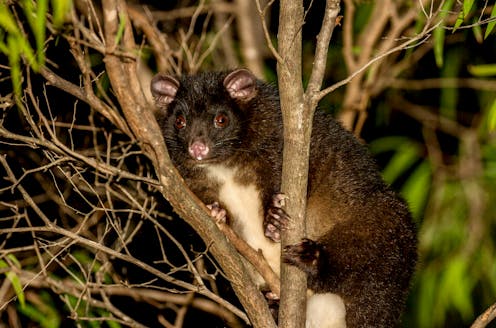
For four years, naturalist Allison Dixon regularly walked from dusk until dawn at the Warrungup Spring bush reserve south of Perth, carefully documenting every western ringtail possum she saw.
The possum – or ngwayir in the language of Traditional Owners – is critically endangered. The species is found only in a small area of southwest Australia, including the population of 22 individuals Dixon was monitoring.
She knew each possum by name. Their voices and physical features were as familiar to her as human faces.
In 2018, a prescribed burn by local authorities was conducted in the Warrungup Spring reserve. Despite burning slowly as planned, it killed 17 of the 22 possums Dixon was monitoring.
I document this incident in a new paper and explore how a carefully controlled fuel reduction burn could cause such catastrophic loss. We must move on from bad fire science to prevent similar tragedies.
The fire-intensity equation
Prescribed burning occurs when authorities intentionally set fire to a particular area of the landscape under defined conditions. The burns are often used to reduce so-called “fuel loads” – fine biomass such as twigs, leaf litter and bark.
As the idea goes, the greater the weight of the fuel load, the more flammable the forest. This theory can be traced back to American fire researcher George Marsden Byram.
In 1959, Byram published an equation beautiful in its simplicity: a fire’s heat output (or intensity) was equal to the amount of energy stored in the fuel, multiplied by the amount of fuel, and multiplied again by the speed the fire spreads and consumes it.
This theory would shape a central tenet of Australian fire management: that prescribed burns are necessary to reduce fuel loads, to make subsequent bushfires less intense.
The influence of Byram’s fire-intensity theory can be seen in an official fire management guide used to inform the burning of ngwayir habitat. The document suggests the animals can survive low-intensity fire – and on the day of the burn that killed 17 ngwayir, weather conditions were conducive to such a fire.
But after years of work in fire management, I’ve come to see Byram’s theory – and the management practices flowing from it – as simplistic. In 2016, my colleagues and I published a new way of modelling fire behaviour. In my latest paper, I applied this model to the Warrungup Spring fire.
Read more: New modelling on bushfires shows how they really burn through an area
The prescribed burn at Warrungup Spring involved igniting patches of balga grasstrees and their surrounds. I investigated what happened to the air around a hollow in a tree where ngwayir were known to live. A balga grasstree burned during the fire was located under the hollow.
According to Byram’s theory, the fire would have been classed as low-intensity because it did not spread horizontally. But this thinking does not account for the vertical spread of heat and flames.
As depicted in the image below, the supposedly low-intensity fire would have heated the air above it to more than 500℃. This would burn the respiratory tracts of possums inside the hollow in just a few minutes.
Byram’s fire-intensity equation might be valuable as a theoretical construct. But using it to inform real-world fire management can be catastrophic.
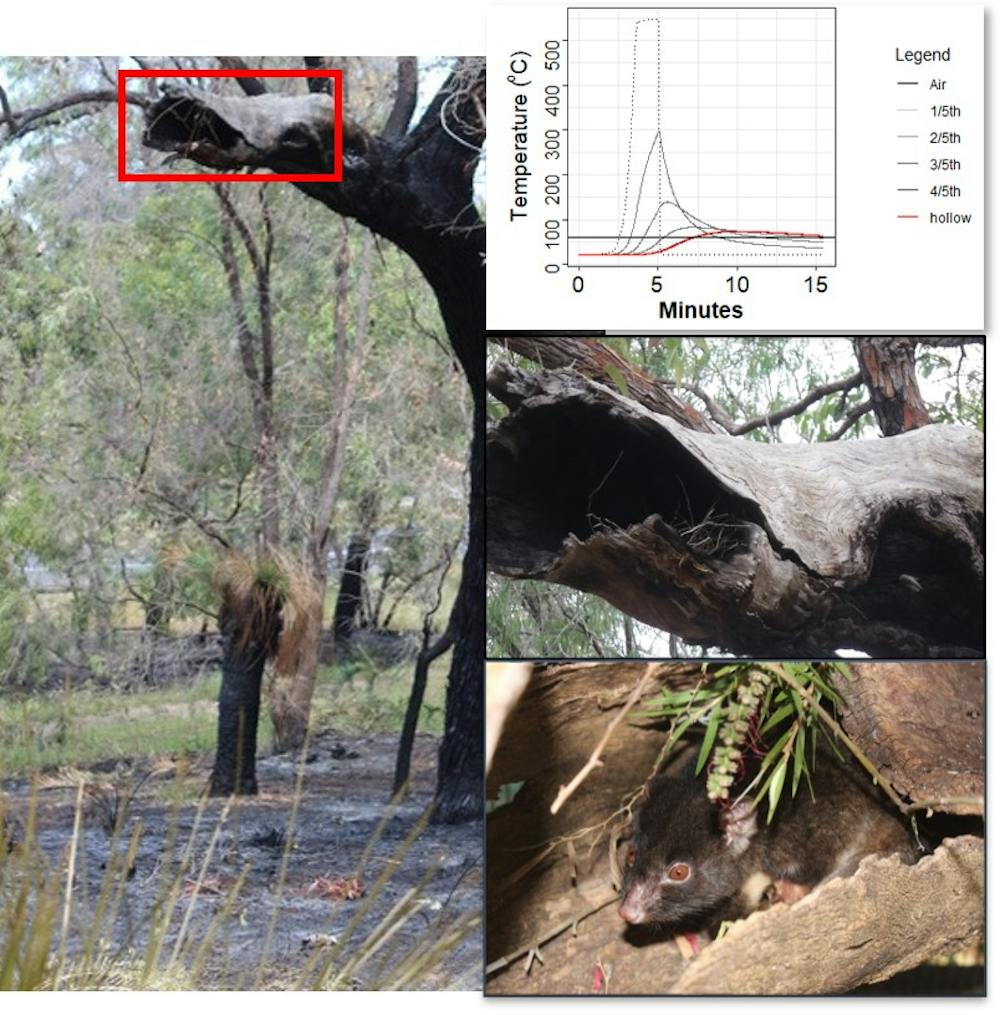
As my latest paper describes, Allison Dixon searched for the western ringtail possums the evening after the fire, and each subsequent evening for two weeks.
In some cases, Dixon found the bodies. In others, the presence of flies in high nest hollows indicated the ngwayir inside had perished.
Dixon visited surrounding properties and structures in case the possums had fled the fire ground, but no survivors were identified. She also continued weekly monitoring of their habitat. In the end, 17 of the 22 critically endangered possums were presumed dead.
But the problem runs even deeper
Most fuel load lies in the litter layer on the ground. But we’ve known for decades that burning it away germinates dense understorey regrowth. In fact, WA government records show bushfires are most likely where prescribed burns have occurred, where that regrowth is most dense.
In November this year, a prescribed burn was conducted in the Walpole Wilderness, in dense regrowth stimulated by a previous prescribed burn.
The fire was reportedly meant to protect quokka habitat. But it escaped containment lines and burnt 25,000 hectares – 10,000 more than originally planned, and at a higher-than-intended severity.
One peer-reviewed study appears to show less fire in areas where prescribed burning has been undertaken. But research by my colleagues and I has challenged this study.
The authors of the study in question compared the amount of wildfire in each six-year period with the amount of prescribed fire in the same period. But this method meant that for some of that period, reduced fire frequency was attributed to prescribed burns that had not yet occurred.
Cooperating with nature
Australia has the world’s worst record for mammal extinction – and we know fire is one of the main culprits. Yet prescribed burning relies on outdated or even disproved theories and assumptions about fire.
Bad fire science is killing our threatened species, but alternatives are available. These approaches reinforce, rather than disrupt, natural ecological controls on forest fire. They include traditional Indigenous fire knowledge, and modern techniques to minimise the extent of dense regrowth in the landscape.
By cooperating with nature to minimise fire risk, we can protect species that have persisted through aeons.
Read more: Coming of age: research shows old forests are 3 times less flammable than those just burned
Authors: Philip Zylstra, Adjunct Associate Professor at Curtin University, Research Associate at University of New South Wales, Curtin University


















