

Artist Tomás Saraceno wants to improve our knowledge about atmospheres – and arachnids
- Written by: Jan Hogan, Senior lecturer, School of Creative Arts & Media, University of Tasmania
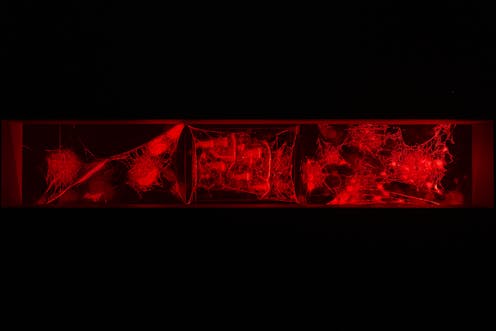
In Oceans of Air, the new exhibition at Hobart’s Mona, artist Tomás Saraceno imagines a future where humans become as sensitive to the environment as a spider in its web. He invites visitors to become participants in his multiple networks and projects. He aims to make us aware of our interconnections with each other and the world.
Held in the underground labyrinthine galleries of Mona, we are invited to reconsider the boundaries between natural and cultural worlds.
As we descend through Mona’s central staircases, the reflective sculptural orbs Aerocene 4 and 5 weave Mona’s architecture and collections into the Saraceno world. Stairs and artworks twist and turn in the reflections.
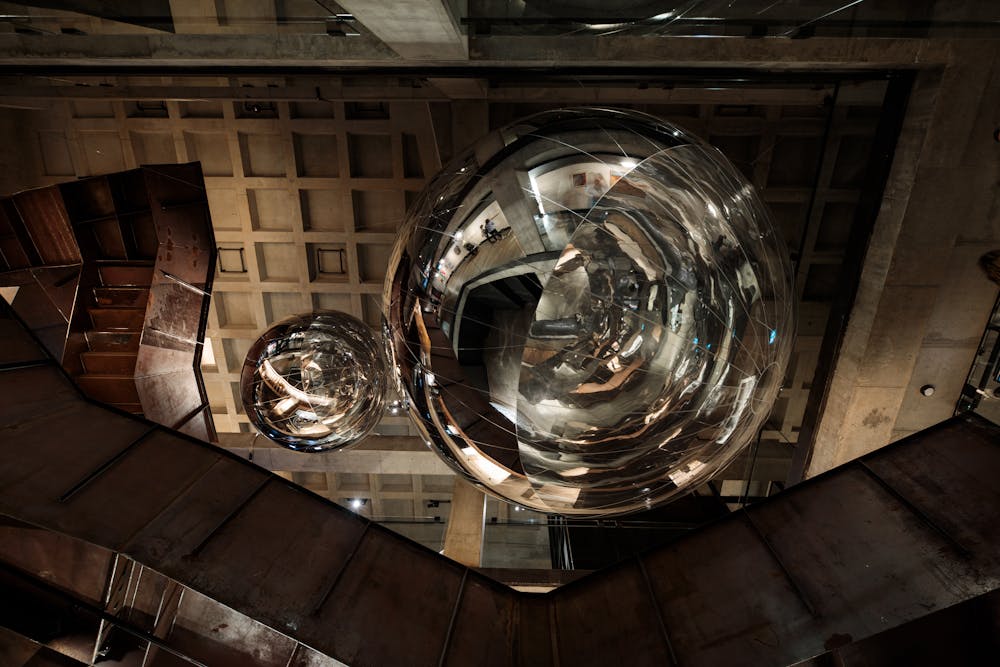
Reminiscent of Escher’s 1923 Relativity lithograph, the laws of gravity are confounded. The binding on the balloons could be tethering them to the building or preventing their fall, like eggs in a spider web.
Before entering the dark subterranean galleries, a photograph shows Saraceno floating below a fuel-free hot air balloon on the boundary between earth and sky.
A multi-sensory experience
Argentinean Tomás Saraceno is a Berlin-based artist, interested in collaborations with research institutes to further our collective knowledge around atmospheres and arachnids.
Submerging into dark gallery spaces may seem a strange phenomenon for an exhibition titled Oceans of Air, however Saraceno and Mona curators Emily Pike and Olivier Varenne have carefully orchestrated the experience. They play with beams of light and the twisting turns of the galleries to make participants slow down and engage in a multi-sensory experience.
Within one darkened room, we encounter Particular Matter(s), 2021, a single light beam travelling across space, landing as a moon formation on the felted wall.
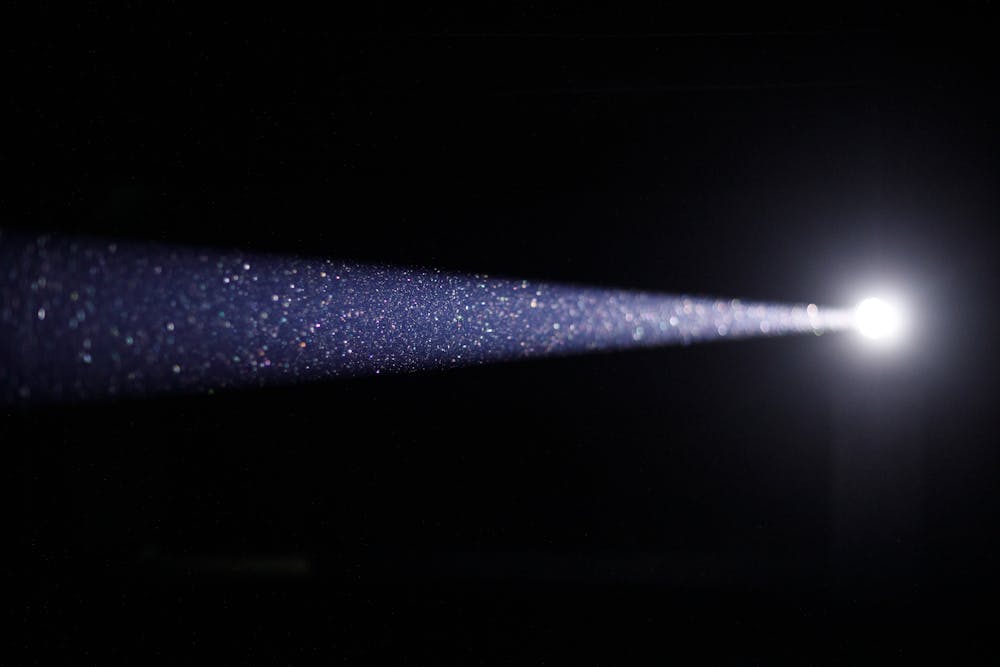 Particular Matter(s), 2021, Tomás Saraceno. Courtesy the artist, neugerriemschneider, Berlin and Tanya Bonakdar Gallery, New York / Los Angeles.
Photo Credit: Mona/Jesse Hunniford Image Courtesy Studio Tomás Saraceno and MONA Museum of Old and New Art, Hobart, Tasmania, Australia
Particular Matter(s), 2021, Tomás Saraceno. Courtesy the artist, neugerriemschneider, Berlin and Tanya Bonakdar Gallery, New York / Los Angeles.
Photo Credit: Mona/Jesse Hunniford Image Courtesy Studio Tomás Saraceno and MONA Museum of Old and New Art, Hobart, Tasmania, Australia
Floating in this light beam (according to the guide), is cosmic dust, PM2.5 (particulate matter), stellar wind, air movement, kinaesthetic feedback and sonic waves.
In other words: the dust and atmospheric conditions present in the gallery today.
Adjacent is a photograph, NORAD 40983 (2015-059B), 2016 displaying the Large Magellanic Cloud, one of the closest galaxies to our own Milky Way, with a line revealing the trail of a satellite. Saraceno encountered this image when visiting Bolivia’s Salar de Uyuni, the world’s largest salt pan.
Here, the sky is reflected on a large salt flat. We become suspended in space, our bodies becoming insignificant matter. Standing between this photograph and the salt covered ground, we shift from godlike creatures scattering particles with our movements to an insignificant speck in the galaxy.
Read more: An expanding universe and distant stars: tips on how to experience cosmology from your backyard
Fleetingly visible
The images in We Do Not All Breathe the Same Air are presented in the format of moon charts revealing the natural rhythms of the solar system.
But instead of charting our solar system, these digital prints capture samples of air pollution collected from each state of Australia. The traces of pollutants are a physical reminder of what is invisible in this part of the world, but painfully obvious in cities like Mumbai.
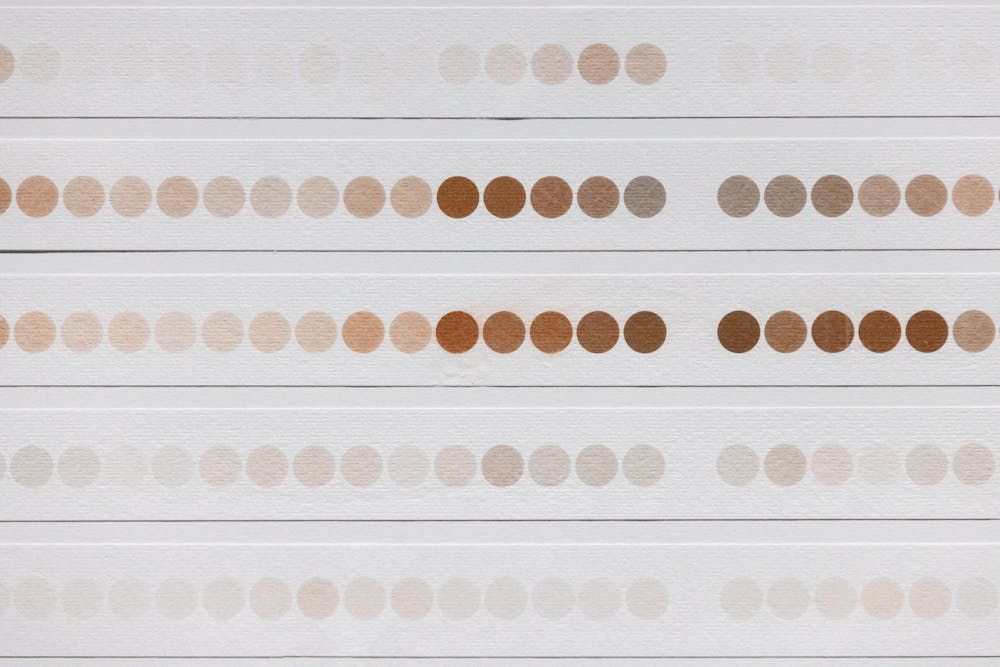 We Do Not All Breathe the Same Air, 2022, Tomás Saraceno. Courtesy the artist, neugerriemschneider, Berlin and Tanya Bonakdar Gallery, New York / Los Angeles.
Photo Credit: Mona/Jesse Hunniford Image Courtesy Studio Tomás Saraceno and MONA Museum of Old and New Art, Hobart, Tasmania, Australia
We Do Not All Breathe the Same Air, 2022, Tomás Saraceno. Courtesy the artist, neugerriemschneider, Berlin and Tanya Bonakdar Gallery, New York / Los Angeles.
Photo Credit: Mona/Jesse Hunniford Image Courtesy Studio Tomás Saraceno and MONA Museum of Old and New Art, Hobart, Tasmania, Australia
Printed Matter(s) are exquisite images of cosmic dust invisible to the naked eye that surround us. They are printed with black carbon PM2.5 pollution extracted from the air in Mumbai on featherlight handmade paper.
Distantly spotlit, the images shift in and out of focus in response to currents of air. The invisible is made fleetingly visible, the insubstantial paper accentuating what is held in currents of air.
In Webs of At-tent(s)ion, 2022, Saraceno convincingly lays claim to the cultural activity of the “More Than Human World”: a phrase coined by the ecologist and philosopher David Abrams to include humans within a broader understanding of the natural world.
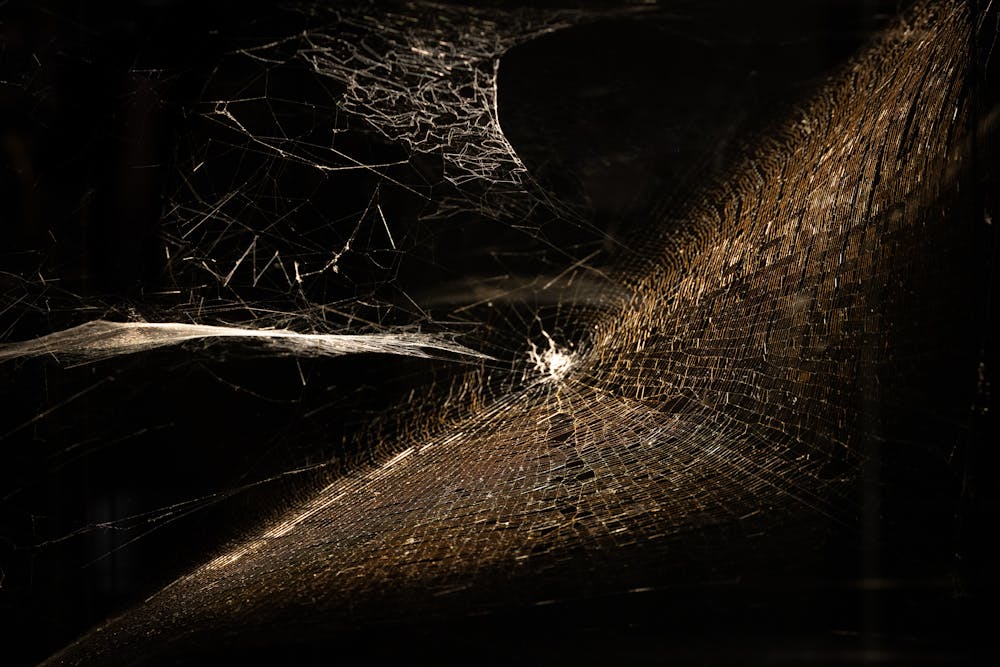 Webs of At-tent(s)ion, 2022, Tomás Saraceno. Courtesy the artist with Arachnophilia, neugerriemschneider, Berlin and Tanya Bonakdar Gallery, New York / Los Angeles Photo Credit: Tomás Saraceno.
Image Courtesy Studio Tomás Saraceno and MONA Museum of Old and New Art, Hobart, Tasmania, Australia
Webs of At-tent(s)ion, 2022, Tomás Saraceno. Courtesy the artist with Arachnophilia, neugerriemschneider, Berlin and Tanya Bonakdar Gallery, New York / Los Angeles Photo Credit: Tomás Saraceno.
Image Courtesy Studio Tomás Saraceno and MONA Museum of Old and New Art, Hobart, Tasmania, Australia
We are presented with glass and metal frames containing exquisite spider web architectures. The constellations of webs were made from spiders invited by a thread to weave within the carbon-fibre frames provided in the space of the studio.
The resilience of the fully formed webs when preserved in glass boxes is made testament through surviving shipping from Saraceno’s Berlin studio.
These intricate universes are spotlit in the darkened gallery. Walking around these forms in the gallery reveals innovations in materials and forms undreamed of by humans.
Read more: Explainer: what are the environmental humanities?
New ways of being
The video Living at the bottom of the ocean of air takes us into the life of the diving bell spider who gathers a bubble of air to live under the surface of water. It is in keeping with the sensation of being in the subterranean depths of Mona where air has been trapped and circulated for our survival.
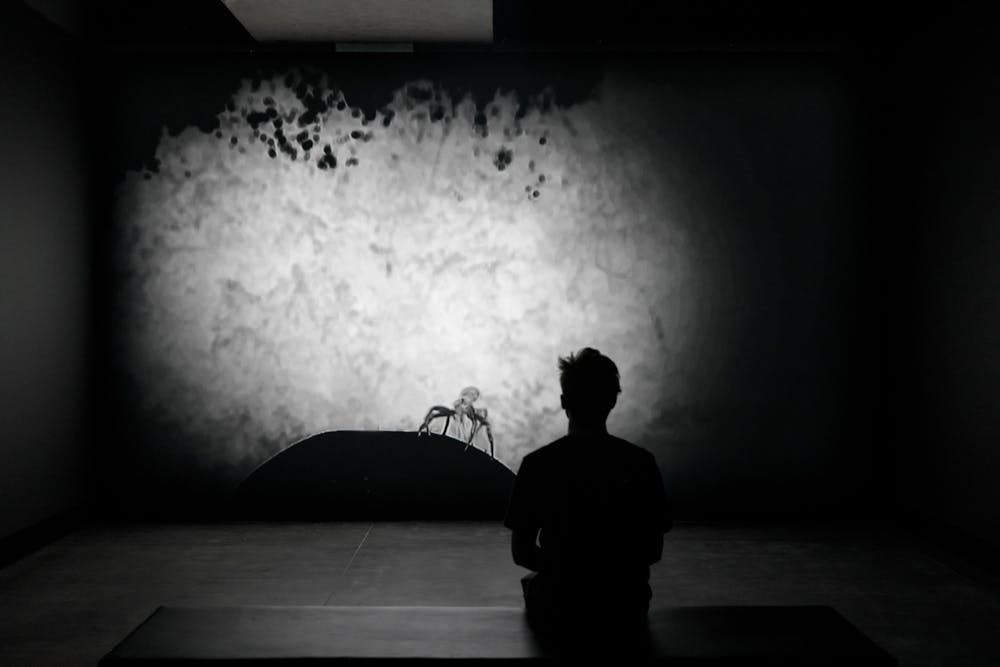 Living at the bottom of the ocean of air, 2018, Tomás Saraceno, Courtesy the artist and Andersen’s, Copenhagen; Ruth Benzacar, Buenos Aires; Tanya Bonakdar Gallery, New York/Los Angeles; Pinksummer Contemporary Art, Genoa; neugerriemschneider, Berlin.
Photo Credit: Mona/Jesse Hunniford Image Courtesy Studio Tomás Saraceno and MONA Museum of Old and New Art, Hobart, Tasmania, Australia
Living at the bottom of the ocean of air, 2018, Tomás Saraceno, Courtesy the artist and Andersen’s, Copenhagen; Ruth Benzacar, Buenos Aires; Tanya Bonakdar Gallery, New York/Los Angeles; Pinksummer Contemporary Art, Genoa; neugerriemschneider, Berlin.
Photo Credit: Mona/Jesse Hunniford Image Courtesy Studio Tomás Saraceno and MONA Museum of Old and New Art, Hobart, Tasmania, Australia
In the many rooms, we begin to realise the networks Saraceno has set up. He is weaving interconnections around the world using human technology to question itself, ask new questions and imagine new ways of being in the world.
Nearing the end of the exhibits we encounter Sounding the Air, 2022, which has threads of spider silk suspended between poles, inspired by ballooning – where some spiders release threads to take flight on currents of air. As the threads here drift in the air, their physical undulations are translated by video into sound.
As we exit the exhibition and once again encounter the silver orbs floating in the Mona staircases, we connect again with Saraceno’s invitation to become explorers in sympathy with the rhythms of the earth.
Tomás Saraceno: Float on Oceans of Air is at Mona, Hobart, until July 24.
Authors: Jan Hogan, Senior lecturer, School of Creative Arts & Media, University of Tasmania


















