Modern Australian
The Times

The Morrison government spent a record amount on taxpayer-funded advertising, new data reveal

  • Written by Kate Griffiths, Deputy Program Director, Grattan Institute
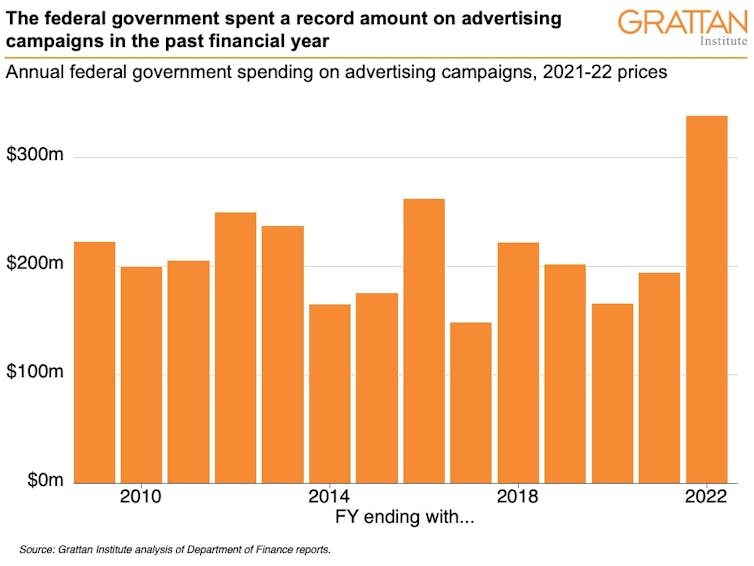
Graph showing annual federal government spending on advertising campaigns

The federal government is a big spender in the advertising world, regularly spending more than major companies such as McDonald’s, Telstra and Coles. New data released on Friday by the Department of Finance shows that in the lead-up to the May 2022 election, the Coalition government’s advertising spend skyrocketed yet again.

The past financial year was the biggest year on record for taxpayer-funded advertising. The previous federal government spent A$339 million on taxpayer-funded advertising campaigns in 2021-22, well above the 25-year average of about $200 million a year.

In the first six months of 2022, the previous government was the biggest advertising spender in the country.

Graph showing annual federal government spending on advertising campaigns
The Morrison government ran 28 separate advertising campaigns last financial year – the most on record. Many were for legitimate purposes, such as an $89 million campaign encouraging take-up of the COVID-19 vaccine, and a $25 million campaign urging people to fill out the Census. But sometimes, taxpayer-funded advertising campaigns seek to confer a political advantage. This is often achieved by including party slogans or colours, and/or spruiking government achievements – often in the lead-up to elections. Chart showing the top 20 most expensive taxpayer-funded campaigns for 2021-22
Author provided Why does government advertising spike before elections? Taxpayer-funded advertising typically spikes in election years, and 2022 was no exception. In the six months leading up to the 2022 election, the Coalition government spent about $180 million, compared with about $120 million in the six months leading up to the 2019 election. Chart showing federal government advertising spend spikes just before federal elections Author provided An otherwise legitimate campaign might be strategically run pre-election to encourage a positive impression of the government. For example, an $18 million federal government campaign on recycling was called out by the then-Labor opposition as “ridiculous and self-serving greenwash”. But usually, pre-election advertising also contains messages that look politically motivated – promoting the government’s policy platform on key election issues. For example, the $28.5 million Emissions Reduction campaign – the third most expensive campaign of the year – ran from September 2021 to April 2022, and sought to promote the government’s “good progress” on reducing greenhouse emissions and switching to renewable energy. The campaign clearly used messaging that created a positive image of the government’s performance, and lacked a call to action that might justify it on public interest grounds. Grattan Institute analysis shows that typically, about a quarter of government spending on advertising is politicised in some way, by both sides of politics. Historically, about $50 million on average each year has been spent on campaigns that are politicised. The former government’s “COVID-19 Economic Recovery Plan” fell into this category, because it blatantly spruiked the government of the day, without requiring any action or behaviour change from citizens. Officially, the campaign sought “to inform Australians about the government response to the recurring challenges being faced and reassure [us] there was an adaptable and future-focused plan in place for the economy”. This was criticised by Labor Senator Tim Ayres in early 2022, who asked: What possible public purpose is there in ‘Australia’s Economic Plan – we’re taking the next step’? […] What is it asking people to do apart from vote Liberal? Why is politicisation of taxpayer-funded advertising harmful? Politicisation of taxpayer-funded advertising is wasteful and creates an uneven playing field in elections. Government advertising budgets are well above the expenditure of individual political parties, even in election years. We won’t know until February 2023 how much political parties spent in the 2022 federal election. But in the lead-up to the 2019 election, the Coalition spent $178 million, Labor $122 million, and Clive Palmer $89 million, with advertising only a portion of their expenses. Read more: How big money influenced the 2019 federal election – and what we can do to fix the system How things should change The new federal government has announced it will cut taxpayer-funded advertising, although by how much is not yet clear. Labor has promised to tackle advertising as part of its broader “rorts and waste” audit. That promise to cut wasteful spending will be best tested by whether Labor tightens the rules and oversight for government advertising. Public money should not be used to spruik government policies. It should be used only on public-interest advertising campaigns that have a clear “need to know” message and a call to action. An independent panel should be established to check compliance. The panel should have the power to knock back campaigns that aren’t compliant – whether they are politicised, or more generally don’t offer value for money. And if the rules are broken, then the political party – not the taxpayer – should foot the bill for the entire advertising campaign. Establishing a proper process is the only way to truly reduce waste and restore public confidence in genuinely important government messages. Kate Griffiths and Anika Stobart are coauthors of New politics: Depoliticising taxpayer-funded advertising, Grattan Institute, 2022. Authors: Kate Griffiths, Deputy Program Director, Grattan Institute

Read more https://theconversation.com/the-morrison-government-spent-a-record-amount-on-taxpayer-funded-advertising-new-data-reveal-196870

Celebration of Life vs Traditional Funeral: What's the Difference?

When saying goodbye to someone you love, there is no single way to honour their life. Every family has different traditions, beliefs, and preference...

Building Approval for Roofing Projects: What Homeowners Need to Know

Roofing projects are an important part of maintaining and protecting your home. Whether you're repairing storm damage, replacing an ageing roof, or ...

Chatswood Tutoring And Its Role In Academic Achievement

Academic success often requires more than classroom attendance alone. Students face increasing expectations as they progress through school, particu...

Why Laser Hair Removal Treatments Continue Growing In Popularity

Managing unwanted hair can become time-consuming and frustrating for many people, especially when shaving, waxing, and other temporary methods requi...

Choosing the Right Devices for a Flexible Workplace

For IT leaders managing large fleets, the device layer is where workforce productivity and security policy meet. The shift towards flexible and hybrid...

How Business Advisory Services Help Companies Achieve Sustainable Growth

Every business owner aims to build a profitable and sustainable organisation. While dedication, innovation, and hard work are important, achieving l...

Why Body Contouring Has Become A Popular Cosmetic Treatment

Many people maintain healthy lifestyles through regular exercise and balanced eating habits but still struggle with stubborn areas of fat that are d...

How to Choose the Right POS Hardware for Your Business in Australia

A lot of Australian business owners spend weeks researching POS software but buy hardware almost as an afterthought. That's a mistake. The wrong har...

Why Material Handling Hose Is Critical for Industrial Efficiency

A high-performance material handling hose is an essential component in industries that transport abrasive, dry, or bulk materials on a daily basis...

How to Choose the Right Lawyer in Melbourne for Your Situation

Choosing legal support can feel difficult, especially when the stakes are personal or business-related. The right lawyer in Melbourne should underst...

Hoteliers Look to Clever Value Adds to Increase Revenue

The Australian hospitality industry is still in recovery mode after a notoriously rough patch in recent years. While there has been a post-COVID tra...

Moving to Queensland? Here’s How to Prep Your Car for the Big Move North

There’s no sign of the northern migration slowing down, with thousands of southerners fleeing from chaotic lifestyles and cooler climates for a brig...

Diesel Shortage to Impact Trades and Contractors

Strait of Hormuz blockage affecting all major parts of trades and construction Trades and construction across residential, commercial and industria...

Why Holiday Home Owners Turn to Rental Management Agents

The Allure — and the Reality — of Renting Out Your Property Owning a holiday home is a dream for many Australians. Whether it's a beachside sha...

Why Finding Reliable Doctors In Bundoora Is Important For Long-Term Health

Access to quality healthcare plays an important role in maintaining overall wellbeing and managing health concerns early. Trusted Doctors in Bundoor...

Understanding the Different Types of Car Services: Minor vs Major

When it comes to car maintenance, one of the most important things every vehicle owner should understand is the difference between a minor and a maj...

How Superannuation and TPD Insurance Work Together

Superannuation is an essential part of financial planning in Australia. It is designed to provide individuals with income during retirement, helping...

Tiny Towns funding granted for Mt Hotham and Mt Buller upgrades

Alpine Resorts Victoria (ARV) has welcomed funding support from the Victorian Government’s  Tiny Towns Fund, with both Mt Hotham and Mt Buller se...