

MMP in New Zealand turns 30 at this year’s election – a work in progress, but still a birthday worth celebrating
- Written by: Richard Shaw, Professor of Politics, Massey University
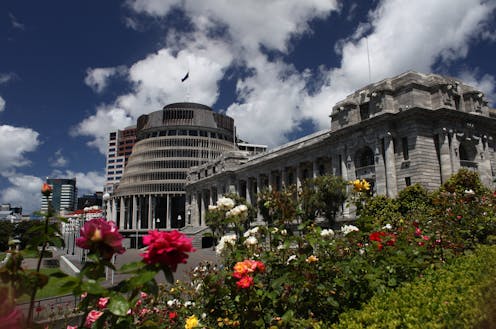
In a tidy alignment of round numbers, this year’s general election will also mark the 30th anniversary of the binding referendum that ushered in the mixed member proportional (MMP) system of voting. It will also be the tenth election held under the proportional system, truly a generational milestone in New Zealand’s political history.
But the public disquiet that led to the country voting out the old first-past-the-post (FPP) system goes further back, at least as far as the 1978 and 1981 elections. Both saw the centre-left Labour Party lose, despite having won a higher percentage of the vote than the victorious centre-right National Party.
The winner-takes-all nature of FPP also sidelined popular minority parties. In 1981, for example, the Social Credit Party won 20.7% of the vote but only two seats. In fact, most parties’ seats in parliament rarely reflected their share of the vote.
In 1984, Labour commanded 60% of parliament, having won only 43% of the vote. Six years later, National owned 70% of the seats based on 47.8% of the vote. As Lord Hailsham famously put it, Westminster jurisdictions were (and are) effectively “elected dictatorships”.
FPP governments tended to deploy their parliamentary majorities with the kind of arrogance that eventually led to the vote for change. Moreover, FPP parliaments failed to reflect the country’s demographic diversity: 77 of the 99 members of the final FPP parliament were men, there were only eight Māori MPs, a single Pasifika MP, and no one of Asian heritage. Hardly a house of representatives.
Accidental reform
The Royal Commission on the Electoral System (RCES) made an early case for change in 1986, but until the late 1980s electoral reform was a niche issue. It took a televised blunder from Labour prime minister David Lange to ignite the debate.
In the final leaders’ debate before the 1987 election, National’s Jim Bolger criticised Lange for ignoring the RCES recommentations. To his own colleagues’ surprise, Lange then went off-script and gave an undertaking that Labour would stage a referendum if reelected.
Lange reneged on the promise, enabling Bolger to give his own commitment during the 1990 campaign that a National government would hold a single binding referendum on the electoral system.
In the event, National strung the process out by legislating for two referendums. An indicative ballot in September 1992 was the first time in a Westminster parliamentary democracy that citizens were given the opportunity to change their electoral system – 84.7% of the 55% of eligible voters who turned out opted for change, and 70.5% indicated a preference for MMP.
That result triggered the second and binding referendum, a straight drag race between FPP and MMP, held in conjunction with the 1993 general election. The campaign leading up to the crucial decision was divisive and at times dirty.
On one side stood the pro-MMP Electoral Reform Coalition, supported by the minor political parties, Grey Power, some unions and the Māori Congress. On the other side, the Campaign for Better Government was backed by powerful corporate lobby group the Business Roundtable, the Employers Federation and a number of chambers of commerce.
Neither Labour nor National took an official position, but most MPs supported FPP. Indeed, Labour’s Helen Clark and National’s Simon Upton established the bi-partisan Campaign for First-Past-the-Post.
The second referendum was far closer than the first, with 53.9% ticking the box for MMP. But the result meant that when the country went to the polls in 1996, it was under a new electoral system. Contrary to some predictions, the sky did not fall.
Moderation and compromise
Fast forward three decades and the political landscape has changed considerably. Parliament is larger, with 120 members (occasionally one or two more, depending on the electoral caclulus), and therefore better placed to scrutinise executive activity.
It’s also more diverse than its FPP predecessors: the current House of Representatives contains more or less equal numbers of female and male MPs, 25 Māori MPs (bearing out the hopes of those for whom MMP meant “more Māori parliamentarians”) and 18 members of Chinese, Cook Island Māori, Eritrean, Indian, Iranian, Korean, Maldivian, Mexican, Samoan, Sri Lankan and Tongan descent.
There are also wider lessons to be drawn. The arguments of naysayers notwithstanding, MMP has not led to government instability. We have learned how to form and maintain multi-party and minority governments, none of which has fallen to a confidence motion or failed to pass a budget. And, unlike the original Westminster jurisdiction, New Zealand prime ministers have generally seen out multiple parliamentary terms.
MMP also tends towards policy moderation. For some – including the senior public servants who hoped it would lock in the public financial management reforms of the 1980s and 1990s – that’s the point. Others argue it prevents decisive policy action.
Despite heading a single party majority government – the only one under MMP, and the first since 1951 to secure a majority of the vote – Jacinda Ardern has tended not to rule by virtual decree the way some of her FPP predecessors did. She has been cautious (too much so for some), mindful that more normal minority or coalition government will inevitably soon return.
Ardern’s reluctance to throw her parliamentary weight around can be read another way, too. The imperative under MMP to build and maintain executive and legislative alliances also encourages political centrism.
Compromise can be frustrating, but over the long haul it can also help prevent the kind of political division and constitutional chicanery that have plagued nations with FPP electoral systems. Zero-sum games tend to apply in electoral politics: when winners take it all, others lose out.
A work in progress
Not everything has changed under MMP. True, small parties are often central to the formation of governments, either as formal coalition partners or parliamentary support parties, but the two major players continue to dominate.
Their combined vote share has dropped – in the nine elections before 1996, National and Labour captured 82.5% of the vote between them, compared with 72% across all nine MMP elections. But under MMP they have provided all of the prime ministers, the overwhelming share of cabinet ministers, and the vast majority of budget commitments.
Read more: Lowering New Zealand's voting age to 16 would be good for young people – and good for democracy
MMP also needs refining as it evolves. The increase in the number of constituency seats relative to list seats is eroding the system’s capacity to deliver true proportionality.
And the thresholds for securing parliamentary seats are under scrutiny as part of the Independent Electoral Review. The 5% party vote threshold is arguably too high, while the ability to “coat tail” several MPs into parliament off a single constituency win unduly advantages small parties. But those are details in which there are few, if any, devils.
Aotearoa New Zealand, as elsewhere, faces challenges to its democracy. But coalition governments and diverse parliaments are not among them. Most people won’t notice when MMP celebrates its tenth election this year – that alone is a sign of just how far we’ve come.
Authors: Richard Shaw, Professor of Politics, Massey University


















