

After devastating earthquakes, Indonesia must embrace radical change
- Written by: Jonatan A Lassa, Senior Lecturer, Humanitarian Emergency and Disaster Management, Charles Darwin University
An earthquake on Lombok island in Indonesia has left 98 people dead and 20,000 people homeless, according to the National Disaster Mitigation Agency.
Around 70% of North Lombok’s housing stock has either collapsed or been severely damaged. Just a week earlier, a 6.5-magnitude earthquake hit a nearby region, destroying tens of houses and claiming 10 lives, and injuring more than a dozen people.
Read more: Two types of tectonic plate activity create earthquake and tsunami risk on Lombok
As the area recovers, we need to ask: how can Indonesia address its vulnerability to earthquakes?
We know that Indonesia can improve its response to natural disasters, which has happened with tsunami preparedness. The next challenge is to apply these lessons to seismic activity.
Prepare for tourists
Thousands of tourists were caught in panics after both earthquakes. It’s time for Indonesia’s emergency systems to address the vulnerability of foreign visitors as well as its own citizens.
With tourism on the rise in many earthquake-prone areas, solid preparation measures need to be put in place. Vulnerable hotels and fragile houses can jeopardise tourism’s future.
The past 30 years have been filled with wake-up calls. A 1992 earthquake that struck Flores island caused 15,000 houses to collapse in a single district alone. It took almost 20 years for tourism to recover.
More technology isn’t the answer
It’s often easier to attract international funding to sophisticated new technology for hazard prediction and monitoring – for example, the Australia-funded Inasafe, which has the potential to help government to develop scenarios for better planning, preparedness and response activities, and the US-funded Inaware which is a disaster management tool aimed at improving Indonesia’s risk assessment and early warning systems.
At the same time, it is not clear how these technological advancements will serve to help small hotels or households in earthquake-prone regions. What people really need is need help to build structures in accordance with proper construction codes, so that they don’t become death-traps during an earthquake.
This points to a deeper problem. Such building codes already exist, but local governments are currently showing little desire to comply with national building regulations.
For example, before 2011, less than 12% of local governments adopted and endorsed the Building Law 2002. By 2016 that figure had risen to 60% – an improvement, but still not enough.
In North Lombok, where most houses collapsed in the recent earthquakes, the local government only endorsed national building regulations in 2011. It will take years for the local administrators to actually implement them.
The no-regreat approach
To save lives, we need to move beyond the idea that perfect risk assessment exists.
Seismic mitigation measures need to start immediately, at the local level. Thousands building are built every day and right now, while many are rebuilding after disaster, is the time for local governments to put into practise the codes and standards that exist at a national level.
Local and central governments can embrace innovation. Central government and local governments in Indonesia must focus on transforming the way houses are built, including checking earthquake preparedness when issuing building permits.
Can local government radically audit all vulnerable houses? And can we create a machine of local bureaucrats who can deal with the risk assessment on every single house in earthquake prone regions?
It may seem hard, but good practices are already available. Apart from creating incentives for local engineers, contractors, and building consultants to be mindful of seismic measures, local governments can also gradually audit critical public buildings, which are particularly crucial to disaster to response (and may be especially dangerous if they collapse).
Indonesia could even follow California’s example and publicly shame the owners of buildings that the building code.
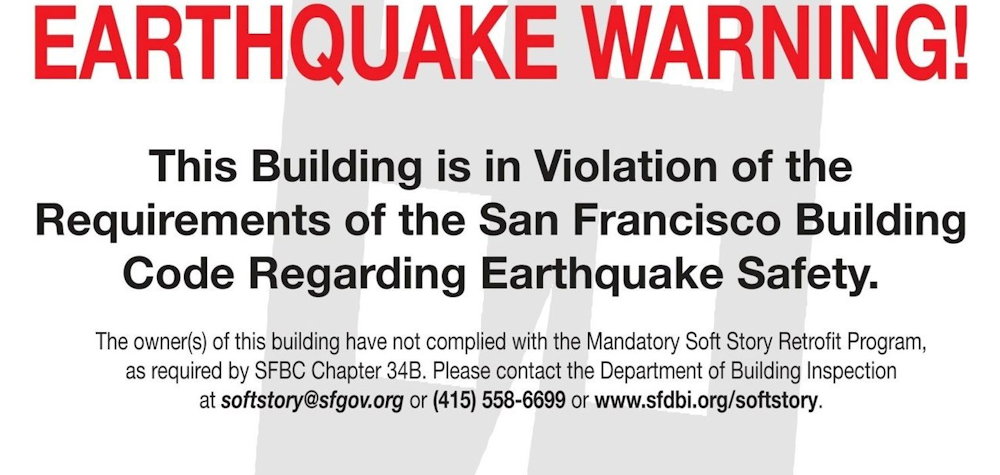 A sign from California alerting passers-by to a potentially dangerous building.
It will require radical reform in public administration, including construction at local level. Without this radical change, the status quo will remain and people will continued to be killed by their houses when moderate to big earthquakes hit their area.
Read more: How earthquake safety measures could have saved thousands of lives in Nepal
The present approach is failing. Stronger political and administrative commitments are needed at all levels.
Authors: Jonatan A Lassa, Senior Lecturer, Humanitarian Emergency and Disaster Management, Charles Darwin University


















