

Can reading help heal us and process our emotions – or is that just a story we tell ourselves?
- Written by Jane Turner Goldsmith, PhD candidate, Creative Writing, University of Adelaide
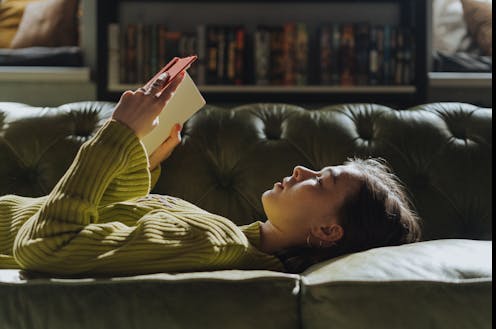
The oldest known library, dating back to the second millennium BC, in Thebes, Egypt, reportedly bore a sign above its portals in Greek: Psyches Iatreion, translated as “healing place of the soul”.
The idea that reading may confer healing benefits is not new, but continues to intrigue readers and researchers.
Of course, this doesn’t apply to reading about how to put up the tent, or tidy our piles of household stuff. When we talk about books that might offer a balm for the soul, we mean fiction, poetry and narrative non-fiction (including memoir).
The idea of emotional catharsis through reading is intuitively appealing. But does it work that way? Or do we read for interest, pleasure, escapism – or love of words?
Reading as catharsis and transport
“The highest aspiration of art is to move the audience,” claims George Saunders. Who is not still moved by the first book that affected them on a cellular level – whether that’s Storm Boy, The Little Prince, or their high-school reading of To Kill a Mockingbird?
According to the authors of The Novel Cure: an A-Z of Literary Remedies,
novels have the power to transport you into another existence, and see the world from a different point of view […] sometimes it’s the story that charms; sometimes it’s the rhythm of the prose that works on the psyche, stilling or stimulating.
Humans imitate or re-present the world through art: poetry, drama and epic. That drive, claimed Aristotle, sets humans apart from animals.
In 1987 Jerome Bruner proposed that “world making” is the “principal function of mind”, in both the sciences and arts. As humans, we are drawn to the momentum of narrative to tell our stories, he says.
We seek to make sense of the events in our lives, as if life really were a three-act play with a clear narrative arc. (Conveniently summarised as: “Get him up a tree; throw rocks at him; get him down.”)

Read more: Friday essay: empathy or division? On the science and politics of storytelling
How reading works
Reading is one way we seek to understand our worlds. Evolutionary psychologists propose the brain is “designed for reading”, just as it is for language, facial recognition or other drives. The act of reading engages both cognitive and – especially where there’s a narrative – emotional processes.
Children learning to read must first grasp the basics of recognition (sound-letter-phoneme-word) and then proceed to the higher-order cognitive skill of comprehension of the meaning of the text (semantics).
It is at that next level of meaning-making that words connect and stir the emotions. That might be fear (Frankenstein), love (Pride and Prejudice), outrage (Germaine Greer’s polemic The Female Eunuch) or existential angst (Albert Camus’ philosophical novel L’Etranger/The Outsider).
But how does this process “work”? Or, as Saunders puts it: “How does [the writer] seduce, persuade, console, distract?”
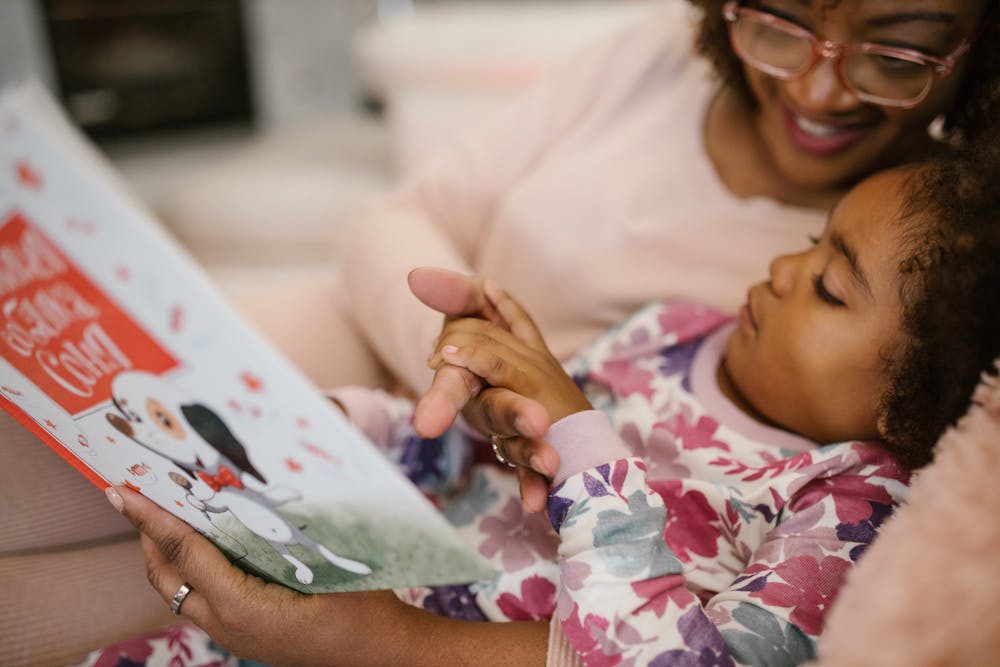 Evolutionary psychologists says the brain is ‘designed for reading’.
Rodnae Productions/Pexels, CC BY
Evolutionary psychologists says the brain is ‘designed for reading’.
Rodnae Productions/Pexels, CC BY
How reading between the gaps invites us in
World or meaning making can occur directly by acquiring knowledge (for example, when reading that tent manual) or indirectly, through our engagement with the social world, art and our meaning-making faculties.
Works of art invite thought and feeling. This “indirect communication” of literature is one of the unique affordances (or benefits) it offers readers.
Meaning-making is a transaction between author, text and reader; the “gap” between the words and the reader’s interpretation, shaped by their own experiences and predispositions, is critical. Thus, an author might seek to move a reader – but whether the reader is moved will depend on individual circumstances and preferences. (Not the least among these is the skill of the writer, of course.)
Book clubs, where heated discussions can be motivated by how books and their characters made readers feel, are a great example. So is consumer review site Goodreads, and #BookTok, the sector of TikTok where books that make readers cry dominate.
As Flannery O’Connor says, “the writer can choose what he writes about but he cannot choose what he is able to make live” (my italics). In other words, some books will always speak to some readers. And those same books will leave other readers cold – or even make them regret joining a book club.
An author might want to move a reader, but a reader’s emotional reaction – whether sadness, rage or indifference – is particular to them.What neuroscience tells us about reading
Virginia Woolf wrote of books as “mirrors of the soul”. And contemporary neuropsychologists have proven it, with brain-imaging studies.
These studies have demonstrated that when a person indirectly experiences an event associated with an emotion, the same regions of the brain are activated as if they had experienced the event directly.
We feel disgust, whether we actually discover (or half-eat) the maggot in the ham sandwich or view a TikTok video of the simulated event. The same fear is elicited in the brain when we walk a tightrope in a virtual reality simulation, view the film of Phillipe Petit in The Walk, or high-wire walk ourselves (do not try this at home). Mirror neurons prompt us to yawn or smile or frown when another person yawns, smiles or frowns.
The same fear is elicited in the brain when we see a high-wire walk, like Phillippe Petit’s, read about it, or do it ourselves.The other person – the protagonist, in a book – can be completely fictional, the entire plot make-believe: yet we still cry. Who of us hasn’t wept real tears when tragedy befalls a favourite character in a novel? (For me, it’s the death of shell-shocked World War I soldier Septimus in Virginia Woolf’s novel Mrs Dalloway.)
The psychology of fiction
University of Toronto professor emeritus and author-psychologist Keith Oatley explains that reading narratives allows us to “simulate” a social world where we identify with characters and their struggles, and observe their way of solving conflicts.
This way we can process emotional content and solve life’s problems indirectly. It’s much more effective than being given the solution! Oatley’s research has also demonstrated that readers’ long-term engagement in fiction (especially literary fiction) improves their empathy and their ability to take the perspective of another person (referred to as “Theory of Mind”).
Oatley suggests: “We need not lead one life; through fiction we can lead many lives”.
 Reading can help us understand the inner lives of others.
Min An/Pexels, CC BY
Reading can help us understand the inner lives of others.
Min An/Pexels, CC BY
In this sense, reading can prompt us to understand the inner lives of others as well as our own. It can even help us to re-imagine the narrative of our lives – especially if we are not happy with the one we are actually leading. In this way, reading can provide both escape and a way to imagine (and perhaps start to plan for) alternative ways to live.
In her book Why We Read Fiction, Lisa Zunshine argues:
Fiction helps us to pattern in newly nuanced ways our emotions and perceptions […] it creates new forms of meaning for our everyday existence.
Quite apart from the practical benefits of this kind of cognitive and emotional gymnastics, Zunshine says our biggest reason for doing it is enjoyment itself.
Read more: Do art and literature cultivate empathy?
Does reading prompt emotional catharsis?
Marcel Proust wrote that a novelist can, in an hour, “set free all kinds of happiness and misfortune which would take years of our ordinary lives to know”.
Reading, as a hard-wired impetus and a form of engaging with art, allows us to process our emotions.
Importantly, this can be at a distance. We don’t have to directly, for example, pursue forbidden love and sort out the ensuing mess (Graham Greene’s The End of the Affair), or cope alone with alienation or discrimination (Alice Walker’s The Colour Purple). We can scare ourselves without ever having to go into the dark woods.
We can access experiences unavailable to us in life – and the positive feelings they produce can remain with us. For example, we can transform ourselves into magical, powerful heroes and heroines who prevail against impossible odds (Lord of the Rings).
Saunders suggests art (including literature) might be
an offering of sorts – a hypothesis for both writer and reader to take up and consider together […] the goal of that offering might be to ease the reader’s way; to make the difficulty of this life less for her. We try to give the reader a way of thinking about reality that is truthful, yes, and harsh, if need be, but not gratuitously harsh, a way of thinking that, somehow, helps her.
Authors: Jane Turner Goldsmith, PhD candidate, Creative Writing, University of Adelaide

















