

Is your child anxious about starting school? The approaches we use for children with disability can help all families
- Written by: Bethany Devenish, Research Fellow, School of Educational Psychology & Counselling, Monash University

Why does one child experience excitement at the thought of starting the school year while another experiences debilitating anxiety?
It’s rarely one thing and is often a combination of factors, including a child’s temperament and self-confidence; their previous experiences at school, kinder or childcare; friendships they’ve already formed; and the types of transition activities they’ve undertaken.
As psychologists and mental health researchers, we also look at how the family is coping, and the child’s previous history of mental health or developmental disability diagnoses.
The good news is research shows parents, schools and health professionals can intervene early to support children who are feeling anxious about school.
Our research team developed a program called AllPlay Learn to support children with disability, who are at higher risk of experiencing anxiety at school because of the additional load from new routines, friendships, expectations, and “sensory overload” (where the noise, clutter, smells and other sensory input from the classroom or playground become overwhelming and distressing to a child).
These strategies can help all children, parents and teachers to better cope with the transition to school, or going back after the holidays.
What does back-to-school anxiety look like?
Anxiety in children isn’t always easy to spot. The symptoms can range from very subtle changes to body language, through to defiant behaviours such as anger and acting out.
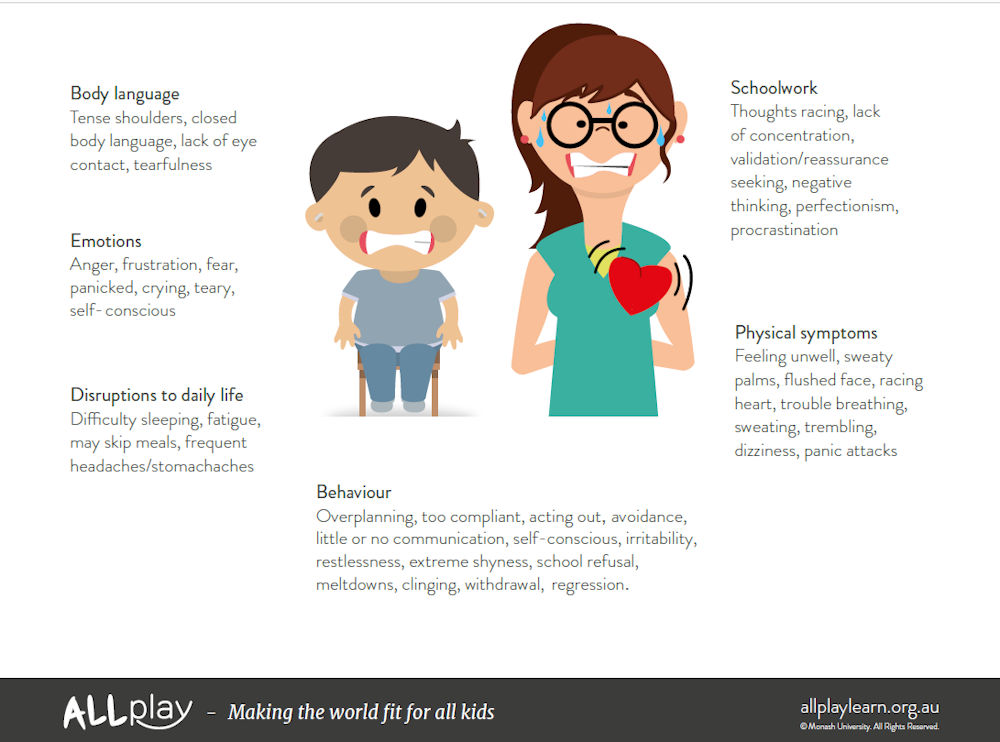
However, avoidant behaviour is a hallmark feature for anxious children. Everyone can relate to gravitating to what makes us comfortable – being at home, engaging in things we like and are good at, and avoiding what makes us anxious or overwhelmed.
At its extreme, anxious-avoidant behaviour in relation to school can turn into school refusal, where a student regularly misses school with their parents’ knowledge due to school-related emotional distress.
Read more: Anxiety can look different in children. Here's what to look for and some treatments to consider
4 ways parents can support their anxious child
How parents communicate about the new school year is important. Speaking positively about school and learning can reduce feelings of anxiety in children.
Parents can help children feel prepared and develop strategies to cope with feelings of anxiety by:
Familiarising them with their new school/classroom. Take your child to visit their new school or classroom, read stories about school and “play” school so they can practise things they’ll need to learn, such as packing their bag.
Helping them set goals. Encourage them to identify the things they can already do to get settled in their classroom, then set small goals for what they can do next. For example, “I can say goodbye without getting upset when my mum leaves. This term, instead of mum walking me into the classroom, I will wave through the window.”
Developing some “calming” supports. Ask what has helped them before when they had worries. They could practise relaxation breathing, have quiet bedtime activities, practise “brave statements” (such as “I might feel a little worried, but I know the teacher will be there if I need help”), or bring a special item from home.
Ensuring they can unwind after school. Some of the emotions your child has held inside all day may spill over when they return home. Consider calming activities, spaces or supports your child may need to process their emotions and sensory overwhelm.
How can teachers help children who are anxious?
Teacher support is important, particularly on arrival. Settling-in activities such as the choice to either read books or draw quietly can provide security to a child.
Communicating clear expectations of students, such as class rules, can also build trust between children and their teacher.
If a child is anxious, reflect on what aspects of school life might be contributing to anxious feelings and identify – with the child’s input – what they could manage with supports in place. For example, a child may feel able to separate from parents in the morning if they have a familiar toy or photo from home, and can have some quiet time in the classroom before the bell. Over time, these additional supports can be reduced.
Read more: Back to school blues: how to help your child with shyness
Allow children time and space to manage big emotions. Children may have different preferences for support when distressed, but may find it challenging to communicate their needs when anxious or upset.
Provide structure and predictability. Visual schedules, social narratives (stories that tell children what they can expect at school), and warnings for transitions can provide security. Knowing what to do and who to play with can be challenging for a child who is feeling anxious, particularly during unstructured school time such as lunchtime.
What if your child remains anxious about school?
Some children may experience significant signs of anxiety such as not sleeping, social withdrawal, changes in eating habits, or significant ongoing distress or unhappiness.
When children experience ongoing, significant signs of anxiety that don’t resolve, some additional supports may be needed to ensure your child’s wellbeing and feelings of safety at school.
Talk to your GP, who can rule out underlying medical factors and refer you to appropriate support services, such as a child and adolescent psychologist.
More evidence-based tips for supporting a child feeling anxious about starting the school year are available on the AllPlay Learn website. Other helpful resources include the Australian Psychological Society’s referral service, Kids Helpline, and Beyond Blue.
Authors: Bethany Devenish, Research Fellow, School of Educational Psychology & Counselling, Monash University


















