

Australia Day hasn't always been on January 26, but it has always been an issue
- Written by: Benjamin T. Jones, Senior Lecturer in History, CQUniversity Australia
January 26 is a date that sparks mixed emotions in Australia. For some, it’s a day to celebrate all the good things about living in Australia. For others, it’s a painful reminder of the beginning of British colonisation and the dispossession of First Nations.
Increasingly, January 26 is becoming a date that divides the nation even as it attempts to unite it. Some local councils have stopped holding citizenship ceremonies on the date. In 2018, Triple J stopped hosting its Hottest 100 on Australia Day, and this year Victoria announced it will no longer hold its Australia Day parade.
An Essential Poll this week suggests around a quarter of Australians would now prefer January 26 to be a day to recognise First Nations people with a national holiday on a separate day.
Those who defend the status quo often appeal to tradition, but it’s important to recognise Australia Day has not always been celebrated on January 26, and the meaning of the date has long been contested.
When did Australia Day begin?
In the early 19th century, January 26 was a Sydney-centric celebration, sometimes called “Foundation Day”. These were initially informal gatherings and parties, but by 1838, it was declared a public holiday to mark the 50th anniversary of the colony. As the other colonies were established, they celebrated their own foundation, rather than January 26.
During the Federation debates of the 1880s and 1890s, there was a push for a single national holiday. But some objected to January 26 on the grounds it was focused on New South Wales. Nevertheless, by the centenary of the British arrival in 1888, all colonies except South Australia observed the day.
However, even after Federation in 1901, the primary national holiday was not January 26 but “Empire Day”, celebrated on May 24. The choice of date (the late Queen Victoria’s birthday) and the form of celebrations were more imperial than nationalist in flavour.
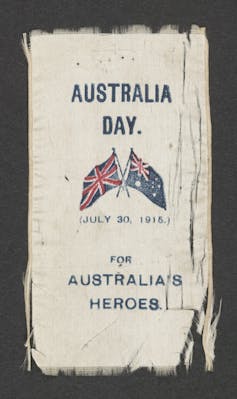
It was only in 1915 that Australia Day emerged, as a fundraising effort for the first world war. Held on July 30, the first Australia Day was directly shaped by the experience of the Gallipoli landing. It continued to be held in July for the remainder of the war.
By 1935, the states all agreed to use the name Australia Day and celebrate it on January 26. But it was a decision that caused controversy and protest. The 150th anniversary in 1938 was celebrated nationally but also saw First Nations declare the date to be a “day of mourning”.
Similarly, the 1988 bicentenary epitomised the contested meaning of January 26. It saw both sides – the largest party in Australia’s history and the largest protest since the Vietnam moratorium.
It was only in 1994 that Australia Day became a public holiday in every state and territory.
What are we celebrating?
Technically, January 26 does not mark the arrival of the First Fleet to Australia. Leaving England on May 13, 1787, the first ships arrived at Botany Bay on January 18, but Arthur Phillip decided it was not a suitable site. January 26 marks the day the British flag was hoisted at Sydney Cove.
Throughout the 19th century, January 26 was a celebration of Britishness held by people who largely identified as Australian Britons. As Australian national identity evolved in the middle of the 20th century, the narrative around Australia Day became more exclusively nationalistic. Civic rituals like the Australian of the Year (first awarded in 1960) helped give January 26 a national focus.
Today, Australia Day is presented as a day to “celebrate our nation”. But for many First Nations people and their allies, it’s considered “Invasion Day” or “Survival Day”.
If not January 26, then when?
Most countries hold their national holiday on the date they became independent. It’s a quirk of Australian history that the date the British flag was raised has taken this role, but it demonstrates how malleable national symbols can be.
If the date of Australia Day was to change, there’s no clear alternative, although some argue that if Australia becomes a republic, that should be the new date. A pragmatic alternative is simply to hold Australia Day on the last Friday of January. A more humorous suggestion is May 8, which pronounced with a broad Australian drawl sounds like the word “mate”.
Historic suggestions are the anniversary of the Eureka Stockade (December 3), the Mabo judgement (June 3), or the passage of the Australia Acts (March 3).
For all their wisdom, it could be argued the constitution writers did Australia a disservice by having the Commonwealth form on January 1, 1901. Had it been almost any other day of the year, the legal creation of Australia would be the obvious choice for a national holiday.
As emotive as the topic is, Australians should be free to debate what January 26 means and if it should continue to be the national holiday. The ability to openly debate tough issues without fear is, after all, one of the many freedoms Australia Day is supposed to celebrate.
Authors: Benjamin T. Jones, Senior Lecturer in History, CQUniversity Australia


















