

AI is helping us search for intelligent alien life – and we’ve already found 8 strange new signals
- Written by: Danny C Price, Senior research fellow, Curtin University
Some 540 million years ago, diverse life forms suddenly began to emerge from the muddy ocean floors of planet Earth. This period is known as the Cambrian Explosion, and these aquatic critters are our ancient ancestors.
All complex life on Earth evolved from these underwater creatures. Scientists believe all it took was an ever-so-slight increase in ocean oxygen levels above a certain threshold.
We may now be in the midst of a Cambrian Explosion for artificial intelligence (AI). In the past few years, a burst of incredibly capable AI programs like Midjourney, DALL-E 2 and ChatGPT have showcased the rapid progress we’ve made in machine learning.
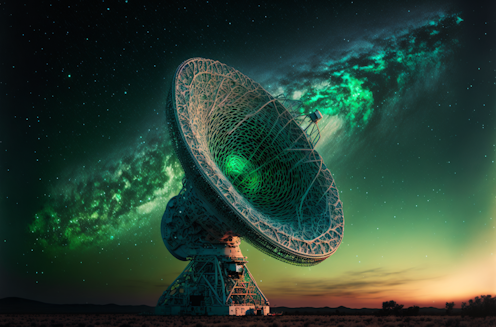
AI is now used in virtually all areas of science to help researchers with routine classification tasks. It’s also helping our team of radio astronomers broaden the search for extraterrestrial life, and results so far have been promising.
Discovering alien signals with AI
As scientists searching for evidence of intelligent life beyond Earth, we have built an AI system that beats classical algorithms in signal detection tasks. Our AI was trained to search through data from radio telescopes for signals that couldn’t be generated by natural astrophysical processes.
When we fed our AI a previously studied dataset, it discovered eight signals of interest the classic algorithm missed. To be clear, these signals are probably not from extraterrestrial intelligence, and are more likely rare cases of radio interference.
Nonetheless, our findings – published today in Nature Astronomy – highlight how AI techniques are sure to play a continued role in the search for extraterrestrial intelligence.
Not so intelligent
AI algorithms do not “understand” or “think”. They do excel at pattern recognition, and have proven exceedingly useful for tasks such as classification – but they don’t have the ability to problem solve. They only do the specific tasks they were trained to do.
So although the idea of an AI detecting extraterrestrial intelligence sounds like the plot of an exciting science fiction novel, both terms are flawed: AI programs are not intelligent, and searches for extraterrestrial intelligence can’t find direct evidence of intelligence.
Instead, radio astronomers look for radio “technosignatures”. These hypothesised signals would indicate the presence of technology and, by proxy, the existence of a society with the capability to harness technology for communication.
For our research, we created an algorithm that uses AI methods to classify signals as being either radio interference, or a genuine technosignature candidate. And our algorithm is performing better than we’d hoped.
What our AI algorithm does
Technosignature searches have been likened to looking for a needle in a cosmic haystack. Radio telescopes produce huge volumes of data, and in it are huge amounts of interference from sources such as phones, WiFi and satellites.
Search algorithms need to be able to sift out real technosignatures from “false positives”, and do so quickly. Our AI classifier delivers on these requirements.
It was devised by Peter Ma, a University of Toronto student and the lead author on our paper. To create a set of training data, Peter inserted simulated signals into real data, and then used this dataset to train an AI algorithm called an autoencoder. As the autoencoder processed the data, it “learned” to identify salient features in the data.
In a second step, these features were fed to an algorithm called a random forest classifier. This classifier creates decision trees to decide if a signal is noteworthy, or just radio interference – essentially separating the technosignature “needles” from the haystack.
After training our AI algorithm, we fed it more than 150 terabytes of data (480 observing hours) from the Green Bank Telescope in West Virginia. It identified 20,515 signals of interest, which we then had to manually inspect. Of these, eight signals had the characteristics of technosignatures, and couldn’t be attributed to radio interference.
Eight signals, no re-detections
To try and verify these signals, we went back to the telescope to re-observe all eight signals of interest. Unfortunately, we were not able to re-detect any of them in our follow-up observations.
We’ve been in similar situations before. In 2020 we detected a signal that turned out to be pernicious radio interference. While we will monitor these eight new candidates, the most likely explanation is they were unusual manifestations of radio interference: not aliens.
Sadly the issue of radio interference isn’t going anywhere. But we will be better equipped to deal with it as new technologies emerge.
Narrowing the search
Our team recently deployed a powerful signal processor on the MeerKAT telescope in South Africa. MeerKAT uses a technique called interferometry to combine its 64 dishes to act as a single telescope. This technique is better able to pinpoint where in the sky a signal comes from, which will drastically reduce false positives from radio interference.
If astronomers do manage to detect a technosignature that can’t be explained away as interference, it would strongly suggest humans aren’t the sole creators of technology within the Galaxy. This would be one of the most profound discoveries imaginable.
At the same time, if we detect nothing, that doesn’t necessarily mean we’re the only technologically-capable “intelligent” species around. A non-detection could also mean we haven’t looked for the right type of signals, or our telescopes aren’t yet sensitive enough to detect faint transmissions from distant exoplanets.
We may need to cross a sensitivity threshold before a Cambrian Explosion of discoveries can be made. Alternatively, if we really are alone, we should reflect on the unique beauty and fragility of life here on Earth.
Read more: We asked astronomers: are we alone in the Universe? The answer was surprisingly consistent
Authors: Danny C Price, Senior research fellow, Curtin University


















