

Hybrid future? Interbreeding can make heat-averse species more resilient to climate change
- Written by Luciano Beheregaray, Matthew Flinders Professor of Biodiversity Genomics, Flinders University
As the climate heats up rapidly, many species will struggle to avoid extinction. If they had time, they could evolve to the new environmental conditions. But they don’t. That’s where hybridisation could help. When related species interbreed, the flow of new genetic diversity could help them adapt to warmer environments.
Hybridisation can often be a cause for concern for species conservation. Our new research suggests genetic mixing across species may, in fact, offer better chances of survival for some species – especially those that don’t tolerate much environmental variation and are likely to be the worst hit by a hotter climate.
Some species won’t have to face a very uncertain future wholly alone. Related species may well be able to help.
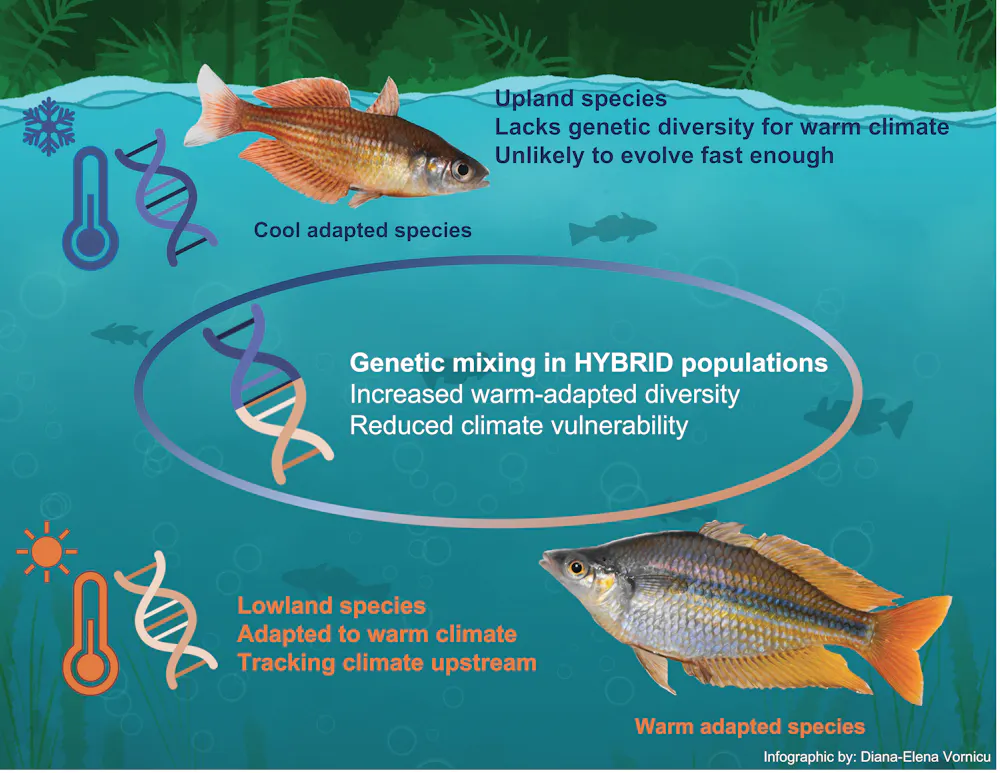
We looked at what happened when cold-adapted and warm-adapted rainbowfish interbred. We found the welcome infusion of new genetic diversity was a boon, bringing down the risk of extinction for threatened species and potentially making them more resilient.
What did we learn?
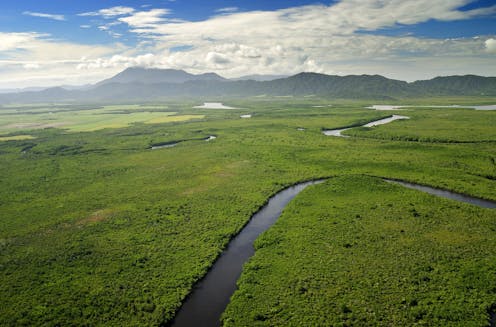
Australia’s wet tropics run roughly from Townsville to Cooktown, including the Daintree Rainforest. Sadly, this spectacular bioregion is expected to be particularly badly hit by climate change. The cooler climates of the mountainous rainforest are likely to vanish.
In the rivers here live many species of tropical rainbowfish (Melanotaenia spp.). Some species live in colder water, higher up in the headwaters. Others live in the warmer waters lower down, but are slowly moving up the rivers as the climate warms. Different rainbowfish species can readily interbreed.
Read more: How hybrids could help save endangered species
We collected samples of five species of rainbowfish adapted to life at different elevations. These included a widespread lowland species known for its adaptability, as well as three species only able to live in a narrow range of mountain rivers and one only able to live in the lower reaches.
Using genomic analyses, we found a mixture of pure and hybrid populations of these rainbowfish species. Then, we found the genes enabling rainbowfish to adapt to the region’s varying climates and estimated how vulnerable each of the species was to future climate.
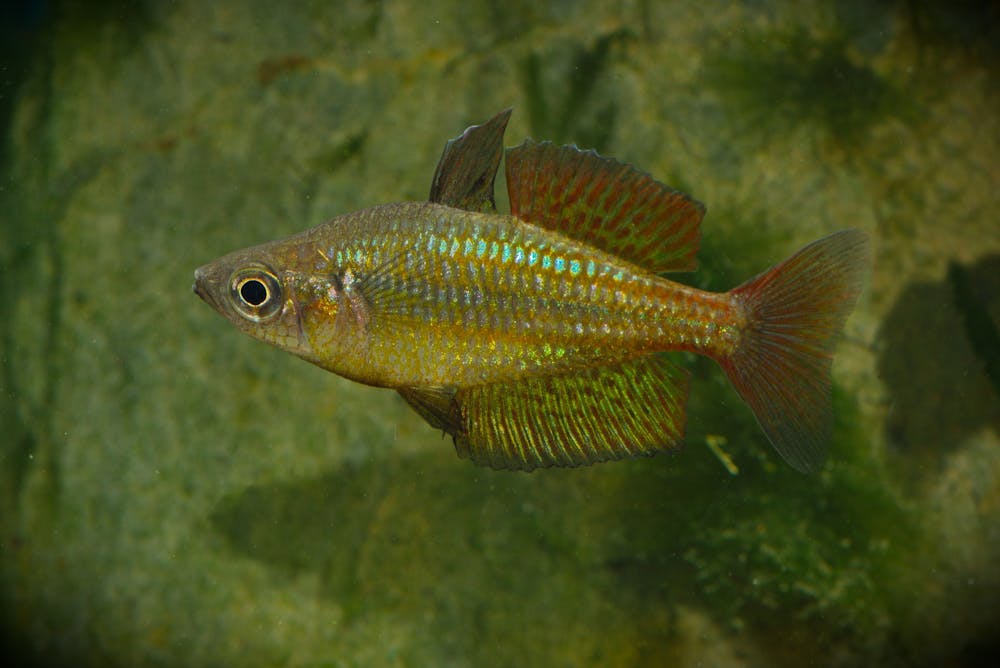 One of the rainbowfish species we collected from Australia’s wet tropics.
Keith Martin, Author provided
One of the rainbowfish species we collected from Australia’s wet tropics.
Keith Martin, Author provided
What did we find? That the cooler-water rainbowfish species were better placed to adapt to future climates if they had hybridised with the generalist warm-water species.
Then we modelled the habitats available to cool-water species against the warming expected in climate models. We found upland rainbowfish species would probably lose more than 90% of their habitat within 50 years, while the lowland warm-water species would lose relatively little habitat.
If the upland species are to survive, they have to either find new habitats or adapt to new conditions. Freshwater fish are, of course, extremely limited in their ability to find new habitat. These rainbowfish, in particular, live in Australia’s last remaining cool tropical cloud forests. Even if we wanted to relocate them, there’s not many places for them to go.
The only other option is to adapt in situ.
Luckily for rainbowfish – and potentially, many other species – we found hybrid fish from warm and cool species had more genetic diversity. This was particularly true for genes associated with the ability to live in warmer conditions.
These hybrids also don’t require as much overall genetic change to keep up with climate change compared to the pure populations. Taken together, that means we could be seeing a kind of natural evolutionary rescue, which may help moderate the impact of climate change.
They’ll need every bit of help they can get to escape the hot water they’ll find themselves in. Our climate models suggest pure rainbowfish populations will need to evolve far faster in the coming decades than they did since the arrival of the Holocene era about 11,000 years ago.
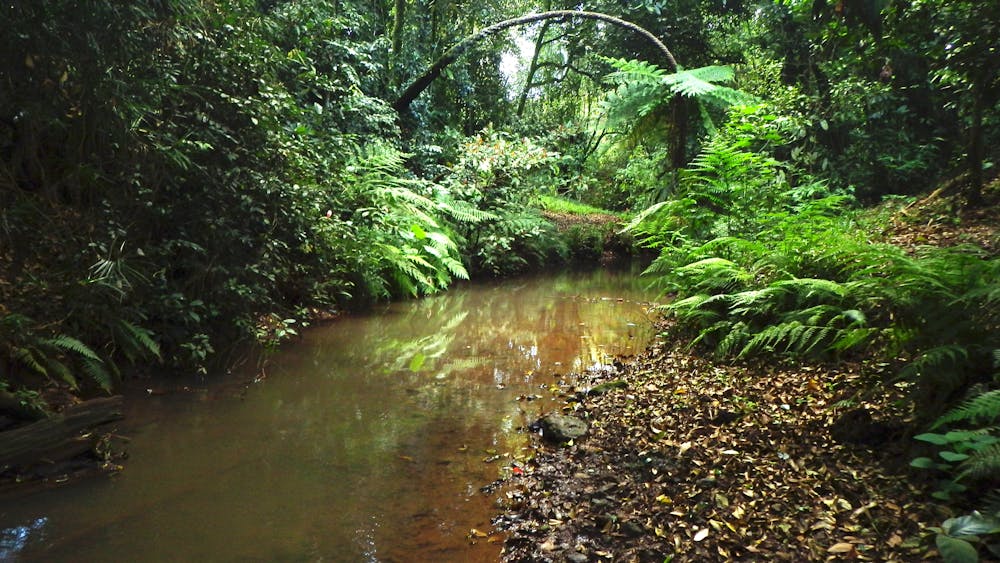 Many species have very restricted ranges, such as the rainbowfish living only in cooler streams in the wet tropics.
Michael Hammer, Author provided
Many species have very restricted ranges, such as the rainbowfish living only in cooler streams in the wet tropics.
Michael Hammer, Author provided
How can hybridisation help?
Genetic diversity is one of the best resources a species can have. Food, water and shelter are immediately important to individual animals. But from a bird’s eye view, genes also matter.
When a species has broad genetic diversity, they’re far better placed to weather changes. If their environment changes, they have a better chance of evolving to cope with new conditions.
That’s especially important now, as millions of species face the existential threat of climate change. If they had enough time to adjust, they could cope. But this is happening at warp speed. Species that can’t handle much variation to their environment are at higher risk of extinction because they often lack genetic diversity for adapting to climate change.
Read more: Which species will win and lose in a warmer climate? It depends where they evolved
When you think genetic diversity, you might think of a large population of one species. But in fact, genes can jump across species.
This means both interbreeding and mixing among populations (through migration) or between species (hybridisation) can potentially enable some threatened species to gain welcome infusions of novel genetic diversity from species already adapted to warmer environments.
Hybrids have often been seen as a problem.
There’s an old saying in conservation: “local is best”. By that, scientists mean local, often small populations are best managed in isolation to maintain the genetic purity of lineages. But more and more, we have come to understand this doctrine can be more harmful than good.
Hybrid populations have often been overlooked – or even thought of as threatening the gene pool of endangered species.
What we hope our research demonstrates is that hybridisation may contribute to the persistence of some species.
Of course, mixing between other species may not always produce the same result. We need to find out when hybridisation could be beneficial to conservation.
We hope this work offers rare empirical support for the idea that genetic mixing isn’t always a threat. In fact, it may hold the promise of a new tool for conservation.
Read more: Hybrid species are on the march – with the help of humans
Authors: Luciano Beheregaray, Matthew Flinders Professor of Biodiversity Genomics, Flinders University

















