Google AI


Modern Australian

reform a fuel tax credit scheme with no real rationale

  • Written by: Marion Terrill, Transport and Cities Program Director, Grattan Institute
reform a fuel tax credit scheme with no real rationale

Revising the generous fuel tax credits given to businesses should be a priority for the Albanese government, because keeping them would conflict with two other pressing priorities: reducing carbon emissions and repairing the budget.

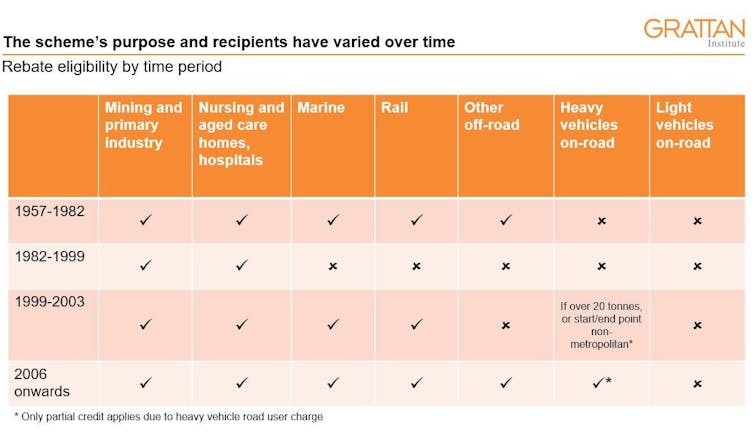
Fuel tax exemptions have existed for as long as the federal government has taxed fuel, starting in 1957. With the rationale for the tax being to pay for building and maintaining roads, initially all off-road users were exempt.

But the earmarking of all fuel tax revenue for spending on roads ended in 1959 – more than 60 years ago. With the tax becoming a general revenue-raiser, the rationale for exemptions or tax credits has shifted with the disposition of the government of the day.

The settings inherited by the Albanese government now cost the budget almost $8 billion a year.

CC BY As long ago as 1991, the Australian National Audit Office recommended the credit scheme “clarify its purpose and objectives”. Yet those objectives remain unclear today. Who benefits most? Previous governments have argued exemptions and tax credits support regional industries, and people living in regional areas. In 1999, when the credit was extended to marine, rail, and some trucks and buses, the then-deputy prime minister (and National Party leader) John Anderson said the goal was to reduce transport costs, particularly for “those people living in regional, rural and remote areas”. In 2006, when expanding the credit to include all off-road users and on-road vehicles weighing over 4.5 tonnes, the then-assistant treasurer Peter Dutton said: “This is good news for business, and regional Australia in particular.” But if the aim of the policy is to support regional areas, fuel tax credits are a poorly targeted way to do so. Read more: We pay billions to subsidise Australia’s fossil fuel industry. This makes absolutely no economic sense In the five industries that receive almost 90% of the value of credits, more than 60% of businesses, and 67% of employees, are in major cities. There is no evidence fuel tax credits particularly benefit regional areas, or that they are more effective than other policies in doing so. It is hard to avoid the conclusion that fuel tax credits are mostly a gift to the mining and agricultural industries – the only non-care industries that have always received an exemption from paying taxes on fuel, and the major recipients of fuel tax credits today. Business in the mining, transport and agriculture industries are biggest recipients of fuel tax credits. CC BY-SA Budgetary needs have prompted changes Changes to fuel tax credits have also aligned with the budgetary needs of the government of the day. In 1982, when government debt as a share of GDP was rising steadily, the Fraser government narrowed the scheme to just mining, primary industries and care industries. Many businesses previously exempt – including in rail, marine, construction and manufacturing – were forced to pay fuel taxes. In 2006, the Howard government broadened the scheme during the mining boom when budget surpluses meant no net debt for the first time in 30 years. Despite the straightened fiscal position the government now faces, the credit scheme remains unchanged. Out of step with net zero and budget repair The Albanese government has several growing spending obligations, particularly in health, aged care, disability care and interest expenses on its debt. After stripping out the effects of temporary factors such as high commodity prices, there remains a stubborn gap between government receipts and spending of about $40 billion a year. In a new report published by Grattan Institute, Fuelling budget repair: How to reform fuel taxes for business, we argue fuel tax credits should be removed for on-road users, and roughly halved for off-road users. This would save about $4 billion a year. It would also reflect the environmental and health costs of diesel use. Read more: Australia's government gives more support to fossil fuel research than is apparent Giving businesses tax credits on for consuming fuel without having to pay for or reduce their carbon emissions is sharply at odds with the government’s goal of net zero emissions by 2050. Diesel combustion currently accounts for 17% of Australia’s emissions. In 2020, the top five industry recipients of fuel tax credits directly produced more than half of Australia’s emissions. That share is expected to reach 64% by 2030. As well as helping repair the budget, reducing fuel tax credits would signal to businesses that they need to consider emissions in their investment decisions, minimising the costs to future consumers, taxpayers and shareholders. Authors: Marion Terrill, Transport and Cities Program Director, Grattan Institute

Read more https://theconversation.com/how-to-save-4-billion-a-year-reform-a-fuel-tax-credit-scheme-with-no-real-rationale-198999

What to Do When an Older Car Is No Longer Worth Keeping in Melbourne

Ever looked at another repair quote and wondered whether your old car is still worth the trouble? It is a common turning point for Melbourne motoris...

Your Baby's First Year: A Local Guide to Feeding, Sleep, and When to Get Extra Support

Ask ten parents in a Brisbane mothers' group how their baby is feeding or sleeping, and expect ten different answers.  Someone's baby sleeps throug...

Kitchen and Laundry Makeover Ideas That Don't Require a Full Renovation

Full kitchen renos are expensive — and most people don't actually need one.  They need the kitchen to stop looking like it's stuck in 2009, or they...

How Technology Is Reshaping the Modern Australian Commercial Kitchen

The commercial kitchen has always been shaped by technology. Refrigeration changed how ingredients could be stored, modern ventilation transformed k...

The Number on a Roller Blind Fabric That Nobody Explains

Somewhere in the fabric book, next to the colour name, there is a percentage. Three per cent. Five per cent. Ten per cent. Nobody explains it, most c...

What’s Trending in Men’s Jewellery This Father’s Day!

Finding a Father’s Day gift that feels personal, stylish and genuinely wearable is not always easy. While socks and novelty mugs have traditionally ...

Road Signs: Understanding Their Role in Clear and Effective Signage

Effective signage and display hardware can help businesses communicate information, promote products and organise customer or visitor movement. Road...

Bottle Label Printing: Key Factors to Consider Before Your Next Packaging Run

Effective packaging begins with understanding the product, bottle material, artwork and production requirements when planning bottle label printing. H...

Planning a Long-Distance Move With Interstate Movers Melbourne

Moving between states involves more planning than a typical local relocation. Along with packing and transporting household belongings, you need to...

Understanding the Role of an I/O Controller in Industrial Automation

Modern industrial systems depend on accurate communication between sensors, machines and control systems. An I/O controller can help manage this commu...

How the Right Mining Hose Supports Demanding Operations

Mining environments place considerable demands on equipment used for material transfer, water management and processing. Hoses operating in these co...

Simple Ideas for Making Social Gatherings More Memorable

We have all been to those parties where everyone just stands around the kitchen island, staring at their phones, waiting for someone else to make a mo...

Outdoor Wall Lights: Improving Exterior Lighting Around Your Home

Lighting can influence how a room looks, feels and functions, so the right fitting should be selected according to both appearance and practical req...

Commercial Office Cleaning: Combining Routine Office Cleaning With Melbourne Service

Keeping a workplace clean requires a service that can accommodate everyday tasks as well as the particular needs of the business. Professional comme...

Caravan Sales in Queensland: How to Find the Right Caravan for Sale QLD

Caravan ownership is about more than having somewhere to sleep while travelling. For many Queenslanders, it is one of the best ways to explore regio...

What Sir Walter Buffalo Turf Actually Costs in 2026 (And Why Quotes Vary So Much)

Two quotes landed on a Hills District homeowner's kitchen table last spring for the exact same 80-square-metre backyard. One said $12 a metre. The o...

Nearly 1,300 NSW Hospital Beds Are Occupied By People Who Are Ready To Go Home

1,276 people in NSW hospitals have been medically cleared for discharge but remain in hospital because they're still waiting for NDIS or aged care sup...

National Survey Launched to Measure Operational Impacts of Federal NDIS Policy Reforms

The effects of recent NDIS reforms are beginning to move beyond policy papers and into day to day service delivery. A new national survey is asking ...