

Did China's balloon violate international law?
- Written by Donald Rothwell, Professor of International Law, Australian National University
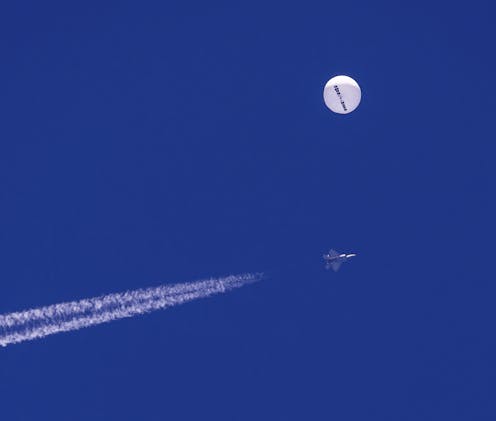
Was the balloon that suddenly appeared over the US last week undertaking surveillance? Or was it engaging in research, as China has claimed?
While the answers to these questions may not be immediately known, one thing is clear: the incursion of the Chinese balloon tested the bounds of international law.
This incident has also added another layer of complexity to the already strained relations between the US and China. US Secretary of State Antony Blinken’s planned visit to Beijing has been postponed. And China has reacted to the shooting down of the balloon with diplomatic fury.
Both sides have long disagreed over the presence of US warships in the South China Sea and Taiwan Strait, which China claims as its own waters and the US considers international waters. Will the air be the next realm to be contested by the two superpowers?
A long military history
Hot air balloons have a somewhat benign public image. But they also have a long military history that extends back to the Napoleonic era in Europe during the late 18th century and early 19th century when they were used for surveillance and bombing missions. The early laws of war even included some specific measures designed to address the military use of balloons during armed conflict.
The modern military significance of balloons now appears to be understated, especially in an era of uncrewed aerial vehicles or drones, which have proven effective during the current Ukraine war.
However, while balloons may no longer be valued for their war-fighting ability, they retain a unique capacity to undertake surveillance because they fly at higher altitudes than aircraft, can remain stationary over sensitive sites, are harder to detect on radar, and can be camouflaged as civilian weather craft.
Who has sovereignty over the air?
The international law is clear with respect to the use of these balloons over other countries’ airspace.
Every country has complete sovereignty and control over its waters extending 12 nautical miles (about 22 kilometres) from its land territory. Every country likewise has “complete and exclusive sovereignty over the airspace above its territory” under international conventions. This means each country controls all access to its airspace, which includes both commercial and government aircraft.
But the upper limit of sovereign airspace is unsettled in international law. In practice, it generally extends to the maximum height at which commercial and military aircraft operate, which is around 45,000 feet (about 13.7km). The supersonic Concorde jet, however, operated at 60,000 feet (over 18km). The Chinese balloon was also reported to be operating at a distance of 60,000 feet.
International law does not extend to the distance at which satellites operate, which is traditionally seen as falling within the realm of space law.
There are international legal frameworks in place that allow for permission to be sought to enter a country’s airspace, such as the 1944 Chicago Convention on International Civil Aviation. The International Civil Aviation Organization has set an additional layer of rules on airspace access, including for hot air balloons, but it does not regulate military activities.
The US also has its own “air defence identification zone”, a legacy of the Cold War. It requires all aircraft entering US airspace to identify themselves. Canada has its own complementary zone. During the height of Cold War tensions, the US would routinely scramble fighter jets in response to unauthorised Soviet incursions into US airspace, especially in the Arctic.
Many other countries and regions have similar air defence identification zones, including China, Japan and Taiwan. Taiwan, for instance, routinely scrambles fighter jets in response to unauthorised incursions of its airspace by Chinese aircraft.
Testing the waters – and air
So, given these clear international rules, the US was on very firm legal footing in its response to the Chinese balloon. Overflight could only have been undertaken with US permission, which was clearly not sought.
China initially attempted to suggest the balloon malfunctioned and drifted into US airspace, claiming force majeure. If the balloon was autonomous, it would have been entirely dependent on wind patterns. However, a report in Scientific American said the balloon appeared to have a high level of manoeuvrability, especially when it appeared to linger over sensitive US defence facilities in Montana.
Washington displayed a lot of patience in dealing with the incursion. President Joe Biden authorised military jets to shoot down the balloon, but it took some days before that could be done safely without endangering lives on the ground.
The balloon incident has clearly tested the Biden administration and the US response to China’s growing military assertiveness.
Similar events occur on a regular basis in the South China Sea, where the US Navy conducts freedom of navigation operations through Chinese claimed waters. The US presence is vigorously challenged by the Chinese Navy.
Read more: Does the US have the right to sail warships through the South China Sea? And can China stop them?
China has also responded aggressively to the presence of US reconnaissance planes over the South China Sea, raising the risks of an accident that could spark a wider conflict.
What is remarkable about the balloon incident is China has asserted its physical presence well within America’s sovereign borders. How both sides respond in the aftermath will determine whether China-US tensions worsen further and if we can expect potential future provocations between the two sides in the air, as well as the seas.
Authors: Donald Rothwell, Professor of International Law, Australian National University
Read more https://theconversation.com/did-chinas-balloon-violate-international-law-199271

















