

What if Opal and Myki became one? It'd help more of us than you'd think
- Written by James Bushell, PhD Candidate and Research Associate, Institute of Transport and Logistics Studies, University of Sydney
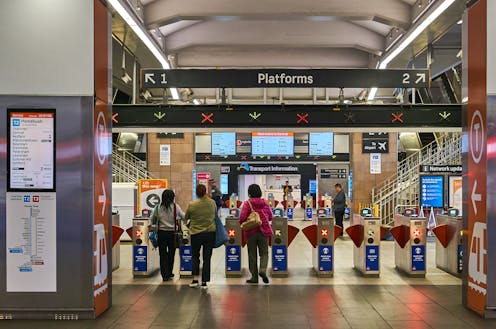
Melburnians know Myki, Sydneysiders know Opal. These two electronic ticketing systems for public transport may be streets ahead of what they replaced, but are now decidedly old-fashioned compared with systems elsewhere in the world.
In the Netherlands you can buy a single card and use it on public transport anywhere in the country. In Japan you can buy a card to travel on the majority of public transport options.
Why can’t Australian public transport work the same, starting with Myki and Opal?
These two systems cover about 40% of Australia’s population. Melbourne and Sydney are the two cities most visited by international and domestic tourists, and travel between the two cities is one of the world’s busiest routes.
Research shows the easier it is to use public transport, such as through integrated ticketing, the more people will use it. It stands to reason more travellers will use public transport if they can use the card they already have in their wallet or purse. Few Australians hold more than the card from their home city.
Upgrading Opal and Myki
Now is the time to do something about this, before NSW and Victoria spend hundreds of millions of dollars upgrading (and reduplicating) Opal and Myki.
The NSW government committed almost A$570 million in its last budget to upgrade Opal. The Victorian government is looking at options to upgrade Myki and will sign a new contract with an operator this year. The current contract is worth about $100 million a year. How much it will commit to upgrading the system is still unknown, but it is reasonable to assume it’s comparable to NSW.
You can only imagine the duplication happening in these parallel processes.
Moving to a system as in the Netherlands and Japan is not without its challenges. It means overcoming the same constitutional arrangements and state-based cultures that once led to incompatible rail gauges, and why we have state-based driver’s licences and vehicle registrations.
But the potential benefits of national integrated ticketing include lower ticketing costs and ease of transport access, leading to better service provision, cheaper fares and overall greater public transport use.
Implementing account-based systems
Both NSW and Victorian governments are touting the benefits of moving from their wallet-based systems to what are known as “account-based systems”.
Instead of buying a standalone card (which you or anyone else can use), account-based systems tie your card (or credit card, or “tappable” device) to your travel account. You can pay using a credit card in some cities in Australia (Melbourne isn’t one of them – one reason for the Myki upgrade) but they are just a payment mechanism, without other benefits.
Account-based ticketing brings with it a far more powerful back-end system upgrade, providing better fare and payment flexibility and data collection.
Most importantly it can enable greater integration between transport operators. Data collected on how and when people use public transport enables operators to better plan and integrate services. For travellers combining several transport legs, it could mean cheaper fares. For operators in the system, it could open new ways of working together to make better journeys for passengers. This greater collaboration may also lead to benefits we can’t yet predict.
Yet there appears to be no attempt to discuss collaboration across state lines.
Read more: Victorians won't miss myki, but what will 'best practice' transport ticketing look like?
Travellers want compatible systems
Our research, using a survey of 715 people in across all capital cities (except Darwin), indicates intercity travellers would choose public transport over private car options at a ratio of about two to one, if given the option to use their home card when travelling in another city.
It may be argued public transport in Australia is very different to the Netherlands or Japan, notably in terms of population densities. But similar single account systems are also under development in New Zealand, Britain and California.
So how do we get a common system?
Constitutional arrangements are not insurmountable. And while there are differences between Australia’s cities, they are not so wildly different that ticketing needs differ. The basics of tapping on and off for most trips are the same. Fares are programmable.
The greater challenge will be in overcoming the institutional inertia of state-based bureaucracies.
The first step is for the states (and territories) to talk to one another and develop a common understanding of the benefits of collaboration. Starting with NSW and Victoria makes sense, though it is also worth starting a conversation about a national system.
The challenge will be for states to look past their immediate self-interest, and for transport ministers to agree on the same policy directions.
But this is all quite possible. They’ve done it before, as evidenced by the fact you can now get a train from Melbourne to Sydney without needing to change at the border. Though that did require some federal intervention.
Authors: James Bushell, PhD Candidate and Research Associate, Institute of Transport and Logistics Studies, University of Sydney

















