

We found 2.9-million-year-old stone tools used to butcher ancient hippos – but likely not by our ancestors
- Written by Julien Louys, Deputy Director, Australian Research Centre for Human Evolution, Griffith University
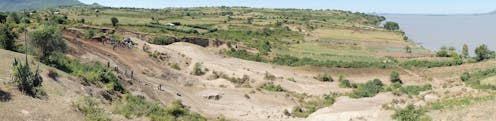
On the shores of Lake Victoria in Kenya, a short valley extends south towards the looming Mount Homa. From it have emerged some of the oldest-known stone tools used to butcher large animals, as well as the oldest remains of one of our early cousins, Paranthropus – a genus we think co-existed with our direct ancestors.
Similar tool and fossil discoveries had been made before, in different places and at different times. But to find these all together in one place, as old as they are, is truly extraordinary.
In research published today in Science, we explain how findings at the Nyayanga site are changing the way experts think about carnivory among hominins – a group that includes modern humans, extinct humans, direct ancestors and close cousins.
It also raises doubt about who was really responsible for making the stone tools we’d previously attributed to Homo and closely related species.
Fossils on the Homa Peninsula
Nyayanga is a typical pastoral valley situated on the Homa Peninsula in western Kenya. This peninsula has long been known to produce various fossils. In 1996, a multidisciplinary team led by one of us (Thomas) began work on a two-million-year-old site called Kanjera South. This work produced a wealth of fossil remains from large mammals, as well as stone tools associated with our genus, Homo.
During a field season at Kanjera South, a local man named Peter Onyango who was working with the team suggested we investigate some fossils and stone tools eroding out of a valley on the shores of Lake Victoria. This new site, named Nyayanga after the nearby beach, was situated on a donkey track leading to the lake.
The first stone tools and fossils we collected were eroding out from the gully walls. Beginning in 2015, a series of excavations eventually returned a trove of 330 artefacts and 1,776 animal bone fragments from a range of species characteristic of open savannah and open woodland environments.
The bones included animals we’re familiar with today, such as giraffes, antelopes, elephants and hippos. But they also included extinct megafauna such as Eurygnathohippus, an extinct horse ancestor, Pelorvis, the giant buffalo, and Megantereon, the sabre-toothed cat.
Of particular interest were the remains of two teeth from the extinct hominin Paranthropus – nicknamed the Nutcracker Man as its large flat teeth are thought to have been used to process tough vegetable matter. These teeth, one intact and the other a fragment, were the first direct evidence of an extinct hominin on the Peninsula.
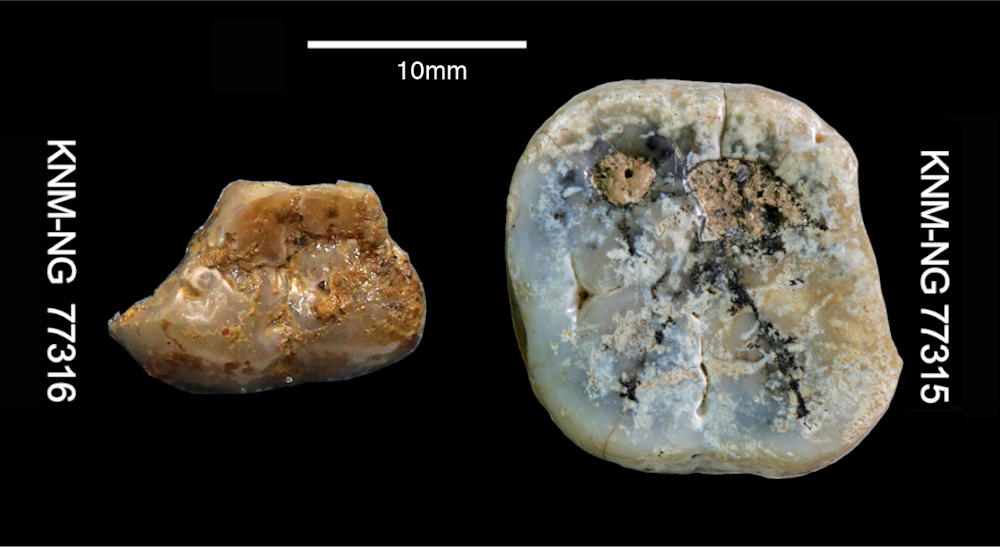
What made their recovery even more surprising were the tools we found associated with them. Alongside Paranthropus’s teeth were some stone tools belonging to a technology known as the Oldowan, characterised by three main forms: hammerstone, core, and flake.
Oldowan tools had long been associated with our own genus, Homo, and were once considered a marker for the beginnings of human modernity. While we can’t demonstrate Paranthropus actually made these tools, this species is so far the only suspect at the scene of the crime.
Early signs of butchery
So, what was a nutcracking, plant-chomping hominin using these tools for? Well it turns out in addition to processing plants – the evidence of which we could see on the tools’ edges – these lithics were also used to make hippo tartare.
We found evidence of meat cutting on the edges – but the smoking gun was the cut and percussion marks found on several hippo individuals associated with these stone tools.
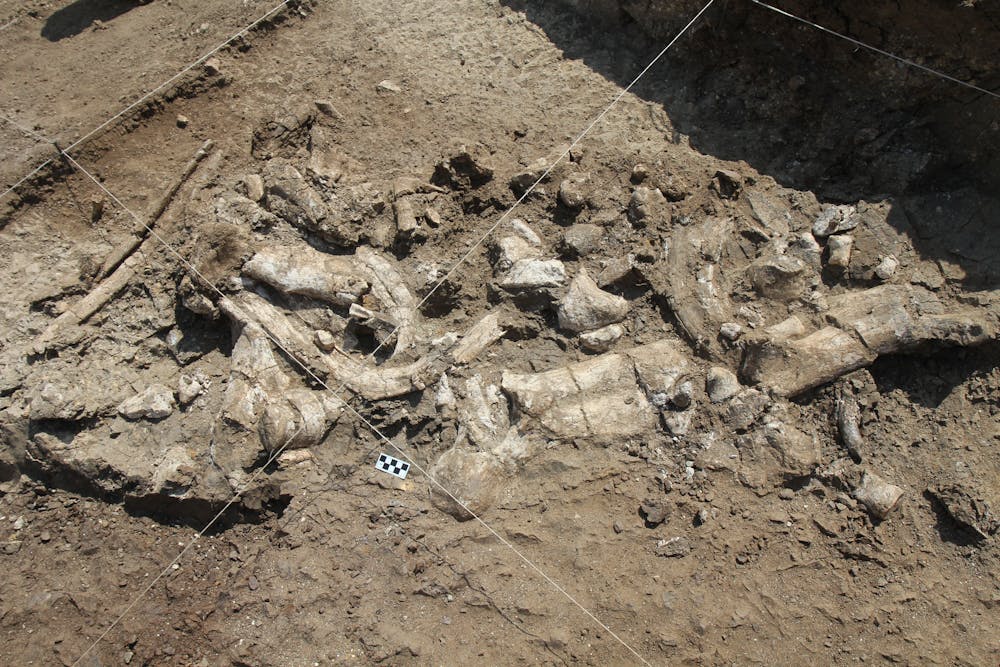 Hippo skeleton excavated at Nyayanga. This probably represents a single individual, and shows evidence of butchery.
T.W. Plummer, Homa Peninsula Paleoanthropology Project, Author provided
Hippo skeleton excavated at Nyayanga. This probably represents a single individual, and shows evidence of butchery.
T.W. Plummer, Homa Peninsula Paleoanthropology Project, Author provided
Of course, this wasn’t the first time cut marks had been found on megafauna. In fact, some of the earliest evidence of megafauna butchery was reported on by our team at Kanjera South back in 2013.
However, our comprehensive dating program at Nyayanga revealed the site’s deposits to be about 2.9 million years old. This means they’re probably the oldest stone tools found to have butchered hippos and processed plant material.
Not only that, but this is about two million years before the first evidence that people used fire. This suggests raw hippo was on the menu for the hungry hominins.
Adding to that, the tooth fossils are the oldest Paranthropus remains ever found, and the associated tools are the oldest-known Oldowan tools. The second-oldest were uncovered some 1,200 kilometres away in Ethiopia, and dated to about 2.6 million years.
A brave old world
There’s no evidence Paranthropus was actively hunting megafauna. But it would have been competing with sabre-toothed cats, hyenas and crocodiles for access to carcasses, at the very least.
The Nyayanga deposits provide a glimpse into an ancestral world that’s possibly radically different from any we had pictured. In doing so, they’ve raised even more questions about hominin evolution.
Who were these resourceful toolmakers? How far back does carnivory go? And just how old and widespread is the innovative Oldowan toolkit? Despite more than 100 years of research on the Homa Peninsula, much remains unearthed.
Authors: Julien Louys, Deputy Director, Australian Research Centre for Human Evolution, Griffith University

















