

Can clouds of Moon dust combat climate change?
- Written by Aaron Tang, PhD Scholar in Climate Governance, Australian National University
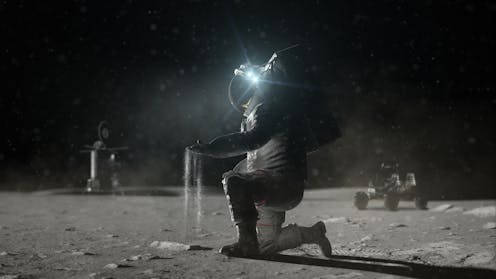
A group of US scientists this week proposed an unorthodox scheme to combat global warming: creating large clouds of Moon dust in space to reflect sunlight and cool the Earth.
In their plan, we would mine dust on the Moon and shoot it out towards the Sun. The dust would stay between the Sun and Earth for around a week, making sunlight around 2% dimmer at Earth’s surface, after which it would disperse and we would shoot out more dust.
The proposal, which involves launching some 10 million tonnes of Moon dust into space each year, is in some ways ingenious – and if it works as advertised from a technical perspective, it might buy the world some vital time to rein in carbon emissions.
Unfortunately, but also unsurprisingly, the story of Moon dust reflection isn’t as simple as it seems.
Why Moon dust?
Proposed measures to cool Earth by reducing the amount of sunlight reaching the surface are often called “solar geoengineering” or “solar radiation management”.
The most-discussed method involves injecting a thin layer of aerosol particles into Earth’s upper atmosphere.
However, tinkering with the atmosphere in this way is likely to affect rainfall and drought patterns, and may have other unintended consequences such as damage to the ozone layer.
Read more: Trying to cool the Earth by dimming sunlight could be worse than global warming
Moon dust in space should avoid these pitfalls, as it would leave our atmosphere untouched.
Others have suggested deflecting sunlight with gigantic filters or mirrors in space, or swarms of artificial satellites.
Moon dust looks pretty good compared with these ideas: Moon dust is plentiful, and launching dust clouds from the Moon’s lower gravity would require substantially less energy than similar launches from Earth.
So, what’s the problem?
Too slow, too clumsy
One of solar geoengineering’s core selling points is supposed to be speed. Reflecting sunlight is at best a way to rapidly stave off short-term catastrophic warming impacts, buying time for renewable energy transitions and removal of greenhouse gases from the atmosphere.
Global injection of aerosols into the atmosphere, for instance, may require development of special aircraft. This is certainly no trivial task, but definitely doable in the next decade or so.
Moon dust ambitions would be much slower. There are several major engineering and logistical hurdles to overcome.
At minimum, we would need Moon bases, lunar mining infrastructure, large-scale storage, and a way to launch the dust into space.
No human has even set foot on the Moon in more than 50 years. While China is looking to establish a Moon base by 2028, followed by the US in 2034, a well-functioning mining and dust launching system is likely many decades away.
Another advantage of solar geoengineering is meant to be fine tuning.
Injecting aerosols into the atmosphere can in theory be fine-tuned to reduce negative side effects. Changing where aerosol injections take place, for instance, can drastically change potential side effects and its risk profile.
A giant space cloud offers no such precision.
A law and policy vacuum
To make matters worse, the world currently has little in the way of coherent policy or governance for space and the Moon. Many fundamental questions about human activity in space, such as how to manage the growing layer of bullet-speed space junk orbiting the Earth, are unanswered.
Also unanswered is another fundamental question: is Moon mining even legal? Who “owns” space, and the resources in it?
At present, we have a patchwork of contradictory policies.
Read more: The Artemis I mission marks the start of a new space race to mine the Moon
The 1967 Outer Space Treaty prohibits “appropriation” of space resources (implying a ban on mining), and Article 11.3 of the 1979 Moon Treaty states that the Moon’s resources cannot become property of a country, group or person.
However, the US, Russia and China have not signed the Moon Treaty. In fact, the US has Obama-era legislation, a Trump-era executive order, and a non-binding international agreement – the Artemis Accords – that all emphasise commercial resource extraction.
With such contradictory policy in place, lunar mining is a fundamental legal grey area. Shooting Moon dust off into space is another legal dilemma several steps down the line.
As above, so below
Such a legal patchwork exists because of broader political firewalls.
Similarly to how the 20th-century space race reflected Cold War geopolitics, contemporary space governance is shaped by today’s political rifts. Russia and China have not joined the Artemis Accords, deciding (ironically together) to go it alone. But disagreements over a non-binding agreement are just the tip of the iceberg.
Political disagreements over Moon dust deployment could prove far more dangerous. Different countries could prefer different extents of cooling, or whether Moon dust cooling should be used at all.

Even the proposed “launch system” for dust, essentially a giant electromagnetic railgun (of the kind currently used to launch fighter jets), could spark security and weaponisation concerns.
These disagreements could leak into terrestrial politics, further exacerbating political divisions. At worst, these disagreements may cascade into armed conflict or sabotage of lunar infrastructure.
Space is another frontier for political conflict, and one that Moon dust reflection schemes could worsen. Such conflict also compromises a cooperative and altruistic Moon dust deployment.
Prime space real estate
Even if the implementation and political issues were resolved, there are plenty more.
For example, the Moon dust would linger around the “Lagrange point” between Earth and the Sun, where the gravitational forces of the planet and the star balance out.
Unfortunately, this valuable piece of space real estate is already occupied by satellites including the Solar & Heliospheric Observatory and the Deep Space Climate Observatory.
These could perhaps be moved or decommissioned, but that would be expensive and create new risks.
Read more: Betting on speculative geoengineering may risk an escalating ‘climate debt crisis’
In sum, the Moon dust proposal does address some of the problems with Earth-based solar geoengineering. But it would likely be too slow to dampen the short-term impacts of climate change, and would in any case face diplomatic obstacles that may well be insurmountable.
To their credit, the authors do acknowledge their work has limitations, saying in a press release:
We aren’t experts in climate change, or the rocket science needed to move mass from one place to the other. We’re just exploring different kinds of dust on a variety of orbits to see how effective this approach might be.
So instead of worrying about displacing satellites, we are better off focusing on replacing fossil fuels. The solutions to climate change are right in front of us, not in the stars.
Authors: Aaron Tang, PhD Scholar in Climate Governance, Australian National University
Read more https://theconversation.com/can-clouds-of-moon-dust-combat-climate-change-199592

















