What the sci-fi blockbuster Wandering Earth II can teach us about China's global and local aspirations
- Written by: Yimin Xu, Ph.D student at School of Humanities & Language, Faculty of Arts, Design & Architecture, UNSW Sydney
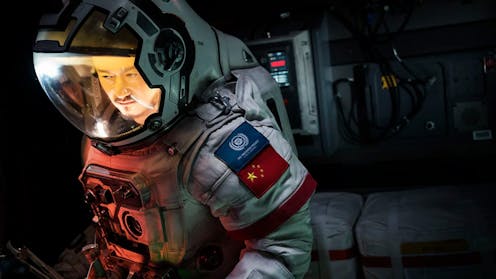
A prequel to the 2019 film Wandering Earth, the Chinese blockbuster hit Wandering Earth II opens on a futuristic dystopia where the dying Sun is about to explode and engulf Earth.
A survival strategy is proposed: the Wandering Earth Project will build giant engines and use them to propel Earth away from the Sun.
Amid a global crisis, China rises to save the world. Western countries descend into chaos. Using state-of-the-art made-in-China technologies, China carries out the Wandering Earth Project – disregarding the cost of lives lost.
Now released globally, Wandering Earth II has earned more than half a billion dollars in China since it opened on January 22. It has also achieved critical success in its home country, with domestic media saying it exemplifies a “Chinese-style space romance”.
Adapted from a short science fiction story by celebrated Chinese author Liu Cixin, at first sight the plot will seem very familiar to fans of Hollywood.
But this film speaks to China’s growing ambition of leading global governance, and its embrace of collectivism and consequentialism.
Chinese science fiction
These political imaginations are not recent. They are deeply rooted in China’s political traditions, along with the development of science fiction literature in China.
Western science fiction was first translated into Chinese in 1902, at a time when Chinese thinkers called for learning from the West to “subdue” the West: a self-salvation plan to modernise China.
Science fiction was taken as an educational tool to disseminate Western sciences. Science fiction enabled China to imagine a bright future when it achieved national independence from Westerners – or became a new power in international politics.
An early Chinese science fiction book was The New Era, published in 1908. This book envisioned China would rise as a regional power in 1999 and secure peace in the Asian continent.
Chinese science fiction began by learning from Western counterparts at the turn of the 20th century when works of Jules Verne and H.G. Wells were widely translated and read in China.
After 1949, however, the genre followed the footsteps of the Soviet Union in its imagination of how science and technology could be better used in the hands of communists than Western capitalists.
Read more: China's Communist Party at 100: revolution forever
East versus West
Wandering Earth II continues this tradition of praising the science possible under communism, and positioning China as a global power. Here, China invests the most resources – technological, financial and human – in saving Earth.
The West is often represented as a rival in Chinese science fiction literature. Alternatively, it serves as a witness to China’s victory: in Wandering Earth II, even the United States has to consult a Chinese diplomat for advice.
This diplomat, Mr Zhou, bears a remarkable resemblance to Zhou Enlai, China’s first premier under Mao Zedong’s leadership. As a diplomat, Zhou Enlai helped China negotiate regional disputes with neighbouring countries.
Today, Xi’s “community of common destiny” is shaking the world order.
China’s leadership in Wandering Earth II’s “united Earth government” echoes the increasingly assertive image of China in global politics.
Chinese collectivism
The Wandering Earth Project exemplifies Chinese collectivism when old astronauts voluntarily join in a suicide mission – although some of them are not given a chance to speak.
Chinese history is permeated with political myths of individual sacrifices, derived from the long-existing authoritarian regime.
After communism won in 1949, “for the people” became supreme doctrine: the new government worked to eliminate remaining bourgeois liberal thoughts, and build revolutionary heroes. Individual interest was reduced to be secondary to service for the nation.

A key part of Chinese political life is the collective ideology of conspicuous consequentialism: that is, the morality of an action is measured only in its consequences.
Taking human survival as its goal, the supreme artificial intelligence in the film pushes Earth to the verge of destruction to test the willingness of human unity.
Despite the “good” intentions of this artificial intelligence, it drags everyone’s life into extreme danger and leaves more than half the world’s population on a barren and frozen Earth without atmospheric protection.
No one in Wandering Earth II questions this draconian decision-making logic. Indeed, when the AI’s true purpose is revealed at the end of the film, the human survivors eulogise its intelligence, forgetting the high price they have paid.
Individual sacrifices
There are many parallels to draw between Wandering Earth II and modern Chinese society.
Today in China, the authoritarian bureaucracy emphasises results, while the policy goals – whether extensive economic growth or COVID-zero – lead to a moral dilemma between overall outcome and individual losses in the process.
When the greater good is achieved, individual sacrifices are lightly portrayed as a necessary cost and a “detour” in the development – which, of course, can be forgivable, and then forgettable.
In contrast to Kant’s humans are ends, not means, both Wandering Earth II and Chinese politics conceive the opposite.
Authors: Yimin Xu, Ph.D student at School of Humanities & Language, Faculty of Arts, Design & Architecture, UNSW Sydney