Love languages are hugely popular – but there's very little evidence they exist at all
- Written by: Gery Karantzas, Associate professor in Social Psychology / Relationship Science, Deakin University

Love languages – the concept coined by Baptist pastor Gary Chapman some 30 years ago – has taken the relationships world by storm. It’s often the “go-to” topic on first dates, and for those in relationships love languages are said to provide deep, meaningful and reliable insights into how relationships function. Putting love languages into action is believed to increase relationship happiness.
The concept clearly has appeal. At last count, 20 million copies have been sold worldwide of Chapman’s 1992 book The Five Love Languages: The Secret to Love that Lasts. The book has been translated into 49 languages.
There is only one catch. There is little evidence to support the idea that love languages are “a thing”, or that love languages do much of anything to help improve relationships.
What are the love languages?
According to Chapman, there are five love languages. Each of these love languages is a way to communicate your love to your romantic partner.
In his role as a Baptist pastor, Chapman had been counselling couples for years. It was through his observations of couples that the idea of love languages was born.
He believed love languages were an intuitive and simple way to teach couples about how to tune into each other’s ways of expressing love. And so, he began running seminars for husbands and wives, and the popularity of his seminars grew.
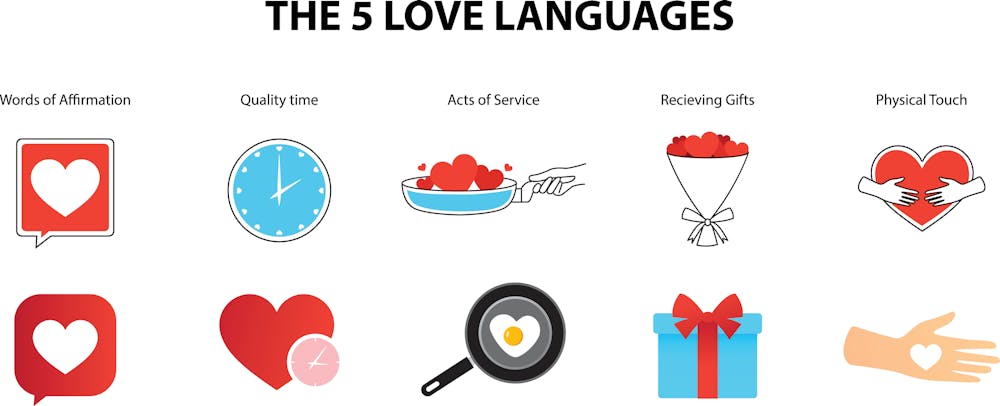
The five love languages are:
(1) acts of service (doing something that helps a partner, such as running an errand)
(2) physical touch (demonstrating physical affection, such as giving your partner a hug or kiss)
(3) quality time (spending time together and giving each other undivided attention)
(4) gifts (giving your partner a present that communicates thoughtfulness, effort, and/or expense)
(5) words of affirmation (such as expressing your admiration, or complimenting your partner).
Chapman suggests that people typically use all love languages, but that most people tend to rely on one love language most of the time. This is referred to as a person’s primary love language.
According to Chapman, people are more satisfied in their relationships when both partners match when it comes to their primary love language. However, people experience less satisfaction in their relationships when both partners do not share the same primary love language.
Another important aspect of the love languages concept is that relationships are likely to deliver the greatest satisfaction when a person can understand their partner’s love language, and act in ways that “speaks to” their partner’s language. In essence, this idea is about tuning in to what a partner wants.
This is an idea that has existed across many models and theories about how relationships function well. That is, responding to a partner in a way that meets their needs and wants makes a person feel understood, validated, and cared for.
What does the evidence tell us?
Despite the popularity of the theory of love languages, only a handful of studies have been conducted and reported over the past 30 years. Research is largely inconclusive, although the balance sways more towards refuting rather than endorsing the love languages concept.
Let’s start with how love languages are assessed. In popular culture, the Love Language QuizTM is an online questionnaire that people can complete to find out about their love languages. Despite millions of individuals having taken the quiz (according to 5lovelanguages.com), there are no published findings as to the reliability and validity of the measure.
Researchers have developed their own version of the love languages survey, but the findings did not meet the statistical thresholds to suggest the survey adequately captured the five love languages. Also, their findings did not support the idea that there are five love languages.
Furthermore, a qualitative study in which researchers coded the written responses of undergraduate students to questions about how they express love, suggested there may be six love languages. However, the researchers reported difficulty agreeing on how some of the students’ responses neatly fitted into Chapman’s love languages, particularly in the categories of “words of affirmation” and “quality time”.
Next, let’s turn to research testing a core premise of the love language theory: that couples with matching love languages experience greater satisfaction than those who do not. Evidence for this premise is very mixed.
Read more: From Chaucer to chocolates: how Valentine’s Day gifts have changed over the centuries
Three studies, including one that used Chapman’s Love Language Quiz, have found that couples with matching love languages were no more satisfied than couples who were mismatched.
However, a more recent study found that partners with matching love languages experienced greater relationship and sexual satisfaction than partners with mismatched love languages. This research also found that men who reported greater empathy and perspective-taking had a love language that better matched the language of their partner.
Finally, what does the research say about whether having a better understanding of your partner’s love language is linked to higher relationship satisfaction? Only two studies have investigated this question. Both found that knowing your partner’s primary love language did predict relationship satisfaction in the present or into the future.
So, as you can see, not only is there very little research investigating love languages, but the research to date doesn’t strengthen belief in the powerful properties of love languages.
Authors: Gery Karantzas, Associate professor in Social Psychology / Relationship Science, Deakin University