

Australians likely to use more energy to stay in and save money
- Written by: Kari Dahlgren, Research Fellow Emerging Technologies Research Lab, Monash University

Soaring energy costs are a major factor in Australia’s cost-of-living crisis. The conventional wisdom is people will reduce their energy use in response to rising prices – and this may be the case for the most vulnerable households. However, our research published today suggests rising costs of living are more likely to increase household energy use as people economise by doing more at home.
Our research shows people relate to energy through what it helps them do: feed the family, clean the house and stay healthy, comfortable and entertained. Energy itself is rarely the first consideration. When we understand energy as embedded in everyday life, the simple laws of supply and demand become complicated.
For example, in the face of the cost-of-living crisis, households are investing in home luxuries, our research shows. Rather than spending money on outside activities, it’s going into upgrades and technologies that bring them fun, comfort and safety.
Many are adding air conditioning, air filtration, pools, spas, heated outdoor entertaining areas and bar fridges. They are adding or renovating sheds and outdoor areas to create extra living space. All these changes increase their energy use.
Drawing on a four-year study of households in Victoria and New South Wales, our research developed four scenarios of everyday life in 2030 and 2050. In two scenarios, the home takes on an even more essential role in everyday life. This has significant implications for both energy forecasts and social inequality.
Read more: Older Australians on the tough choices they face as energy costs set to increase
Why are people doing this?
Many people reason investing in a home cinema, kitchen appliance, spa or bar is more affordable than going out all the time. Setting up a home office may also be cheaper and more convenient than commuting.
For example, research participants Haruki and Sara (both pseudonyms) were converting a disused shed into a recreation space, complete with a television, video games, refrigerator, heating and cooling, and an electric drum kit. It would be a space where their three children spend their free time, but also serve as an office for Sara to teach music.
COVID-19 lockdowns were a strong impetus for these trends. Many people’s homes became their main site of work and play. They were schools, workplaces and gyms all in one. They also become a haven from the airborne threats outside.
Some might expect these trends to reverse with COVID restrictions lifted and the cost of living soaring. However, our research shows these expectations of the home are continuing and accelerating.
Read more: Flexibility makes us happier, with 3 clear trends emerging in post-pandemic hybrid work
As activities like going on holidays, or going out for dinner, become more expensive, investing in the home makes sense. Staying home, even if it involves higher energy costs or buying new appliances, may still mean big savings for the overall household budget.
Our in-depth research provides a nuanced view of how diverse consumers will engage with the energy system beyond merely responding to energy prices. This evidence can help the sector improve forecasting and energy future scenarios. We provide resources to help incorporate aspects of our scenarios into industry modelling.
4 scenarios of everyday life in 2030 and 2050
Our team at Monash University’s Emerging Technologies Research Lab developed the Scenarios for Future Living report. It presents four scenarios of everyday life – two each in 2030 and 2050.
The scenarios are based on qualitative research with households in Victoria and New South Wales for the Digital Energy Futures project, as well as national data from the Energy Consumer Behaviour Survey. We studied people’s everyday routines, priorities and future visions, including the use of emerging digital and energy technologies. The scenarios also draw on broader demographic, technological, economic and environmental trends and the latest climate science.
One 2030 scenario, called “Creature Comforts”, envisions a world where, in response to rising living costs, households invest in consumer electronics and home upgrades. Energy use remains high as households seek to create a comfortable and safe haven.
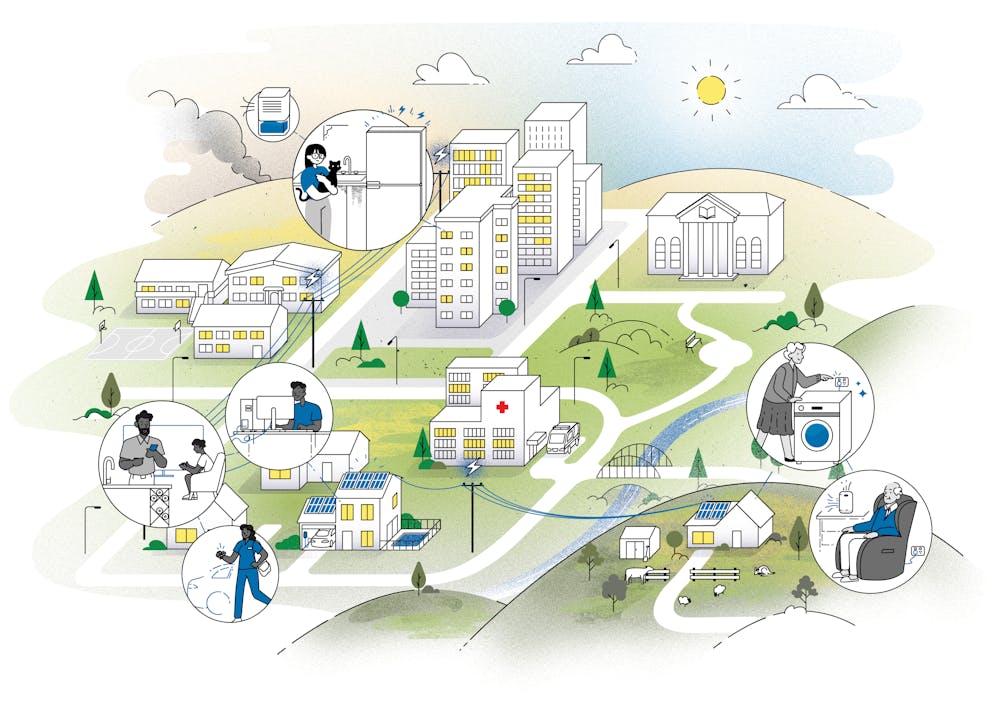
Read more: Top 10 tips to keep cool this summer while protecting your health and your budget
The 2050 scenario, “Hunkering Down”, takes this trend further. Homes are optimised to provide a safe, productive and comfortable refuge from extreme weather and climate change. Institutions regularly close due to more frequent extreme weather events. People who can afford housing and technology upgrades stay home, where additional spaces and advanced equipment enable most work, school, exercise and entertainment activities.
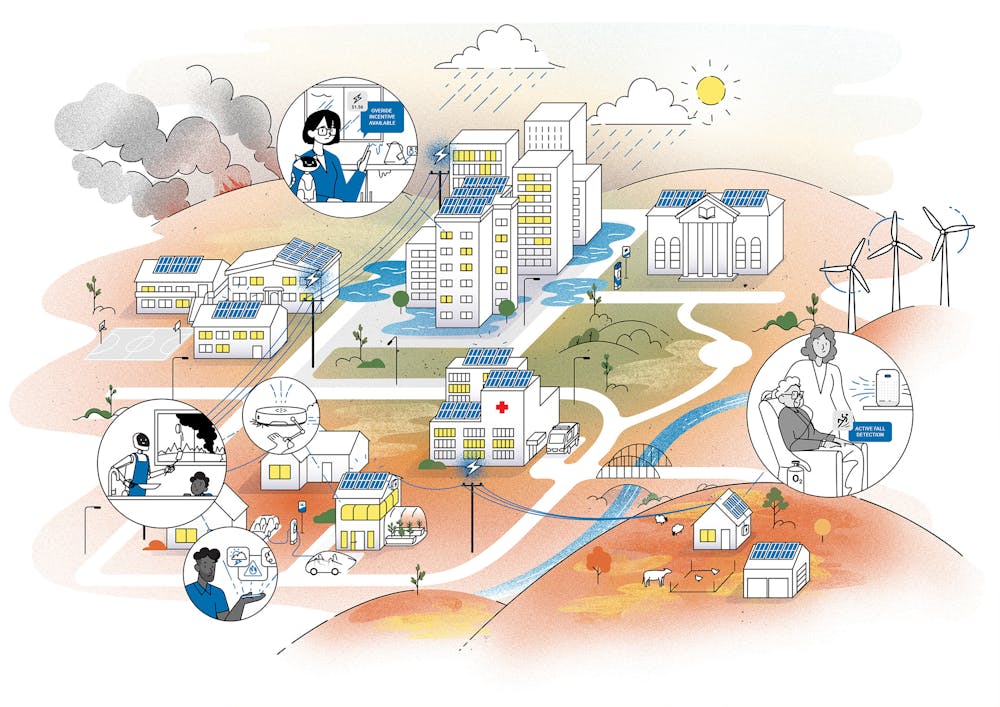 2050 scenario ‘Hunkering Down’.
Illustration by Stephen Elliget (https://epicsteve.com/)/Digital Energy Futures: Scenarios for Future Living Report
2050 scenario ‘Hunkering Down’.
Illustration by Stephen Elliget (https://epicsteve.com/)/Digital Energy Futures: Scenarios for Future Living Report
In the second 2030 scenario, “Sharing the Load”, households continue to invest, where possible, in solar panels, household batteries and electric vehicles. They prioritise being resourceful and generous with excess power by sharing it with others.
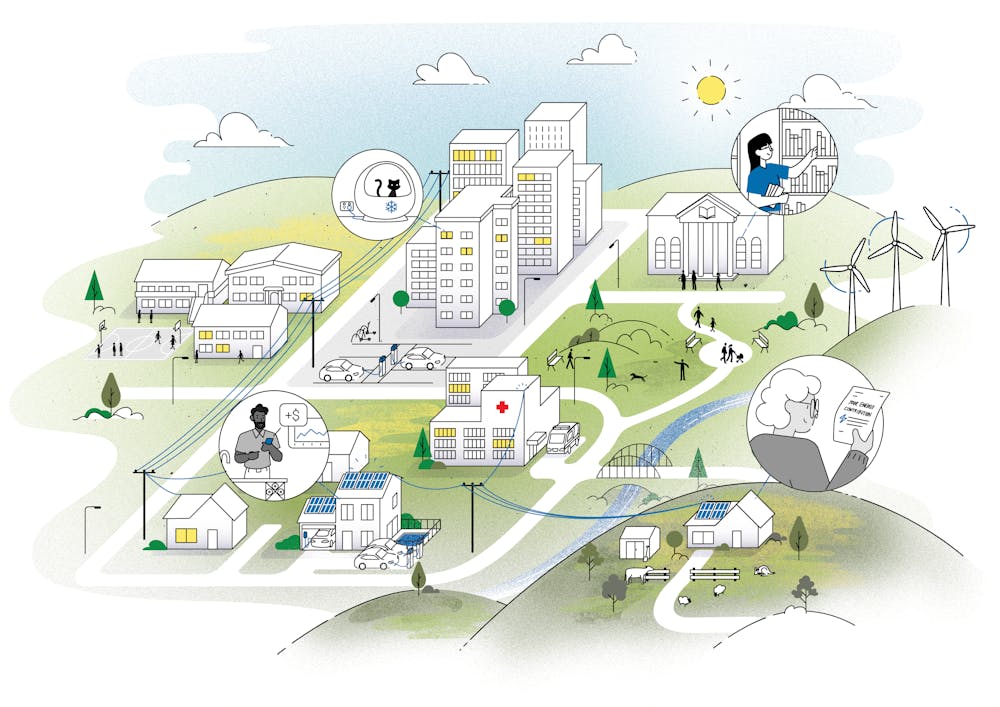 2030 scenario ‘Sharing the Load’.
Illustration by Stephen Elliget (https://epicsteve.com/)/Digital Energy Futures: Scenarios for Future Living Report
2030 scenario ‘Sharing the Load’.
Illustration by Stephen Elliget (https://epicsteve.com/)/Digital Energy Futures: Scenarios for Future Living Report
Read more: How to maximise savings from your home solar system and slash your power bills
In the second 2050 scenario, “Sunrises and Siestas”, institutions and society adapt to climate change through policy and community initiatives and infrastructures. The home remains important to people’s safety and comfort – but there are more services and technologies that ease the financial pressures on households due to their energy use.
 2050 scenario ‘Sunrises and Siestas’.
Illustration by Stephen Elliget (https://epicsteve.com/)/Digital Energy Futures: Scenarios for Future Living Report
2050 scenario ‘Sunrises and Siestas’.
Illustration by Stephen Elliget (https://epicsteve.com/)/Digital Energy Futures: Scenarios for Future Living Report
Energy planning must take account of inequalities
To bring these scenarios to life, we created narratives for three households: a wealthy and technology-savvy suburban household, a low-income renter, and a retired rural household. Following these households across each scenario reveals the varying impacts on households of different socio-economic and geographic backgrounds.
Wealthy households can afford to insulate themselves from external threats. They manage changing conditions by upgrading their homes. In contrast, people without the means to invest in such upgrades are left exposed to rising costs and extreme weather conditions.
Our research has critical implications for energy policymakers and industry. It underscores the need for a sophisticated, comprehensive approach to considering people’s lives, social change and household investment. Energy planning must account for how various futures can amplify or reduce inequities.
Authors: Kari Dahlgren, Research Fellow Emerging Technologies Research Lab, Monash University

















