you're breeding a new waste pandemic
- Written by: Michael Odei Erdiaw-Kwasie, Lecturer in Sustainability| Lead, Circular Economy Research Group, Charles Darwin University
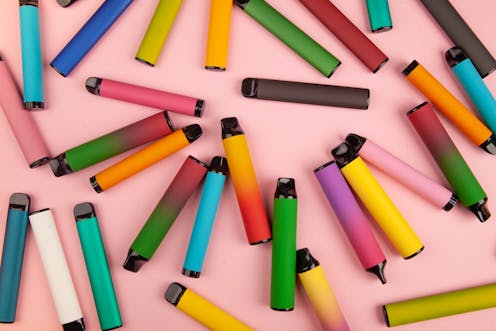
Vaping, or using electronic cigarettes, not only pollutes the surrounding air, it also creates a new contaminated e-waste stream.
Australian waste management authorities are just beginning to tackle this problem, as schools’ stockpiles of confiscated vapes continue to grow. As researchers of issues to do with the so-called circular economy, we take a keen interest in how products can be safely and successfully reused and recycled, rather than being thrown away.
After years of battling the scourge of cigarette butts, Clean Up Australia’s latest National Rubbish Report, released today, reveals cigarette butts are no longer number one on the list of most commonly littered items. Soft plastics have become public enemy number one instead.
But the rate of growth in vaping suggests an even more challenging battle lies ahead. Clean Up Australia says e-cigarettes “appear to be even more damaging to the environment than cigarette butts” as they “present a triple threat to the environment: plastic waste, electronic waste and hazardous waste”.
What is vaping?
A vaping device, also called a vape, is an electronic device that releases an aerosol that users inhale. The vapour may contain nicotine (not always), flavourings, and other substances.
Since their invention in 2003, vapes and e-cigarettes have been marketed as healthier alternatives to tobacco cigarettes, and as a possible stepping stone to quitting smoking.
Vaping, however, has health risks and environmental consequences.
A growing trend
The number of people vaping worldwide was expected to reach a record high of 55 million in 2021, up from 7 million in 2011, according to Euromonitor International.
Globally, the vaping market is expected to reach US$38.5 billion by 2026.
The 2019 National Drug Strategy Household Survey found fewer Australians were smoking tobacco daily, while the use of e-cigarettes was increasing. From the survey results, the Australian Tobacco Harm Reduction Association calculated that 520,000 people vaped that year (2.5% of the population aged 14 or over).
Australian vaping rates are catching up to those in other Western countries, despite attempts from health authorities and professional bodies to dissuade vaping.
National product sales increased from $28.3 million in 2015 to $98.1 million in 2020.
The growing number of users corresponds with a mounting pile of trash in our environment.
Trash or treasure
It is estimated that two disposable vapes are thrown away every second in the United Kingdom, according to a joint investigation by several British media outlets.
Millions of disposable vapes that could be recycled are ending up in landfill across the world. Yet they contain lithium, a metal in high demand. Roughly 1,200 electric vehicle batteries could be made from the lithium in discarded vapes and e-cigarettes in one year.
While some advocate banning these products, others call for better recycling - or the end of disposable vapes in favour of reusable products. That’s because recycling such a complex product makes reusable, rather than disposable devices preferable.
Scott Butler, executive director of the UK-based electrics recycling company Material Focus told The Bureau of Investigative Journalism that when vapes go to landfill they effectively dump plastics, poisons, nicotine salts, heavy metals, lead, mercury, and flammable lithium-ion batteries into the environment.
“The challenge is that people don’t really think about what a vape is made of, but what it does for them,” he says.
In the absence of recycling, vapes and e-cigarettes pose a serious risk. Impacts may include the leaking or aerosol transport of toxic substances from e-liquids, fires caused by lithium-ion batteries, the leaking of corrosive electrolytes from batteries, and the leaching of heavy metals from batteries.
Revving up recycling schemes
In most parts of the world, vapes are classified as waste electrical and electronic equipment. Consumers are encouraged to dispose of these devices at a household recycling centre, the local pharmacy where they purchased the device, or the local community recycling centre.
Recently the vaping industry has taken steps to help recycle its own waste devices. Gaiaca and Terracycle, for example, dismantle, clean, and convert vaping devices into raw materials for use in new products in New Zealand and Canada. The US vape industry has launched recycling schemes such as DotMod, Shanlaan, Dovpo and Vinn. A battery reuse program is one example of the work done by Innokin.
The National Television and Computer Recycling Scheme (NCTRS) and similar e-waste programs are popular in Australia but there is no national disposable vape recycling program. However, several well-established companies and local councils have launched ground-level recycling programs for items not covered by the NTCRS, including vaping devices.
Some of Australia’s community pharmacies are equipped with Return Unwanted Medicines (RUM) bins. Currently, nicotine-containing vaping products are only available through prescriptions in Australia, so RUM bins can be used as a safe disposal channel. Queensland, for example, allows nicotine vaping products to be taken to community pharmacies or public health units. This includes the vaping devices themselves, not just the unused e-vape liquid. The RUM bins are used to collect the devices, which are then picked up by recycling organisations that are mostly contracted by vapes manufacturers for sorting and disassembling.
Raising awareness
In the absence of proper management, single-use vapes and e-cigarettes are more hazardous than single-use plastics because of the chemicals they contain.
Many vape users are unaware that disposable vapes can or should be recycled. In many instances, vapers are provided with basic information about vaping disposal and personal safety in relation to the hazardous materials contained in the devices, as observed by the NSW Environmental Protection Authority. Since many vaping devices are designed to be single use, they cannot be easily disassembled.
It is important to provide users with information regarding the public and private pick-up services that can assist by collecting and disassembling vape and e-cigarette waste into separate components. This involves removing the battery, rinsing the liquid tank and its components, and recycling each of the materials. More recycling initiatives are required by leading companies in the vape industry.
Designing vapes and e-cigarettes for the circular economy has the potential to reduce the environmental impact. Ideally, priority would be given to reusing vapes and e-cigarettes over recycling them.
Vape waste should be considered a resource, for the lithium they contain. Users, policymakers, and the industry must work together to create sustainable disposal channels for vapes and e-cigarettes.
Read more: My teen's vaping. What should I say? 3 expert tips on how to approach 'the talk'
Authors: Michael Odei Erdiaw-Kwasie, Lecturer in Sustainability| Lead, Circular Economy Research Group, Charles Darwin University