

Cyclone Gabrielle triggered more destructive forestry 'slash' – NZ must change how it grows trees on fragile land
- Written by: Mark Bloomberg, Adjunct Senior Fellow Te Kura Ngahere – New Zealand School of Forestry, University of Canterbury
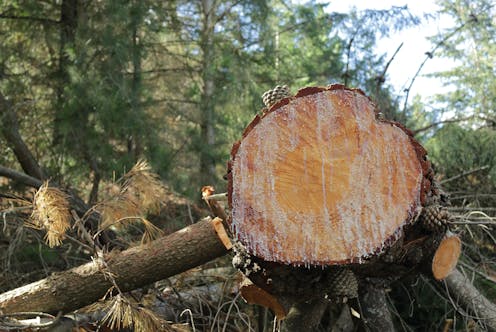
The severe impacts of Cyclone Gabrielle on the North Island, and the five severe weather events experienced by the Thames–Coromandel region in just the first two months of 2023, are merely the latest examples of more frequent erosion-triggering rainfall events over the past decade.
Inevitably with the heavy rain, soil, rocks and woody material (also known as “slash”) from landslides have flowed down onto valleys and flood plains, damaging the environment and risking human safety.
Clear-fell harvesting of pine forests on steep erosion-prone land has been identified as a key source of this phenomenon.
So we need to ask why we harvest pine forests on such fragile land, and what needs to change to prevent erosion debris and slash being washed from harvested land.
Pine was a solution
Ironically, most of these pine forests were planted as a solution to soil erosion that had resulted from the clearing of native forests to create hill country pastoral farms.
The clearing of native forests happened in the 19th and early 20th centuries, but the consequences – erosion, flooding and floodplains covered in silt and rocks – only became apparent decades later.
Read more: Things fall apart: why do the ecosystems we depend on collapse?
Research has shown that pastoral farming on our most erosion-susceptible soils is not sustainable. The productivity of the land is being degraded by loss of soil and large areas have been buried with sediment eroded from hill country farms upstream.
So the need to reforest large areas of erosion-prone farmland is scientifically well accepted.
Why pine?
But why did we choose radiata pine for our reforestation efforts instead of other tree species?
Even today, it is hard to find affordable and feasible alternatives to radiata pine. Affordable is the key word here. We are not a rich country and our liking for “Number 8 wire” solutions makes a virtue out of necessity – we don’t have the money to pay for anything fancier.
Radiata pine is a cheap and easy tree to establish and it grows fast and reliably. Planting native or other exotic trees, such as redwoods, is possible, but it costs more and needs more skill and care to grow a good crop.
The problem with radiata pine is that if grown as a commercial crop, it is clear-fell harvested after about 28 years.
The clear-felled land is just as erosion-prone as it was before trees were planted – with the added threat of large amounts of logging slash now mixed in with the erosion debris.
It can take six years or more after harvesting before the replanted pine trees cover the ground and once again provide protection to the soil.
Benefits of pine come with a cost
If we take a long-term perspective, research shows that even a radiata pine forest that is clear-felled once every 28 years will still significantly reduce erosion, compared with a pastoral farm on erosion-prone hill country.
This is because the erosion from the clear-felled forest is outweighed by the reduced erosion once the replanted trees cover the land.
Read more: Rewilding isn't about nostalgia – exciting new worlds are possible
However, this is not much comfort to communities in the path of the flood-borne soil and logs from that clear-felled forest. It’s difficult to take a long-term perspective when your backyards and beaches are covered with tonnes of wood and soil.
Slash a byproduct of efficiency
Whatever benefits radiata pine forests bring, we need to transition forest management away from “business as usual” clear-felling on erosion-prone hill country.
This transition is possible, but one important problem is not often discussed. The pine forests are privately owned by a range of people including iwi, partnerships made up of mum-and-dad investors and large international forestry companies.
All these people have created or acquired these forests as an investment.
A typical pine forest investment makes a good financial return, but this assumes normal efficient forestry, including clear-felling large areas with highly-productive mechanised logging gangs.
It has become clear that we need to manage forests differently from this large-scale “efficient” model to reduce the risk of erosion and slash from erosion-prone forests. Changing how we manage these forests will inevitably reduce the economic return, and forest investors will absorb this reduction.
Time for a permanent fix
If we go back to when the pine forests being harvested today were planted, the forests had a social value – not just in reducing erosion but in providing employment in rural areas where few jobs were available.
This social value was recognised by government funding, initially through tree planting by a government department, the NZ Forest Service. With the rise of free market economics in the 1980s, such direct government investment was considered inefficient and wasteful.
The Forest Service was disbanded in 1987 and its forests were sold to forestry companies. However, the government continued to promote tree planting on erosion-prone land with subsidies to private investors.
Read more: How to get sustainable forestry right
As these forests grew, they came to be considered purely as business investments and were bought and sold on that basis. When the time came to harvest the trees, the expectation was that these could be clear-fell harvested in the same conventional way as commercial forests growing on land with no erosion risk.
As erosion started occurring on the harvested sites, it became clear why these trees were originally planted as a social investment to protect the land and communities from soil erosion.
Aotearoa New Zealand has achieved control of erosion with a Number 8 wire solution- encouraging private investors to grow commercial pine forests on erosion-prone land. The problem with Number 8 wire solutions is that after a while the wire fails, and you have to find a permanent fix.
Conventional commercial pine forestry was a good temporary solution, but now we need to find a more sustainable way to grow forests on our most erosion-prone lands – and it won’t be as cheap.
Authors: Mark Bloomberg, Adjunct Senior Fellow Te Kura Ngahere – New Zealand School of Forestry, University of Canterbury


















