

Dead kangaroos make a surprising feast for possums in the Australian Alps
- Written by: James Vandersteen, PhD Student, UNSW Sydney
Vultures, hyenas, and Tasmanian devils are highly efficient scavengers, able to locate and consume carrion rapidly, including the meat and bones.
When we think of scavengers, these large carnivores are what comes to mind – not brushtail possums.
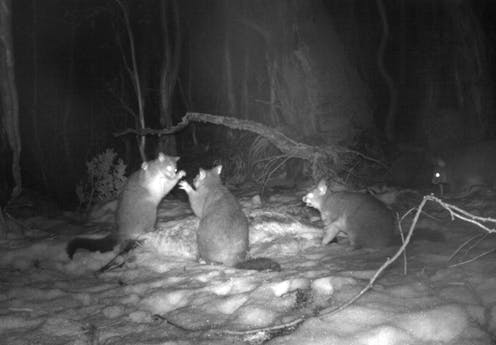
So it came as a surprise when these Australian marsupials turned out to be one of the most common scavengers we caught on camera in our new study published online this month in Wildlife Research.
Circle of life
No vertebrate Australian animals survive exclusively by scavenging – for our wildlife, carcasses are a “sometimes food”.
Scavengers play an important role as ecosystem cleaners, helping to remove carcasses from our landscapes by eating them.
With this in mind, we wanted to know how different seasons affect the use of carcasses by vertebrate scavengers in Kosciuszko National Park, south-east NSW, in the Australian Alps.
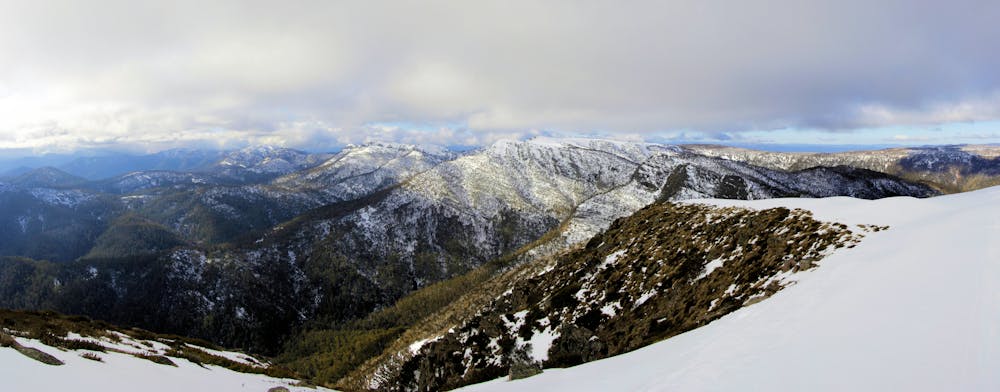
Winter in the Australian Alps covers much of the landscape in snow. But by the following summer, that same landscape can warm up considerably and even experience intense bushfires.
We found scavenging was highly seasonal in terms of who visits carcasses throughout the course of a year. Most surprisingly, brushtail possums and ravens drove these seasonal trends, as the most common scavengers recorded, with possums mostly scavenging in winter, and ravens in spring.
These findings emphasised the key role of smaller scavenger species, and uncovered novel insights into the feeding habits of the brushtail possum, which is generally considered to eat mostly plants and insects.
Catching possums in the act
We expected to see different scavengers appearing with each season, so our monitoring ran across the course of a full year from March 2020 till March 2021.
Each consecutive season (starting in autumn, then winter, spring, and summer) we placed 15 fresh eastern grey kangaroo carcasses – sourced from local culls – throughout the alpine environment (60 carcasses total).
Each of these carcasses were monitored by a remote camera for 60 days to record every species that visited, whether that be to investigate or feed on the carcass.
Across 745,599 remote camera images, the scavenger species we recorded were spotted-tail quolls, feral cats, dingoes, pied currawongs, wedge-tailed eagles, brushtail possums, ravens, red foxes, and feral pigs.
Of the scavenging we recorded, 88% was done by brushtail possums and ravens.
Surviving the seasons
We expected the time it would take the scavengers to find – and subsequently scavenge – a carcass would be linked to the smelliness of the carcass.
During summer, we thought, that heat would make the carcasses’ odours more pungent, and therefore easier to find.
We were wrong about that, not in terms of the smell, but how quickly vertebrate scavengers would find the carcasses.
It actually took vertebrate scavengers longer to find the carcasses in the summer, whether for investigation or scavenging. In the winter, carcass visits peaked.
But, we have a potential explanation for this.
In the summer, a carcass is colonised by many scavenging insects within minutes of its death. These “mini scavengers” may have sped up carcass decomposition so much, that vertebrate scavengers had little time to find the fresh carcasses.
Scavenging rates might also have been lowest in the summer because other food sources were abundant.
Brushtail possums, for instance, eat mostly leaves, flowers, fruit and insects, most of which are only seasonally available during summer.
In the winter, when these food sources are scarce, brushtail possums accounted for 81% of all recorded scavenging. They were eating carrion three times more often than during summer.
Feeding the family
We also considered that the scavengers’ breeding seasons might have an impact on their scavenging rates and behaviours.
Ravens breed from late winter into early spring, and initially prioritise nest construction.
This was even captured by our remote cameras, where ravens were observed collecting fur from the kangaroo carcasses, presumably for nest construction.
Following nest construction, chick rearing often requires breeding pairs to divide time between foraging, feeding chicks, and protecting the nest.
Inherently, during this time, ravens require more energy and must supplement their diets with lots of high-energy food, such as carrion.
Of all the raven scavenging we recorded, 67% was done during spring. This suggests ravens rely heavily on carrion to supplement their own diet – and that of their chicks – during their breeding season.
Where were the usual suspects?
It was also clear that the larger species (dingoes, wedge-tail eagles, feral pigs) were scarcely recorded at the carcass sites. Low rates of scavenging by these larger animals could be another reason why the smaller scavengers were so common.
This is because larger scavengers can scare away or predate on smaller scavengers, potentially moving them away from carcasses. Larger scavengers also have bigger appetites, so in their absence, there was potentially more carrion for smaller species to find.
Although we do not have a good estimate of the true density of larger scavengers in the surrounding environment, species like the dingo are subject to control in the broader region, potentially limiting their numbers.
Beyond the mountains
Given the extent of culling operations in Australia targeting overabundant native species (like kangaroos) or pests such as deer and horses, not to mention all the road-kill, it is important to understand what is happening to carcasses in the landscape.
Our study has set a baseline for scavenging dynamics in an alpine ecosystem, and our methods could be used to learn more about the ecology of scavenging in many different environments.
In this case, it was (surprisingly) brushtail possums who appear to be taking advantage of carcasses as a source of food in the Australian Alps.
Authors: James Vandersteen, PhD Student, UNSW Sydney


















