

Disability and dignity – 4 things to think about if you want to 'help'
- Written by: Angel Dixon, Researcher, Griffith University
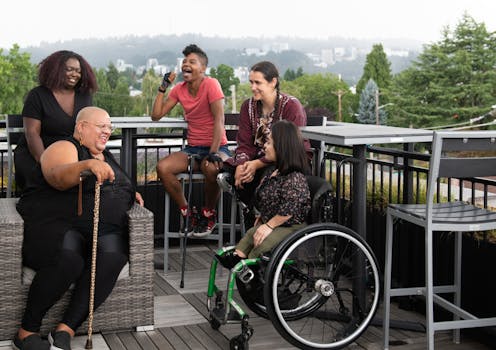
The prevailing public perception is that everything people with disability do is a challenge. Sometimes, that is true. In those times, we may ask or say “yes” to a kind and respectful offer of assistance. Other times, and more often than not, we are simply navigating daily life when a person without disability interjects to offer assistance.
It is rare anyone means to be discriminatory in their approach to supporting people with disability, but society’s attitude still has a way to go.
Disability rights activism used to take place in the streets or by occupying government property or buildings (sometimes it still does). But the age of social media has created an opportunity for people with disability to explore and exercise advocacy in new ways too. Air travel experiences of being treated – and handled – like “baggage”, as writer and advocate Zoe Simmons recently detailed on Twitter, expose the attitudinal barriers people with disability encounter when others “help”.
There could be lots of reasons why people with disability decline or don’t want offers of help. Recent research at the Dignity Project, at Griffith University, echoes Simmons’ experience and also shows there is no “one-size fits all” approach to recommend.
But not offering assistance to fellow human beings is not the answer either. So, what is the right way to ask a person with disability if they would like help?
Disability is about the environment, not a diagnosis
More than 1.3 billion people globally live with disability. The Convention on the Rights of Persons with Disabilities states disability does not result from a diagnosis or impairment, but when a person encounters inaccessible, inflexible, or insufficient environments, systems and attitudes.
In an ideal world, everyone would appreciate that disability is a mismatch between person and environment and would be motivated by a human rights perspective.
In reality, Australian society is still lagging in its understanding of and attitude towards disability. Most people are confused or unsure about how to treat people with disability, which leads to exclusion and increases the barriers people with disability encounter.
Barriers for people with disability can be as obvious as a building with no elevator or as subtle as a pat on the back from a passerby.
Challenging economic, environmental and attitudinal barriers could produce real change.Barriers take their toll
Participants in the Dignity Project, a citizen science research and advocacy program at Griffith University, shared the impact and cumulative effect frequent and repeated encounters with barriers can have on a person’s mental health and behaviour.
These undignified interactions result in people feeling like “less of a person, less worthy, less valid, less visible, annoyed, frustrated, sad, angry” with “no rights, no voice, and reduced control”.
As a result, people may avoid social situations and isolate themselves. Over time, people with disability are silenced or diminished in their role as decision makers in their own lives.
It can be useful to think about four aspects of offering help.
1. Acknowledge people and their rights
Misinformation and limited or reductive tropes perpetuated in the media contribute to the challenge of confronting and changing attitudes.
Participants in the Dignity Project called for acknowledgement and recognition that people with disability are human beings with the same full dimensions of personhood and human rights as people without disability. They described very few instances of needing help but when they did, said dignified experiences are defined by acknowledgement. In the words of one person:
First off, ask me ‘do you need help?’ and acknowledge that I might not need it. I will ask for help if I need it […] Ask how best to help and provide the help I ask for, rather than doing what [you think] I needed.
2. Pay attention to the response and consider what might be behind it
People with disability have rights including the right to freedom of expression and opinion and respect for privacy.
So, listen to a person’s response when asked about needing assistance. If you receive a negative response, have empathy for what you may not necessarily understand. If a response is short or angry, accept it and don’t grow resentful. That response may come from a history of discrimination and misrecognition.
The way to ask a person with disability if they would like help depends on contextual, subjective and relational factors. Providing help or support requires consideration of the diversity of experience, the situation, your relationship with the person and the consequences of helping or not helping.
Although helping may seem like an appropriate and polite thing to do, it may not even be appropriate to ask, particularly if doing so becomes a public act that draws attention to the person.
3. Know what not to do
There are some clear messages about what not to do, reiterated in our research and in Zoe Simmons’ tweets.
Never physically touch someone, their assistive technology, aid or a support animal without asking.
It is inappropriate to ask people about their diagnosis or impairment if not related to the topic at hand and make sure you use language that is dignified.
Even if you mean well, avoid comments that frame disability or a person’s existence in a negative light, such as “you’re managing so well despite everything” or “you’re so brave”.
4. Think bigger
Social change takes time. Auditing your own personal biases while respectfully interacting with a person with disability and simultaneously managing the mix of emotions that can be triggered by disability is a complex social skill.
Building an inclusive society will ensure people with and without disability can interact comfortably in the world together.
A positive and affirming form of “help” might be ensuring environments and attitudes over which you have influence are always accessible and inclusive.
Read more: Will AI tech like ChatGPT improve inclusion for people with communication disability?
Authors: Angel Dixon, Researcher, Griffith University


















