

What Australia learned from recent devastating floods – and how New Zealand can apply those lessons now
- Written by: Iftekhar Ahmed, Associate Professor, University of Newcastle
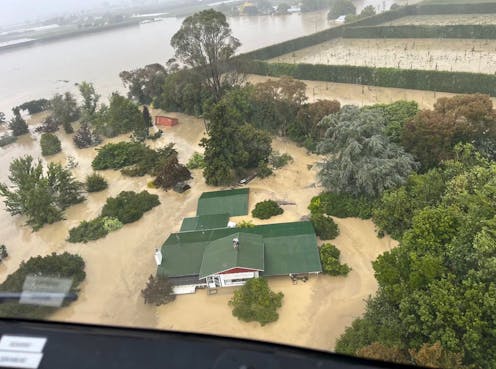
Australia and New Zealand have both faced a series of devastating floods triggered by climate change and the return of the La Niña weather pattern. So it makes sense that Australia has now sent disaster crews to help with the aftermath of Cyclone Gabrielle.
With five serious floods in the space of 19 months in 2021-2022, Australia’s experiences – and how people responded – offer New Zealand a guide for recovering and rebuilding after an extreme weather event.
The flooding events in both countries share two key common elements. First, the floods broke previous records and were the largest in recent history. Second, there were also repeat flood events.
In Auckland, there were two massive floods within five days, while Cyclone Gabrielle became the Coromandel’s fifth severe weather event for 2023 and devastated other parts of the North Island.
The other common factor is urbanisation. Auckland’s population has been growing, resulting in the increasing development of the built environment. Intensifying urban development places pressure on existing drainage systems – parts of which are no longer fit for purpose.
Extensive built-up and paved areas with hard, impermeable surfaces can also cause rapid run-off during heavy rain, with the water unable to be absorbed into the ground as it would be in soft, vegetated areas.
Working with the community
Our recent research in the Hunter Valley in Australia – one of the areas affected by those five successive floods – identified similar factors contributing to the flooding events, including a rapidly growing regional population.
Two of our research sites – the Cessnock and Singleton local government areas – had growing urban centres that reflected a similar development trajectory to Auckland, albeit in a smaller scale.
Our research in the Hunter Valley established the importance of identifying existing community resilience and gaps. We also observed the need to involve the community at all levels. This included having early warning systems and evacuation protocols in place to improve community access to information and warnings.
The State Emergency Services (SES) is the main agency in New South Wales responsible for flood response and management. Supported by community volunteers, the SES has a clear focus at the local level.
This community focus is evident with its “door-knocking kit”, which is based on a community-level vulnerability assessment. The SES has a list of those in the community who are most at risk, such as the elderly and people with disabilities. When a flood risk becomes evident, SES volunteers go knocking on doors to check their preparedness and provide evacuation support.
The equivalent of SES in New Zealand, Auckland Emergency Management, could learn from this community-based approach and include it within its Community Group Support initiative, so that future disaster responses can be more closely tailored to the community.
In the recent floods in Auckland, communication was an issue. Relaying directives and information through multiple institutional layers led to confusion, which could have been avoided through a closer community-based approach.
Building a volunteer army
Another key factor in Australia is the large cadre of SES volunteers – around 9,000 in New South Wales, a state with a population of just over eight million. This is a significant form of social capital, without which the current approach to flood response and management would not be possible.
While there are initiatives in New Zealand to attract and engage volunteers, more needs to be done. Civil defence needs to conduct a structural review of the existing volunteer organisations that work in the disaster and emergency response field to identify ways to improve the recruitment and retention.
We also found evidence of volunteer “burn-out”, meaning there’s a need to support volunteers emotionally and financially during extended periods of disaster response and recovery.
While there is a large number of SES volunteers in Australia, more are needed as climate change drives more frequent, extensive and intense disasters. Given the similar nature of repeat climate-related disaster events in New Zealand, provisions for a large cadre of well-supported and well-trained volunteers is necessary.
A review of existing volunteer agencies and community organisations should be undertaken to identify ways they can be harmonised to avoid competing pressures for resources. As well, there’s a need to nurture collaboration between agencies to help with sharing skills, training, data and resource management.
The need for resilience
Perhaps the key lesson for New Zealand, and also Australia, is the need to think beyond emergency management to building long-term resilience within agencies and communities.
As climate-related disasters become more common, we need to think about how our cities grow and how we can incorporate flood resilience by retaining green areas and vegetation, improved drainage and transportation links.
But both countries also need to focus on being ready for a disaster, instead of managing it after it happens. In doing so, the pressures of managing the disaster when it arrives would be less – and so would the long-term impacts on people and the economy.
Authors: Iftekhar Ahmed, Associate Professor, University of Newcastle


















