

Essentialising 'Russia' won't end the war against Ukraine. Might 'real and credible' force be the answer?
- Written by: Mark Edele, Hansen Professor in History, Deputy Dean, The University of Melbourne
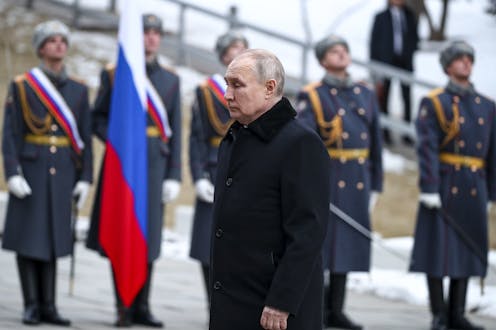
Russia’s War on Everybody, by UK writer Keir Giles, is an alarming book. It argues that for years Russia has been waging “a clandestine war against the West”.
The current all-out military aggression against Ukraine is only the latest escalation of this larger, hybrid war. “Shooting down airliners, poisoning dissidents, interfering in elections, spying and hacking have long seemed to be the Kremlin’s daily business.”
This multi-pronged and sophisticated war is deeply rooted in Russian history, the book further argues. Russia is different from “the West” (the latter term helpfully defined as “you know it when you see it”).
Review: Russia’s War on Everybody and What It Means for You – Keir Giles (Bloomsbury)
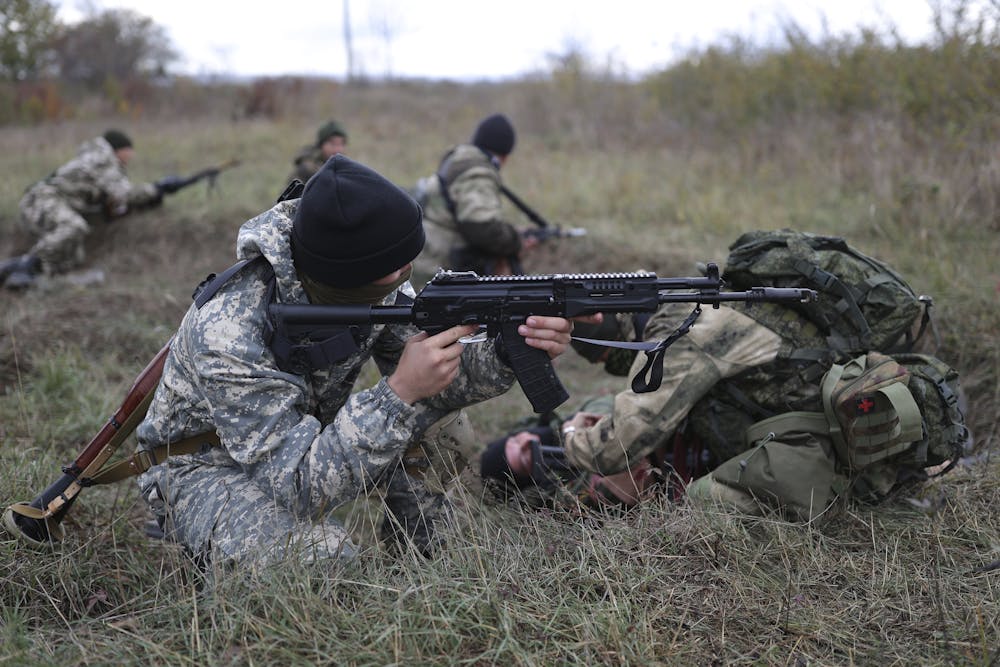
A post-imperial power that has never come to terms with decolonisation, Russia has fundamentally different values from the West – and this difference drives its attempts to take as much power as possible, wherever and whenever it can.
Even at its weakest, Russia never stopped insisting that it has greater rights than other countries around it, or demanding to dictate the foreign policy decisions of countries beyond its borders.
A handbook for hawks
Keir Giles is somewhat more sceptical about the effectiveness of Russia’s various interventions into democratic processes and public debate outside its borders than a book that can be seen as a direct predecessor.
Timothy Snyder’s 2018 The Road to Unfreedom blamed everything from anti-immigration sentiments in Germany, to Brexit and the election of Donald Trump, on Russia’s secretive meddling.
But the upshot is the same in Russia’s War on Everybody: be afraid; Russia is on the march everywhere; nobody is safe. The war against Ukraine is just an escalation of an ongoing hybrid war of “Russia” against “the West”.
Only military defeat will bring Russia to its senses and its leadership to
reassess its place in the world. This would be the shock the country needs to start the long, hard process of transitioning from a frustrated former imperial power to a normal country that can coexist with Europe.
This book, then, is a handbook for hawks. It is a timely corrective to interpretations that blame NATO or “the West” (either partially or “principally”) for Russia’s war of aggression, and imply it’s up to “the West” to find some compromise Russia can live with.
By contrast, Giles sees Russia alone as responsible: not Putin, not the kleptocratic elite in power, not the men of the KGB who have taken over the country, but “Russia”.
The book is sprinkled with historical comparisons that attempt to show everything Putin’s regime does today has “deep roots” in the country’s history.
“Almost everything Russia does,” Giles writes, “is recognizable from previous centuries – just updated as new technology for delivering malign effects becomes available.”
Read more: Back in the USSR: my life as a 'spy' in the archives
A strange historical method
These sections are highly problematic. They pick and choose instances that show continuity, while ignoring all change – a strange historical method. Take the claim that the Soviet Union
did not have a war machine, it was a war machine, because every national effort and every sector of the economy was subordinated to sustaining the Armed Forces.
It neatly encapsulates the period of the Bolsheviks’ War Communism (1918-21) or the Stalin years (1928-53). It is entirely misleading, however, for the New Economic Policy implemented by Lenin (1921-28) and even more so for the post-Stalin decades.
Under Nikita Khrushchev (1953-64), the size of the army was cut back repeatedly. Funds were instead poured instead into welfare for the population, including what one historian has called “the greatest housing program in the world”.
Khrushchev frequently clashed with his top military men over what he saw as their scandalous squandering of resources, as his biographer noted. “Are we planning to conquer anyone?” he grumbled when presented with the military’s shiny hardware. No, he was told. “Then why do we need the weapons we saw today?”
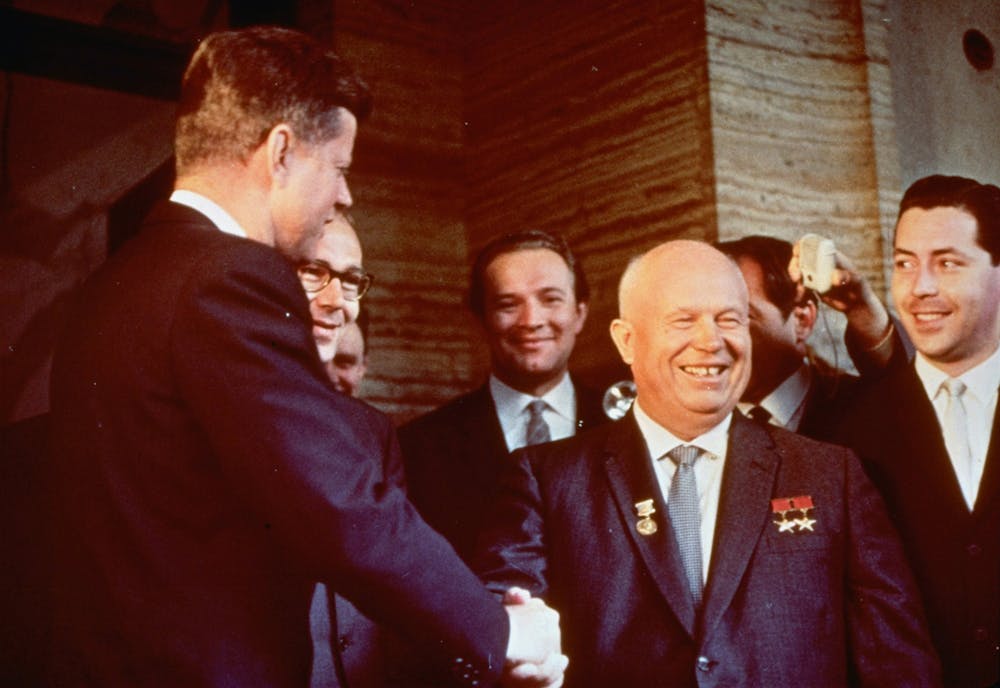 Under Nikita Khrushchev (pictured, shaking hands with JFK), the size of the Russian army was cut back, with funds instead poured into welfare for the population. AP original.
Khrushchev’s vision of the Soviet Union was the exact opposite of an army with a country. What he tried to build was a “thermonuclear welfare state”: behind the shield of the Soviet Union’s nuclear arsenal, the army could be reduced to an absolute minimum and the resources redirected towards welfare.
His successor, Leonid Brezhnev (in power 1964-82), did increase military spending again, but did not finance this by suppressing civilian consumption, as Stalin had. Instead, he overspent on both. And the Gorbachev years (1985-91) “witnessed an unprecedented erosion of the military’s standing in Soviet society at large”.
Othering Russia
Other historical references are the kinds of cliches one could routinely read in the worst examples of 1950s assessments of why “the Russians” were different from “us”.
Russia missed the Reformation, we read. So did, of course, most Catholics. And, as historian Serhii Plokhy has pointed out, Russia did undergo a process similar to the counter-reformation, which is what the Old Believers rebelled against.
Russia also allegedly missed “the enlightenment”, which makes one wonder why Catherine the Great corresponded with Voltaire. As a careful study of the interactions of Russian Orthodox and European thought after 1500 concluded, the “late eighteenth-century Russian intellectual scene would have been unrecognizable” without the reception of enlightenment thinkers like Voltaire and Diderot, Montesquieu, Rousseau and Adam Smith.
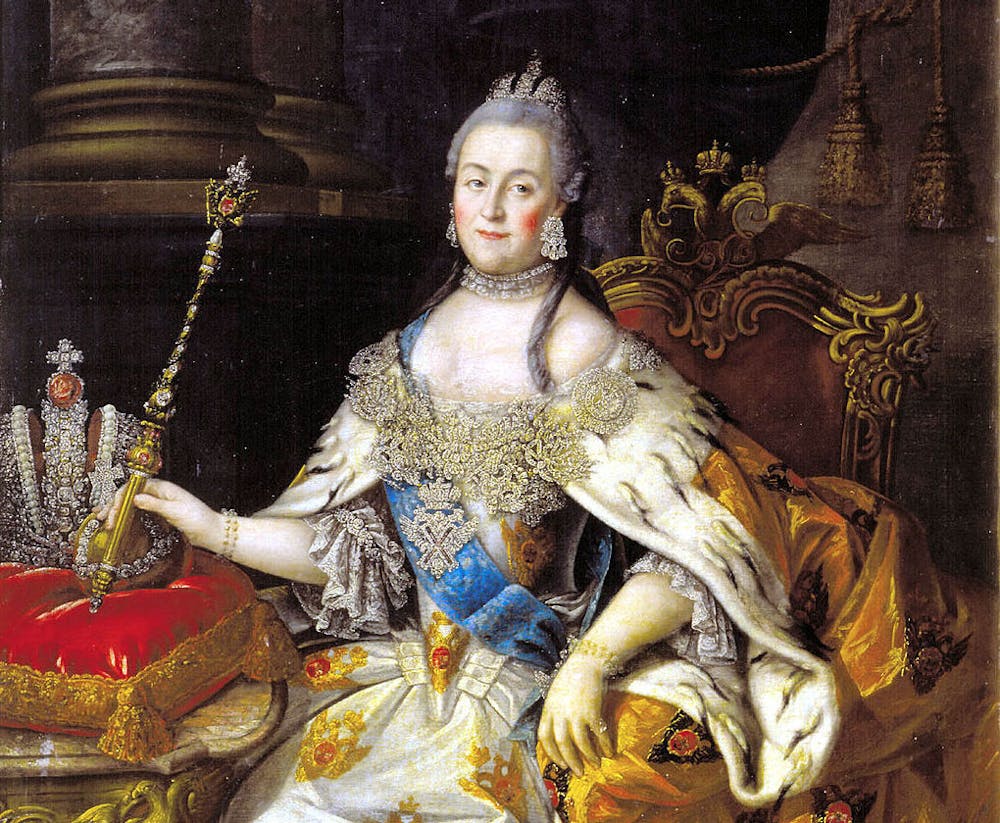 Keir Giles writes that Russia ‘missed the enlightenment’ – but Catherine the Great corresponded with Voltaire.
Catherine II, Alexey Antropov
Keir Giles writes that Russia ‘missed the enlightenment’ – but Catherine the Great corresponded with Voltaire.
Catherine II, Alexey Antropov
The whole notion the Reformation and the Enlightenment are the basis of democracy and civil liberties was a staple of old-fashioned “from Plato to NATO” histories of “Western civilisation”. But this view has been undermined both by newer histories of democracy and explorations of the destructive possibilities inherent in enlightenment thought.
The selective and misleading polemical pseudo-history, intent on showing that what Moscow does these days is just the normal state of how “Russia” behaved through the centuries, leaves the book open to charges of essentialising, othering and orientalising Russia.
Putin’s country is somehow essentially different from “us” – non-Western, non-liberal, non-civilised, and deeply and fundamentally so. The consistent use of “Russia” to refer to the current government in Moscow will further entice some critics to accuse the book of that all-purpose thought-crime of anybody critical of the Kremlin: “Russophobia”.
Is Russia eternally malicious?
Giles attempts to defend his book against such accusations with nimble terminological footwork. He pre-emptively accuses critics of his approach of being “apologists for Russia” and not “objective reader(s)”. And he tries to use a definition of what the word “Russia” means to safeguard his argument against critique.
“Russia” in this book is a shorthand, standing for the people within the country today who direct its state policy, both for dealing with its own citizens and with foreign countries.
Hence, only unobjective readers might claim he essentialises the Russian national character: they mistake a shorthand for a characterisation.
But the claim does not stand up to scrutiny. The historical argument, after all, is that today’s leadership in the Kremlin just enacts the normal way “Russia” has always acted. It has reverted to type: “Russia’s behaviour today is returning to what was normal in its Soviet past, and further back into Tsarist times.”
Russia has always seen the idea of its subjects enjoying uncontrolled access to news and ideas from abroad as highly dangerous […] Russia has always felt the need to insulate its population from excessive exposure to foreigners so they are not contaminated with dangerous ideas of political liberty or democracy.
And so on. Russia is eternal; and it is eternally malicious.
It therefore makes no difference who’s in the Kremlin.
There is no reason to assume that what comes after Putin will be an improvement – because Putin and his accomplices are a product of Russia rather than the other way round.
Russia always interfered in the politics of its neighbours, Giles writes. Putin’s Russia “has moved back towards its own historical normality – vicious repression and dictatorship at home, and open confrontation with the West wherever it can reach out and harm it abroad”.
Whenever “Russia” acts like the current government, it acts normally, in other words; whenever it does not, it’s just a temporary aberration. A better example of the practice of essentialising and simplifying the complex history of a country would be hard to find.
 Giles believes today’s leadership in the Kremlin just enacts the normal way ‘Russia’ has always acted.
AP
Giles believes today’s leadership in the Kremlin just enacts the normal way ‘Russia’ has always acted.
AP
An excellent grasp of Putin’s view
It is lamentable that Giles has weakened the argument of his book by this methodological overreach. The claims about Russian history and the “deep roots” of the Putin regime will make it easy for critics to dismiss it. But his analysis of the way the current government thinks and acts should be taken seriously.
He has an excellent grasp of Putin’s view of the world and the ways the men in the Kremlin perceive the actions of what they, too, conceptualise as “the West” (although they don’t like what Giles tries to defend).
If he’s right (and I think he is), then the recurrent voices in the democratic world who ask to negotiate with Putin, to find him an “off-ramp”, to make concessions, have it all backwards: such approaches will be seen as the predictable weakness of the decadent enemy. Such perceived weakness will be exploited and lead to further escalation rather than compromise.
There are some fundamentally different interests involved, which will be difficult to negotiate. Giles writes:
It’s simply not possible to humour Russia’s demands for what it sees as “great power” rights to influence the countries around it at the same time as respecting those other countries’ rights to independence and to make their own decisions. Russia’s drive to dominate Ukraine and dictate its future stems from an implicit assumption of entitlement and exceptionalism.
Not off-ramps and compromises, but “real and credible military force” will cause Russia “to think twice and step back from aggression”. Replace “Russia” with “Putin” and you get a thesis that requires serious consideration as the war against Ukraine drags into its second year.
Authors: Mark Edele, Hansen Professor in History, Deputy Dean, The University of Melbourne


















