

Will the Turkish earthquakes affect how the country is governed?
- Written by: Mehmet Ozalp, Associate Professor in Islamic Studies, Director of The Centre for Islamic Studies and Civilisation and Executive Member of Public and Contextual Theology, Charles Sturt University
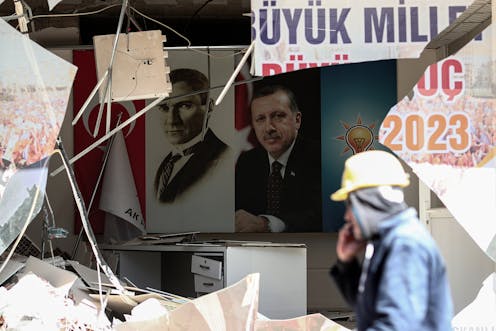
As the death toll in the Turkey-Syria earthquakes spirals past a record 46,000 – and a fresh earthquake has struck the Turkish region of Hatay – there is mounting criticism of the Turkish government and President Recep Tayyip Erdogan for delaying rescue efforts and politicising the disaster.
The aftermath of this catastrophe has ramifications for the critical Turkish presidential elections in May and Turkey’s relations with Syria, Greece and Cyprus.
The earthquake that hit Turkey on February 6 was unusual. The first 7.8 magnitude earthquake was followed by a 7.5 magnitude tremor nine hours later, compounding the damage.
As a result, ten major Turkish cities, scores of large towns and hundreds of villages were affected. The World Health Organization estimates 23 million people have been affected.
With millions on the streets and tens of thousands trapped underneath the rubble in the bitterly cold winter, a swift rescue and aid response was vital.
And this is where politics got in the way.
The government’s mishandling of the disaster
There have been four major criticisms of the Erdogan government’s response.
The first is the inactivity in the crucial first 48 hours. Independent reports are surfacing that the Turkish Disaster and Emergency Management Authority (AFAD) produced a mandatory earthquake report within 45 minutes of the disaster. The interior minister, Suleyman Soylu, then held an emergency meeting with all relevant response departments.
Within hours, rescue and relief teams were ready to go, waiting only for final permission from Erdogan. Inexplicably, he did not immediately give the orders, while international rescue teams arriving in the country were kept in airport lounges due to bureaucratic obstacles.
The lateness of the response dramatically reduced search-rescue operations to find survivors under the freezing rubble. An estimated one million Turkish people were left homeless and fending for themselves.
The second criticism relates to the centralisation of disaster relief agencies and the exclusion of the army from the response plans.
The ruling Justice and Development Party (AKP) centralised disaster operations under AFAD in 2009. While this might have seemed a good idea, AFAD’s dependence on government orders paralysed its response capability. AFAD also performed badly during the 2021 wildfires, raising doubt about its competence.
The Turkish army has the biggest resources, heavy equipment and organisational capability distributed across the country. But, perhaps unwilling for the army to steal the limelight, Erdogan removed it from the response plan and gave sole disaster response responsibilities to AFAD in 2022.
With no immediate help arriving, desperate people started to post tweets demanding to know where the state was and exposing the scale of the disaster. Turkish rock star Haluk Levent launched his own aid and rescue operations, collecting millions and mobilising thousands of volunteers faster than the government.
As criticism of the government mounted, Twitter in Turkey was blocked. This move further fuelled the anger as desperate survivors could not use an important communication channel to get help.
Third, there has been anger about poor urban planning and the disregard for building codes. Turkey is notorious for allowing poor building practices. Corrupt developers and council officials routinely allow the construction of cheap buildings that are unable to withstand earthquakes.
Read more: Earthquake footage shows Turkey's buildings collapsing like pancakes. An expert explains why
The Erdogan government periodically declared “construction amnesties”, where buildings without a safety certificate would be waived for a fee. This generated significant income for the cash-strapped government.
This policy has been responsible for the greatest number of casualties. The city of Erzin, which is in the earthquake zone, did not suffer any major building collapse or significant loss of life because it has implemented zero tolerance of unsafe building practices.
Finally, Erdogan’s critics accuse him of misappropriating funds collected through the so-called earthquake tax, implemented in 1999 following the Izmit earthquake.
Turkey is no stranger to earthquakes, being located on the Alpide belt, a seismic zone that stretches from Europe to Asia. The country has experienced numerous devastating earthquakes throughout its history, with the previous large one in Izmit in 1999. The magnitude 7.6 earthquake claimed more than 17,000 lives.
Being dangerously close to Istanbul, the 1999 earthquake exposed the tremendous risks poor building practices posed in densely populated cities. As a result, the government at the time introduced an earthquake tax.
Funds raised through this tax were meant to be used on earthquake-proof buildings and to invest in disaster prevention logistic hubs across the country. An estimated US$4.6 billion (A$6.7 billion) had been collected during the 21 years Erdogan has been in power. People are now asking what happened to all that money.
How will the earthquake affect Turkey’s presidential election?
Turkey is scheduled to have presidential elections in May 2023. The mishandling of the earthquake is likely to play a big role in the vote.
The opposition parties have been quick to capitalise on the government’s perceived failures. The main opposition Republican People’s Party (CHP) has been calling for an independent commission to investigate the disaster and determine the cause of the government’s delayed response.
The pro-Kurdish Peoples’ Democratic Party (HDP) has also been vocal in its criticism. The HDP accused the government of discrimination in the distribution of aid, alleging it favoured areas with a higher percentage of AKP supporters. This issue is likely to influence Kurdish voters, who make up about 18% of the population.
Erdogan’s AKP could lose votes in quake zones where Kurdish votes hold the balance of power. Conversely, the disaster and the three-month state of emergency could also affect voter turnout and engagement and work in AKP’s favour.
The massive scale of the destruction and death toll, the inexplicable delay in launching rescue and relief operations and poor public relations have exposed the weaknesses in the presidential system introduced to the country in 2016.
It was thought an all-powerful president would speed up bureaucracy and place the country on a fast trajectory of progress and development. The earthquake and poor government response exposed the fallacy of this contention.
The opposition parties will use the government’s handling of the earthquake as a campaign issue and call for reforms to improve disaster preparedness and responses and for a return to a parliamentary system with separation of powers.
The AKP’s mishandling of the earthquake could fuel existing tensions within the party. Erdogan, who founded the AKP, has been criticised for his increasingly authoritarian tendencies and his consolidation of power.
It is also possible the government’s response to the earthquake could be seen as effective in some quarters, which could enhance the AKP’s standing and improve Erdogan’s chances of winning re-election. The largely government-controlled Turkish media are already glorifying the government’s response, with Erdogan posing for cameras next to rescued people and children.
The biggest hurdle for Erdogan is the poor state of the Turkish economy. It has been on the downturn since 2018 when the Turkish lira collapsed. Since then, Turkish people have endured one of the highest inflation rates in the world at 85.5%. The disaster could further hamper the country’s economic prospects, which could in turn influence the election.
There is a strong possibility Erdogan might postpone the elections, citing emergency relief efforts. If he can buy time for another year or so, people might forget about the disaster and his government could hope to improve the economy, maximising its chances of winning the election. A postponement, though, would set an extremely risky precedent for Turkey’s fragile democracy.
Read more: Secondary crises after the Turkey-Syria earthquakes are now the greatest threat to life
How will the earthquake affect Turkey’s foreign policy?
Rallying nationalistic fervour through military operations has been one of Erdogan’s tactics to win elections. Reading his hostile rhetoric towards Greece and the Turkish army’s preparations near the Syrian border, there was an expectation of some military operation just before the presidential election.
Hostility with Greece may have eased, as Greece was one of the first countries to send a team to help with search-rescue operations. If Erdogan needs European Union support to rebuild the country and its economy, he will not push hostility with Greece too far.
A military operation in the earthquake-ravaged north-western Syria also seems unlikely. Such operations would bring widespread criticism from within Turkey, Russia, the Syrian regime that Erdogan is warming up to and rebel groups Turkey supports in Syria.
As remote as it sounds, annexing Northern Cyprus remains a possibility for Erdogan. A sign of this is the Turkish government’s refusal of Cyprus’s offer of assistance. Such a move would bring tremendous nationalistic support for Erdogan within Turkey. Russia may recognise the annexation in turn for concessions over the Ukraine conflict and Syria.
The earthquake in Turkey is a major test for the country and Erdogan. It is likely to dramatically alter the country’s internal political trajectory and its involvement in regional conflicts.
Authors: Mehmet Ozalp, Associate Professor in Islamic Studies, Director of The Centre for Islamic Studies and Civilisation and Executive Member of Public and Contextual Theology, Charles Sturt University
Read more https://theconversation.com/will-the-turkish-earthquakes-affect-how-the-country-is-governed-199946


















