

As livestock theft becomes a growing problem in rural Australia, new technologies offer hope
- Written by: Kyle J.D. Mulrooney, Senior Lecturer in Criminology, Co-director of the Centre for Rural Criminology, University of New England
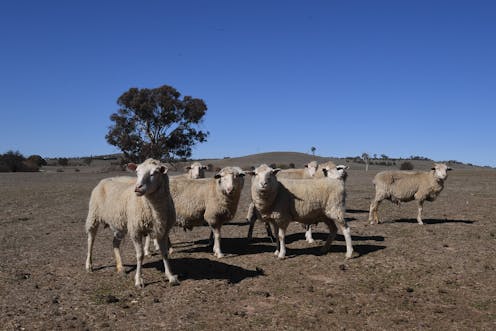
Last week, it was reported that 700 sheep with an estimated value of $140,000, including nearly 200 valuable merino ewes, were stolen from a Victorian property in a highly sophisticated rural crime operation. Such large-scale rural theft is increasingly common.
Rural crime is not isolated to certain states. Rather, stock theft is an Australian problem. Evidence from these large-scale thefts shows that offenders use “corridors” across state borders to move stolen rural property and livestock great distances.
Surveys conducted in Victoria and New South Wales found 70% and 80% of farmers had experienced some type of farm crime in their lifetime, and experienced this victimisation repeatedly.
While farmers experience a variety of crimes, including trespass and illegal shooting on their properties, acquisitive crime – stock theft in particular – is one of the most common crimes faced by farmers.
The impact of “farm crime” is significant. Not only is the farming sector important to the Australian economy, but such crimes can have devastating financial, psychological and physical impacts on farmers, rural landowners and communities.
Why does it happen?
The high rates of theft in farming communities can be explained by unique geographic and cultural factors influencing the incidence and response to crime.
Let’s consider geography in more detail. Rational choice theory suggests offenders make decisions to commit crimes by weighing the risks and rewards. The goal of crime prevention then is to increase risks and lower rewards.
In a busy city, for example, crime prevention might include tools such as locks, motion lights or CCTV, while the many people going about their business may deter criminals simply by being present.
The presence of formal guardians, such as the police or security guards, may serve to deter crime too. The urban environment can also be designed and built in such a way as to discourage crime by limiting hiding places, exit points and escape routes.
The rural environment flips all of this on its head. It is often not possible to implement traditional crime prevention tools given the vast amount of wide-open space, nor are locks or gates always practical on a busy working farm.
The low population density means there are very few “eyes in the paddock” to witness and deter crime. A formal police presence is even more sparse, with slower response times than in urban areas.
The environment itself is also less conducive to crime prevention through evironmental design due to limited and spread-out infrastructure combined with a myriad of access points.
When we add all of this together, the risk-reward calculation for committing crimes such as stock theft in rural areas is often very favourable to offenders.
What can we do about it?
Innovations in policing and agricultural technology appear to offer some promising progress to combat farm crime.
The NSW Police have a dedicated Rural Crime Prevention Team. It’s comprised of officers with cultural and practical knowledge of rural industry and the necessary training, skills and expertise to deal with farm crime.
This team has deployed innovative techniques to fight rural crime, and their efforts have contributed to increases in satisfaction with the police and, most importantly, in the reporting of rural crime by farmers.
Despite this, police are still operating in an environment that presents serious difficulties in preventing, investigating and clearing farm crime.
There are two key issues at work. The first is that farmers may check on stock only intermittently, and so be unaware of a theft for some time. The second is difficulty in tracking and identifying stolen stock.
New technology offers some solutions here. The Centre for Rural Criminology (UNE) staged a mock theft of livestock, with a live police intervention, to evaluate the ability of a smart animal ear tag to combat stock theft. The results were very promising.
Using the movement and location data provided by the tag, the farmers were alerted to the stock theft within minutes of the thieves entering the paddock. This enabled a rapid and effective response and recovery by the police.
Another new technology applies facial recognition to stock by drawing on small variations in the shape and patterns of a their muzzle, which are as distinct as a human fingerprint.
Farmers are able to capture photos of livestock using a smartphone or tablet, then upload this to an AI-powered cloud platform to identify animals. Ideally, law enforcement could use this image recognition technology to identify stolen cattle and return them to their owners.
The theft of stock is a serious and growing problem in Australia. Large-scale and sophisticated thefts are being reported with increasing frequency and farmers, rural communities and the Australian economy suffer from this.
Dedicated policing efforts in combination with new agricultural technologies may increase the risks of committing farm crimes and turn the tables on the offenders.
Authors: Kyle J.D. Mulrooney, Senior Lecturer in Criminology, Co-director of the Centre for Rural Criminology, University of New England


















