

how giant baby galaxies are shaking up our understanding of the early Universe
- Written by: Ivo Labbe, ARC Future Fellow / Associate Professor, Swinburne University of Technology
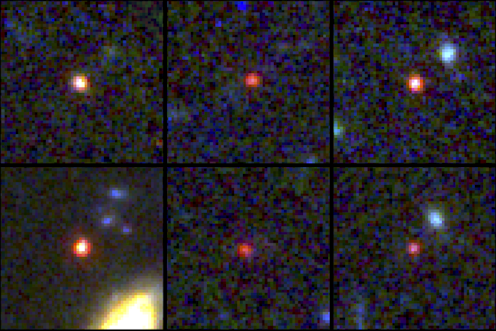
“Look at this,” says Erica’s message. She is poring over the very first images from the brand new James Webb Space Telescope (JWST).
It is July 2022, barely a week after those first images from the revolutionary super telescope were released. Twenty-five years in the making, a hundred to a thousand times more powerful than any previous telescope, one of the biggest and most ambitious scientific experiments in human history: it is hard to not speak in superlatives, and it is all true.
The telescope took decades to build, because it had to be made foldable to fit on top of a rocket and be sent into the coldness of space, 1.5 million kms from Earth. Here, far from the heat glow of the Earth, JWST can detect the faintest infrared light from the distant universe.
Little did I know that among the pictures is a small red dot that will shake up our understanding of how the first galaxies formed after the Big Bang. After months of analysis, my colleagues and I just published our results in Nature.
Hunting new kinds of galaxies
Erica and I are on the hunt to discover new types of galaxies. Galaxies that the venerable Hubble Space Telescope had missed, even after decades of surveying the sky.
She and I go back 15 years. We met when she was a first-year student at a Californian liberal arts college and I was a freshly minted PhD straight out of university, just starting my first gig as a researcher in Los Angeles. JWST was only a distant rumor.
Somehow, many years later, our paths crossed again, and now Assistant Professor Erica Nelson of the University of Colorado and I are finding ourselves at the tip of the spear attacking the first data of a very real JWST.
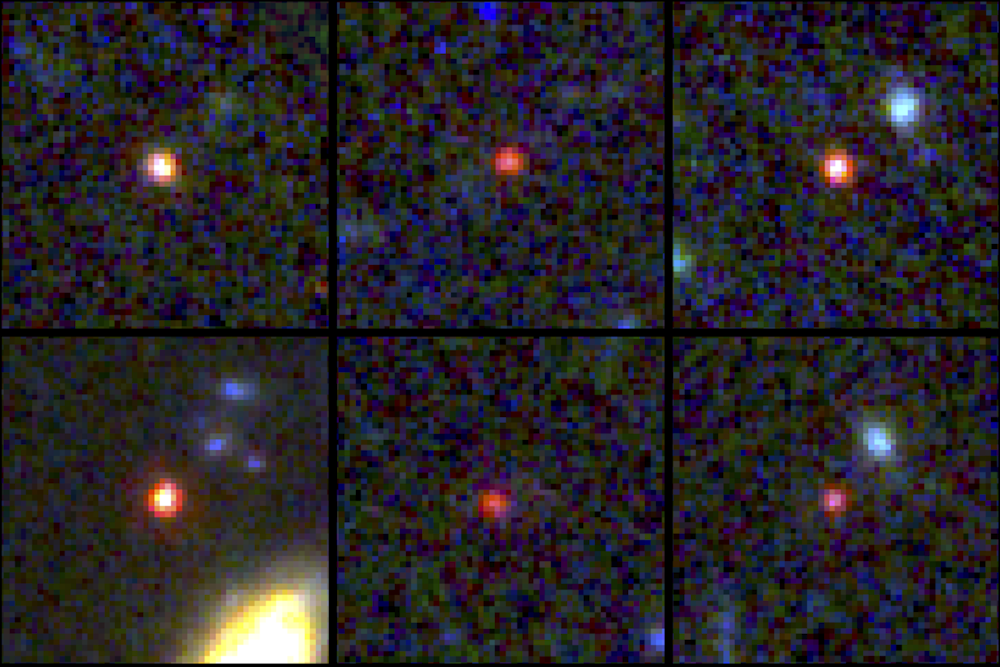
“UFOs”, she calls the new galaxies, and I can read a giant grin between the lines: “Ultra-red Flattened Objects”, because they all look like flying saucers. In the colour images they appear very red because all the light is coming out in the infrared, while the galaxies are invisible at wavelengths humans can see.
Infrared is JWST’s superpower, allowing it to spy the most distant galaxies. Ultraviolet and visible light from the first stars and galaxies that formed after the Big Bang is stretched out by the expansion of the universe as it travels towards us, so by the time the light reaches us we see it as infrared light.
Impossibly early, impossibly massive galaxies
All of Erica’s galaxies look like saucers, except one. I stare at the little red dot on the screen. That is no UFO. And then it hits me: this is something very different. Much more important.
I run the analysis software on the little pinprick and it spits out two numbers: distance 13.1 billion light years, mass 100 billion stars, and I nearly spit out my coffee. We just discovered the impossible. Impossibly early, impossibly massive galaxies.
At this distance, the light took 13 billion years to reach us, so we are seeing the galaxies at a time when the universe was only 700 million years old, barely 5% of its current age of 13.8 billion years. If this is true, this galaxy has formed as many stars as our present-day Milky Way. In record time.
And where there is one, there are more. One day later I had found six.
Astronomy’s missing link?
Could we have discovered astronomy’s missing link? There has been a long-standing puzzle in galaxy formation. As we look out in space and back in time, we see the “corpses” of fully formed, mature galaxies appear seemingly out of nowhere around 1.5 billion years after the Big Bang.
These galaxies have stopped forming stars. Dead galaxies, we call them, and some astronomers are obsessed with them. The stellar ages of these dead galaxies suggest they must have formed much earlier in the Universe, but Hubble has never been able to spot their earlier, living stages.
Early dead galaxies are truly bizarre creatures, packing as many stars as the Milky Way, but in a size 30 times smaller. Imagine an adult, weighing 100 kilos, but standing 6cm tall. Our little red dots are equally bizarre. They look like baby versions of the same galaxies, also weighing in at 100 kilos, with a height of 6cm.
Too many stars, too early
There is a problem, however. These little red dots have too many stars, too early. Stars form out of hydrogen gas, and fundamental cosmological (“Big Bang”) theory makes hard predictions on how much gas is available to form stars.
To produce these galaxies so quickly, you almost need all the gas in the universe to turn into stars at near 100% efficiency. And that is very hard, which is the scientific term for impossible. This discovery could transform our understanding of how the earliest galaxies in the universe formed.
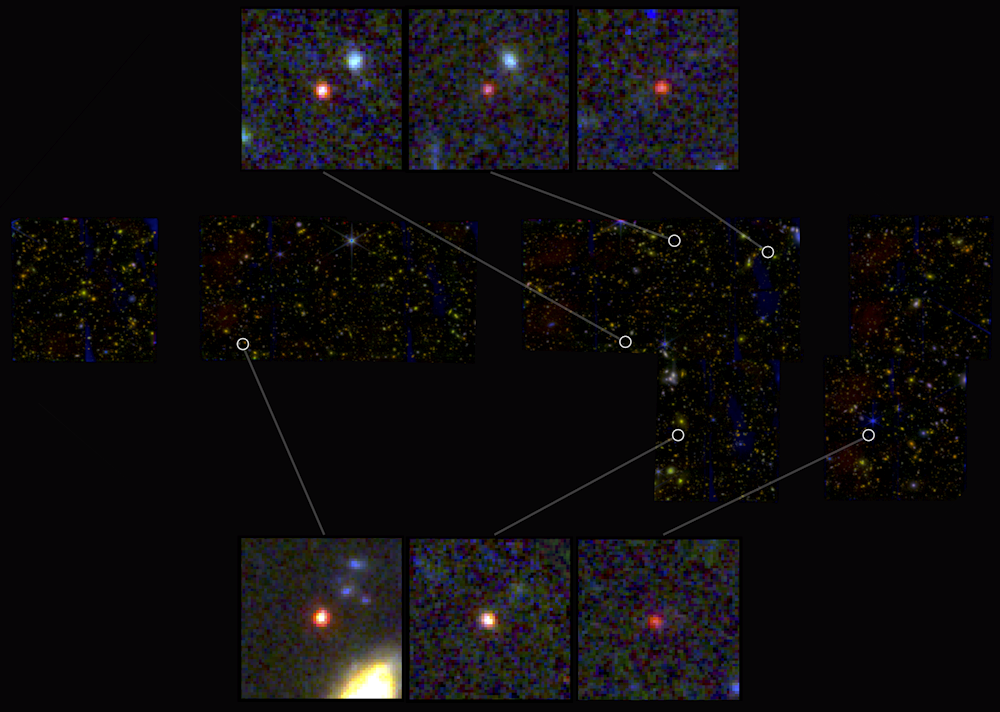 The six galaxies and their surroundings in the sky.
NASA / ESA / CSA / I. Labbe, Author provided
The six galaxies and their surroundings in the sky.
NASA / ESA / CSA / I. Labbe, Author provided
The implication is that there is different channel, a fast track, that produces monster galaxies very quickly, very efficiently. A fast track for the top 1%.
In a way, each of these candidates can be considered a “black swan”. The confirmation of even one would rule out our current “all swans are white” model of galaxy formation, in which all early galaxies grow slowly and gradually.
Checking the fingerprints
The first step to solve this mystery is to confirm the distances with spectroscopy, where we put the light of each of these galaxies through a prism, and split it into its rainbow-like fingerprint. This will tell us the distance to 0.1% accuracy.
It will also tell us what is producing the light, whether it is stars or something else more exotic.
By chance, about a month ago, JWST already targeted one of the six candidate massive galaxies and it turned out to be a distant baby quasar. A quasar is a phenomenon that occurs when gas falls into a supermassive black hole at the centre of a galaxy and starts to shine brightly.
This is really exciting on the one hand, because the origin of supermassive black holes in galaxies is not understood either, and finding baby quasars might just hold the key. On the other hand, quasars can outshine their entire host galaxy, so it is impossible to tell how many stars are there and whether the galaxy is really that massive.
Could that be the answer for all of them? Baby quasars everywhere? Probably not, but it will take another year to investigate the remaining galaxies and find out.
One black swan down, five to go.
Authors: Ivo Labbe, ARC Future Fellow / Associate Professor, Swinburne University of Technology


















