

We're told Pentecostal churches like Hillsong are growing in Australia, but they're not anymore – is there a gender problem?
- Written by: Rosie Clare Shorter, PhD candidate, Religion and Society Research Cluster, Western Sydney University
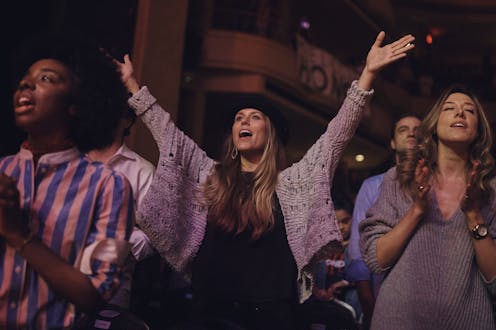
The conventional narrative about Australian Christianity is that Pentecostal churches – most famously, Hillsong – are bucking the trend of declining attendance at the big denominations (such as Catholic and Anglican churches). That in fact, Pentecostal churches continue to grow.
This narrative is based on the steady rise of people indicating affiliation with Pentecostal Christianity from the 1990s, through to 2016. After the 2016 census, sociologists Bouma and Halafoff noted a rise in those claiming affiliation with Pentecostal churches, alongside the rise in the religious “nones”.
But the most recent Australian census shows a decrease in Pentecostal affiliation. Gender inequality and leadership abuses of power seem to be implicated. But more research is needed to confirm who is leaving Pentecostal churches, and why.
Read more: Holy Woman's fleshy, feminist spiritual pilgrimage is a warning against religious coercive control
A shifting story?
As recently as July 2022, an opinion piece for ABC Religion & Ethics retold this story, explaining that while the 2021 data showed a drop in Christian affiliation, “some Christian groups such as Pentecostals are enjoying considerable growth”.
Academic analyses often cite Hillsong as a case study, describing the church as a stand-out success. In their recently published book, sociologists Possemai and Tittensor write, “unlike their fellow Christians who are all in decline, the more patriarchal Pentecostals are growing”. Hillsong is depicted as reaching and retaining large numbers of women, through specifically targeted conferences and events.

For many years, “contemporary” churches like Hillsong have provided the poster-model for Christianity across Australia. We’ve heard other churches ought to learn from their leadership success. We were told by journalists and academics alike that when it comes to gaining new members – especially young people – Pentecostal churches are getting it “right”.
Well, it turns out this story may be in need of a rewrite.
Explaining the shifts
The 2021 census reports that nationally, Australian Pentecostalism declined by 4,700 people – or 2% – since 2016. And a Christian Research Association report shows the strongest drop was among those aged 15-34.
Few are talking about the de-conversion of Pentecostal youth. Unless you follow Christian newspapers, you may not have realised the narrative about the rise of Pentecostalism is dated.
When we look to Hillsong, shifts in attendance and revenue call the growth story into question.
Reported attendance stats are murky, but the 2019 annual report boasted a live attendance of 47,000 across Hillsong churches in Australia and Bali. In 2020, during lockdowns, Hillsong moved online and grew exponentially, with 786,214 people reported to be watching live by the end of March 2020.
However, the church’s 2021 Annual Report shows only 21,219 attendees across Australia. And it states, “we experienced a 12.3% drop in total revenue compared to 2020 resulting in a reduction of our surplus to $514,318 for 2021 (2020: $4,696,547).”
The big question for religious scholars is, following the recent appointment of new leaders, will these changes continue for 2023 and beyond?
For now, we want to know: who is staying, who is leaving – and why?
Read more: Explainer: what is Pentecostalism, and how might it influence Scott Morrison's politics?
Is a gendered analysis needed?
Aside from young people, we don’t know for certain who is leaving Pentecostal churches. But anecdotally, it appears to be women.
Reverend Dr Philip Hughes, a research fellow at the Christian Research Association, told us, “The decline in Pentecostals has been greater among females than males, with the female proportion dropping from 56% in 2011 to 54% in 2021.”
While this is more a slow drift than a catastrophic exit, it shouldn’t be overlooked. Globally, religious women are the backbone of churches, particularly Pentecostal ones. We know women make up about two thirds of the church across Australia’s denominations.
While women are often underrepresented in leadership of these churches, they are – or, at least, have been – overrepresented in the congregation and in the paid and voluntary workforce. It’s often women who do the day-to-day work of administrating a church, keeping its shops, charities and schools going. Churches need women.
International research suggests ultimately, without women, there is no church. As sociologist Penny Marler puts it, “Despite the fact that religious elites continue to be predominantly male, as the women go, so goes the church.”
A gendered analysis of who is staying and who is leaving may help us understand the current shift in Pentecostal affiliation, and future challenges facing church leadership.
Read more: Explainer: why some churches teach that women are 'separate but equal'
Why might women leave?
Larney Peerenboom, who recently completed a masters degree thesis in Christian studies, explained to us:
While Australian Pentecostal churches are often vocal about their support of women in leadership, the lack of an official theological stance regarding gender equality means that while the women themselves largely held egalitarian views, it was more common that their leadership and many others in their community held a stance of soft complementarianism.
A woman Peerenboom spoke to was accused of having a feminist agenda when she tried to introduce inclusive language in church documentation. In Peerenboom’s experience, several women found the disparity between what was preached and what was actually valued led them to feeling out of place at church, with some choosing to leave.
Similarly, there are many converging accounts in the “exvangelical” movement. In her memoir documenting her journey out of Pentecostalism, Australian author Louise Omer describes feeling physically sick when she realised her church had taught her to submit not just to God, but to men, and she had therefore come to see herself as inferior to men. Omer reflects:
I remembered the question I’d left home with: could a woman belong in Christianity? Only if she agreed she was inferior.
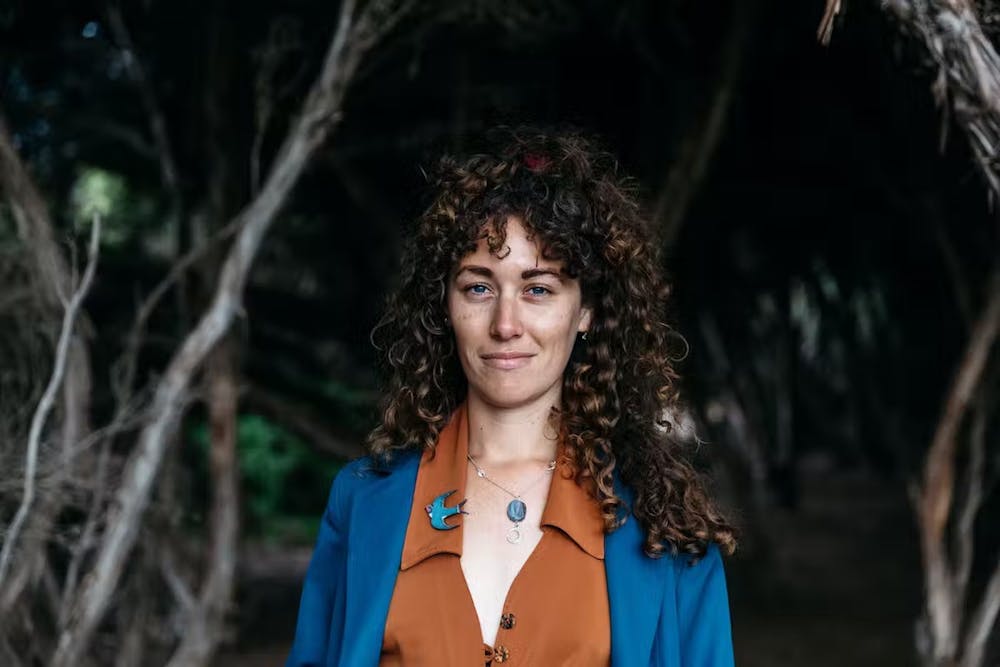 Louise Omer felt ‘physically sick’ when she realised her Pentecostal church had taught her to submit not only to God, but to men.
Sia Duff, Author provided
Louise Omer felt ‘physically sick’ when she realised her Pentecostal church had taught her to submit not only to God, but to men.
Sia Duff, Author provided
Sociologist Katie Gadinni, author of The Struggle to Stay: Why Single Evangelical Women are Leaving the Church, documents the stories of 50 women leaving the church. She states, “single women desire to be valued and treated equally within their religious communities […] In short, they desire more acceptable ways of being.”
Pentecostal leadership cultures matter
The “growth as success” story not only seems inaccurate, but could be obscuring what it’s like to be a Pentecostal Christian. Importantly, it could mean we’re not properly seeing or hearing the experiences of Pentecostal women and leaders.
An important distinction of Australian Pentecostal history has been its emphasis on equality and women’s leadership. While there are notable women leaders within Australian Pentecostalism, almost all known public figures in the movement today are men. Where women are leaders, they are often presented as the wife of the male leader. As a model, this can make Pentecostal women dependent on men for their role.
Why is this important? Christian leadership creates cultures and upholds theologies, which are potential sources of spiritual harm or nourishment. A growing body of Australian and international research shows us certain theologies – particularly the teaching that women should submit to their husbands, or to male authority more generally – can (even if inadvertently) scaffold and sanction abuse.
This seems to be particularly true if churches teach that leadership is reserved for men. It means all denominations of Australian churches have the potential to model unsafe dynamics for women – and that intentionally cultivating safe and trauma-informed practices are necessary. Making sure women leaders are represented and accessible to congregants is one important piece of the picture.
Abuses of power
Churches of all denominations continue to grapple with religious leaders’ varied abuses of power. And women’s continuing church participation, as well as their potential disaffiliation, is part of that story, too.
The news on Hillsong over the past year, both factual and sensational, tended to focus on reports of men’s alleged financial and sexual misconduct.
Brian Houston resigned in March 2022, after allegations surfaced regarding his own conduct. Similarly, recent media reports have highlighted leadership failings in many other Christian communities: including L’Arche, where the movement’s founders have been accused of sexual abuse; and the Southern Baptist Convention, where the US justice department is investigating leaders for several reports of mishandled complaints.
 Hillsong co-founder Brian Houston resigned in March 2022 after allegations of his misconduct.
Bianca De Marchi/AAP
Hillsong co-founder Brian Houston resigned in March 2022 after allegations of his misconduct.
Bianca De Marchi/AAP
There have been multiple accounts of male leaders in churches and Christian organisations who either concealed or perpetrated abuse against women and children. The prevalence of such serious failings raises important questions about how churches will respond to recent events, or whether the established rhetoric about women’s roles (and failure to act) will continue.
For Pentecostal churches, it is time to attend to the stories of what makes church participation both meaningful and safe. Hearing from Pentecostal women – both those who have stayed and those who have recently left – is crucial.
We can attribute women’s decreased church participation and disaffiliation to a variety of societal causes, including the pandemic and changes to work and family patterns. It is important not to frame this as a “woman problem”. We suspect the testimony of church women may show us that Christianity’s gender problem is with its (male) leadership.
More research needed
At the moment, it isn’t entirely clear how the story of Pentecostalism in Australia will need to be rewritten. But we know from looking at other Christian movements that a lack of women’s leadership – not to mention revelations of misconduct – contribute to disaffiliation.
It’s important for Pentecostal leaders to understand their church’s demographic shifts. It will also be important for Pentecostal women, if they are to continue in their tradition, to find new identity markers, separate to the recent scandals and reported leadership misconduct. For Australian Pentecostal churches, “success” may lie not in numeric growth, but in becoming genuinely safe places, particularly for women.
Has Pentecostalism been a success story for women? The only way to know is to ask. For women, at least, talking about why they are (or are not) staying in their churches could quite seriously be a matter of survival.
The time for a detailed, gendered analysis of the shifts in the story of Australian Pentecostalism is now.
Authors: Rosie Clare Shorter, PhD candidate, Religion and Society Research Cluster, Western Sydney University


















