

'Build back better' sounds great in theory, but does the government really know what it means in practice?
- Written by: Suzanne Wilkinson, Professor of Construction Management, Massey University
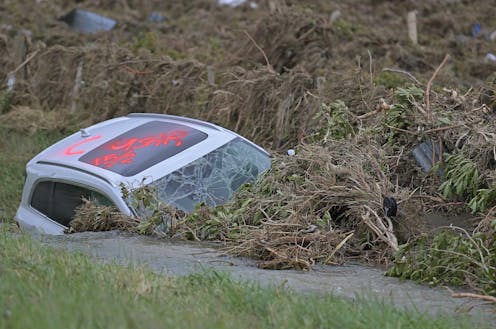
In the aftermath of Cyclone Gabrielle, Prime Minister Chris Hipkins promised to invest billions in disaster-hit communities to “build back better”. But building community and infrastructure resilience will take more than just cash.
In our 2018 book, Resilient Post Disaster Recovery through Building Back Better, my co-authors and I argue for a systematic approach to disaster recovery that focuses on building resilience. This can be achieved by using the principles of building back better and embedding these in all disaster recovery practices.
The ultimate goal of building back better is to make communities stronger and more resilient following a disaster.
In the aftermath of Cyclone Gabrielle, the government will need to work with a wide range of groups – including community and industry leaders, businesses and insurance companies – to rebuild affected social and economic environments, rehabilitate and improve the natural environment and create a resilient built environment.
This is a challenging task that requires a systematic rethinking of how we create the places we live in now – and how we want to live in the future.
Learning from past disasters
A “build back better” approach was advocated in the aftermath of the 2004 Indian Ocean tsunami. Ten key principles proposed by former US president Bill Clinton were adopted in the aftermath of that disaster.
These principles included a commitment to community-led recovery, the promotion of fairness and equity and the goal of leaving communities safer by reducing risks and building resilience.
Read more: Flooded Home Buyback scheme helps wash away the pain for Queenslanders
Closer to home, the post-earthquake Christchurch rebuild provides a case study of where opportunities to build back better were largely missed. Reconstruction was mainly focused on repairing the physical damage caused by the earthquakes.
Creating resilience, however, was largely seen as too costly, and building back better was not fully implemented in most of the city’s reconstruction.
Insurance payouts for damage were fraught with difficulty. Rebuilding with resilience wasn’t considered, with homeowners given like-for-like payouts, or payouts that didn’t fully meet market values. Faulty repairs were common.
Inadequate funding
That said, some build back better principles were applied in Christchurch, including initial community participation in rebuild planning. There were also building code changes to create stronger buildings that could withstand future earthquake damage and the repurposing of unsuitable land.
Big projects, such as the convention centre, justice and emergency precinct and bus interchange, were delivered with earthquake-resilient design features.
But these projects, and others like them, were also marred by controversy, lacked full community support, and have been mostly over-budget and delayed.
The Stronger Christchurch Infrastructure Rebuild Team was one of the few organisations seeking to create resilient infrastructure for future communities. But the funding didn’t fully match the intent, and there is still ongoing work to create genuinely resilient infrastructure in Christchurch.
Offsetting future risks
Building back better requires resilience to be fully costed into the rebuild. It requires a focus on disaster-risk reduction – improving how we build and where, putting the community at the centre of recovery decisions, providing effective governance, and providing mechanisms for recovery monitoring and evaluation.
New legislation and regulations can be used to facilitate post-disaster recovery activities, often by fast-tracking and exempting normal procedures.
As seen in Christchurch, improving the resilience of buildings and infrastructure meant changing building codes. But there needs to be caution, as building code changes can slow recovery efforts.
Changing land use, as with the Christchurch red zones, reduces future risk to life and livelihoods. Before the 2011 earthquake, some 10,000 people lived in suburbs along the Avon river. However, in the 12 years since, almost all of the houses have been torn down and the land largely reverted to public green spaces.
During the 2009 Australian bushfire recovery, town planning was addressed collectively by community recovery committees. These worked with relevant agencies to improve the functionality of town layouts, improve future resilience, and ensure communities understood future hazards and risks.
The 5 stages of recovery
But timing is essential. Our research showed the key stages of recovery after a disaster: chaos, realisation, mobilisation, struggle and new normal. It’s important for all of the groups involved in a recovery to understand the patterns that develop organically after an event, and what is needed at each stage.
For the regions hit by Cyclone Gabrielle, there will need to be a well-resourced authority to coordinate and lead recovery and to help communities move forward with their lives.
This is not just about rebuilding houses and infrastructure. The recovery agency also needs to offer support services – such as assistance with welfare and counselling services. Financial assistance, plus training and support for businesses trying to rebuild should also be provided – though this all comes at a high cost.
Reducing future risk, putting the community at the heart of decision making, and creating resilient infrastructure and buildings will be expensive and take time. But by following a systematic approach to building back better, communities will be safer from future events.
Authors: Suzanne Wilkinson, Professor of Construction Management, Massey University


















